
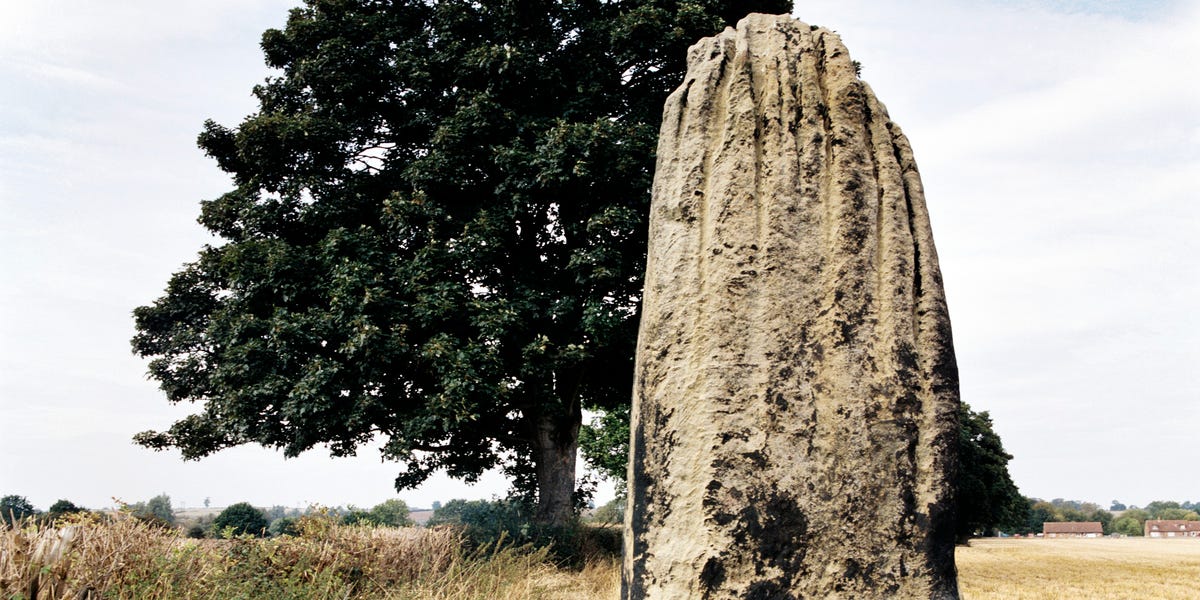
3 min readHere’s what you’ll learn when you read this story:Researchers investigating Britain’s tallest surviving standing stone alignment have developed a new origin story for the stones.Analyzing the “fingerprints” of the stones’ grains, the team said they came from 11 miles away to what is now Boroughbridge in North Yorkshire.The experts ruled out glacier transport, noting that Late Neolithic or Early Bronze Age people figured out how to move and stand the stones.With the tallest reaching 23 feet high (and weighing a colossal 27.5 tons), the three Devil’s Arrows standing stones still aligned in their prehistoric formation constitute the tallest set of remaining standing stones in Britain. Now, researchers believe they’ve determined where the mysterious stones originated.In a new study published in the journal Proceedings of the Royal Society A, a team of researchers from Curtin University and the University of York said they used mineral grain “fingerprints” from the stones to link them to a site 11 miles away.“How prehistoric societies selected and transported megaliths remains poorly understood because the geological sources of many monuments are unresolved,” the authors wrote. The team believes they’ve solved that mystery by showing that the Arrows near modern-day Boroughbridge in northern England came from the Millstone Grit outcrops at Brimham Rocks, 11 miles to the west.Using regional ice flow reconstruction, the team ruled out glacial transport as how the Devil’s Arrows stones made it to their current home. “Our results demonstrate the purposeful extraction and transport of megaliths from a specific, geomorphologically distinctive upland source rather than the opportunistic use of local stone,” the authors wrote. “This evidence indicates that megalith selection reflects deliberate engagement with particular landscapes, linking monument construction to both place and engineering.”The rare lowland stone alignment features three stones across an area of 570 feet. Experts have long believed that stone transport and erection happened during the Late Neolithic or Early Bronze Age, possibly around 2000 B.C.E.“Our research shows these stones weren’t simply taken from the nearest available source—they were deliberately chosen from a challenging landscape,” Anthony Clarke, lead author and part of the Timescales of Mineral Systems Group in Curtin’s School of Earth and Planetary Sciences, said in a statement. “Plumpton Rocks, which is closer to the Devil’s Arrows, had previously been identified as the probable source of the stones. Our findings instead point to Brimham Rocks, showing that prehistoric builders transported these enormous stones significantly farther than thought.”Each stone weighs more than 27.5 tons, so moving them required engineering skill and intricate planning. “This tells us prehistoric people placed real importance on the landscape itself,” Clarke said. “It wasn’t just about convenience. The location the stones came from likely held meaning for them.”Co-author Jim Leary of the University of York said the results show ancient communities made deliberate decisions. “It highlights the importance of landscape and shared belief systems, as well as the remarkable effort involved in transporting and raising stones of this size,” he said.The team sampled mineral grains from the stones using adhesive tape to avoid damaging the rock. Analyzing the age “fingerprints” of the grains, they matched them to Brimham Rocks. The team plans to use this method in the future to better understand other standing stone sites.Justin Cully, National Trust general manager for Fountains Abbey & Studley Royal and Brimham Rocks, said “we’re delighted that this discovery adds a new chapter to [the Devil’s Arrows] story.”Tim Newcomb is a journalist based in the Pacific Northwest. He covers stadiums, sneakers, gear, infrastructure, and more for a variety of publications, including Popular Mechanics. His favorite interviews have included sit-downs with Roger Federer in Switzerland, Kobe Bryant in Los Angeles, and Tinker Hatfield in Portland.
The Mysterious Devil’s Arrows Stones Appeared in England 4,000 Years Ago. Scientists Just Learned Where They’re From.
Full Article
Original Source
Read the full article at Popularmechanics →KhanList aggregates and links to publicly available news content. We do not host full articles from third-party sources. Always verify important information with original sources.