
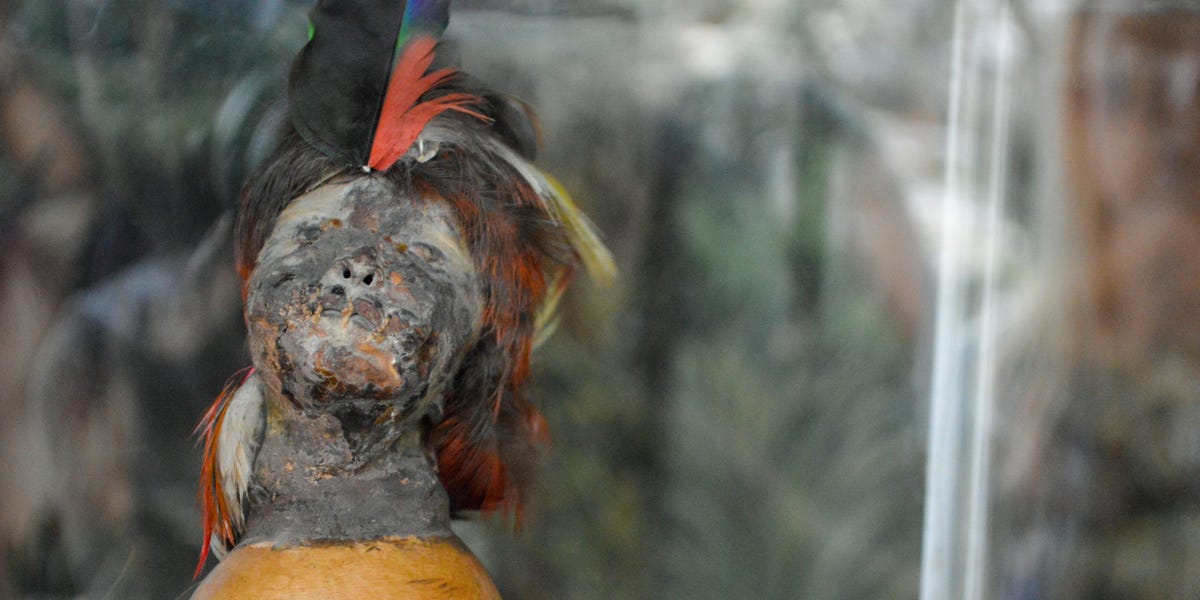
4 min readHere’s what you’ll learn when you read this story:Mummified human remains have been the object of macabre fascination for centuries, but mysterious deaths that may have followed exposure were more than just a mummy’s curse. Researchers who investigated the online mummy trade found that sellers often ship these relics without taking proper precautions, and both buyers and sellers forego masks and gloves.If the living want to stay alive, the only places mummified remains belong are either in their tombs or behind the glass panels of climate-controlled cases in museums.Billy Jamieson never forgot his first encounter with a shrunken head.Seeking an escape from the grind as a building contractor, Jamieson ventured deep into the rainforests of Ecuador and Peru. It was there that he met Takupi, a shaman and warrior of the Shuar people—the culture most associated with the ritual shrinking of heads. Takupi recounted how he took down enemies in battle and turned their heads into what are known as tsantsas, eyes and mouths stitched shut to imprison the avenging soul (muisak) so it can’t escape and take revenge on the killer. While head shrinking is no longer practiced, many tsantsas remain preserved.“After spending time with Takupi, I came home and I thought, wow, it’d be great to have a shrunken head as a mascot,” Jamieson said in an episode of his series Treasure Trader. “Once I’d bought two shrunken heads, I was hooked.”Jamieson, who died in 2011, was a dealer and collector of oddities and relics that included mummified human remains. Today, there are many others. In the dusty corners of the internet lurk online auctions and Facebook groups where mummies (and parts of mummies) have become a commodity. And many of these objects are haunted by legends of the “mummy’s curse.”After the self-taught Egyptologist Howard Carter discovered the tomb of Tutankhamun in late 1922, there were mysterious deaths among his team, including his patron Lord Carnarvon. It was rumored to be a curse, and debate raged for decades over whether Carnarvon could have fallen ill due to the presence of Aspergillus fungal spores in the tomb. Nowadays, it is broadly accepted that what killed Carnarvon was almost certainly an infected insect bite that progressed to pneumonia, but the fungal danger isn’t entirely fanciful. When conservation scientists opened the tomb of King Casimir IV Jagiellon in Kraków in 1973, for example, ten of the twelve researchers died within just a few years, and Aspergillus flavus was recovered from the tomb.Aspergillus flavus is a pathogenic fungus that feeds on decaying organic matter. But in the shadow market of mummified remains, this potentially fatal risk—and others like it—are often ignored as collectors hunt for mummified body parts in a trade that’s largely unregulated. Because of the clandestine nature of the mummy market, most remains are disguised to evade restriction, with hardly any precautions taken to prevent exposure to the toxic substances used for preservation.In a perfectly safe world, mummies would be left alone entirely—or, at the very least, kept in climate-controlled glass cases in museum galleries. But when a team of researchers from the University of Staffordshire investigated the online mummy trade, they discovered that many are instead making their way into the hands of private collectors who are usually uninformed about the substances they could be inhaling from their latest aquisitions. Auction houses and social media platforms deal in mummies from multiple different time periods, and though oils and resins were primarily used in ancient times, later embalmers turned to substances such as arsenic, lead, and mercury to prepare bodies for funerals. The combination of these toxins with fungi and other decomposer microbes can be deadly.“The popularity of mummified human and faunal remains has presented notable challenges to their preservation throughout history,” the researchers said in a study recently published in International Journal of Cultural Property. “Their extraordinary nature has led some individuals to collect these bodies and parts thereof.”Generally speaking, it seems that the living are so invested in acquiring mummies because of their rarity, much in the way that art collectors may lust after a one-of-one sculpture. Entire mummies are uncommon, and even disembodied parts can cost hundreds of thousands of dollars. As a result, it is ot uncommon among collectors to display uncovered remains out in the open no differently than antique plates or porcelain figurines.But this is a stark contrast from how mummified remains should be approached. Curators and conservators working in museums follow strict safety protocols and protect themselves with lab coats, masks, and gloves when handling anything mummified. Most underground sellers, on the other hand, ignore these biohazards, either unaware of the dangers or are solely concerned with making money.Embalming practices may preserve bodies to a degree (some almost immaculately), but remains that are improperly packaged or stored can still deteriorate or grow fungus. The researchers found an unnerving number of social media posts in which buyers and sellers weren’t even wearing gloves when coming into direct contact with human remains or adjacent materials, such as the linens that mummies were wrapped in. Unmarked packages containing these remains can also be dangerous for the warehouse and postal workers who handle them.“Tighter legislation…would undoubtedly make it more difficult for individuals to partake in this gray market,” said the researchers, adding that coordination between specialist organizations, police, and lawmakers is needed to “protect individuals, descendant communities, and the mummified dead themselves.”Elizabeth Rayne is a creature who writes. Her work has appeared in Popular Mechanics, Ars Technica, SYFY WIRE, Space.com, Live Science, Den of Geek, Forbidden Futures and Collective Tales. She lurks right outside New York City with her parrot, Lestat. When not writing, she can be found drawing, playing the piano or shapeshifting.
The Mummy’s Curse Is Real... Sort Of.
Full Article
Original Source
Read the full article at Popularmechanics →KhanList aggregates and links to publicly available news content. We do not host full articles from third-party sources. Always verify important information with original sources.