
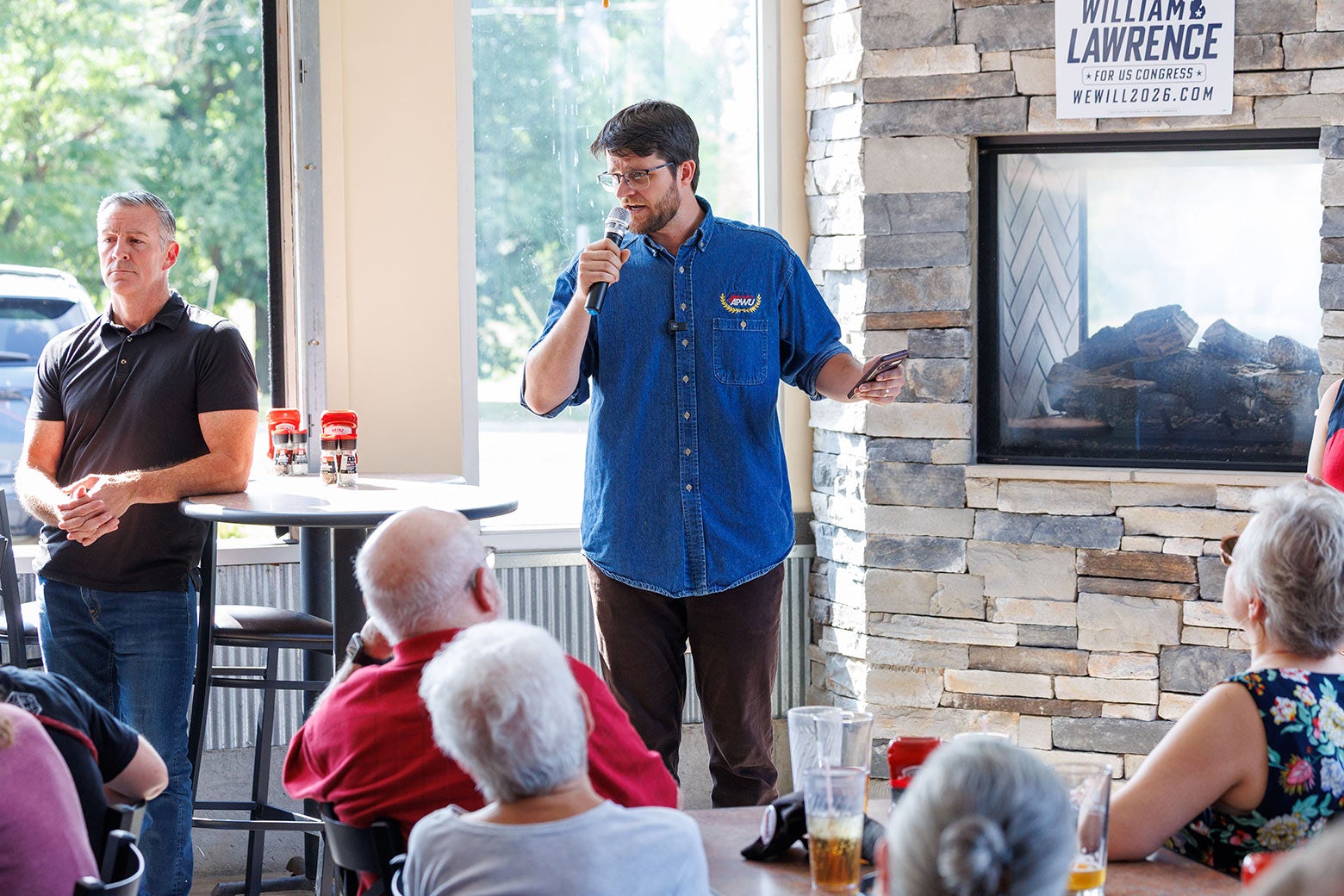
Politics The Michigan District Testing the Democrats’ Future Abdul El-Sayed has the national spotlight. But another progressive is testing how dems can win in the Wolverine State. By Enter your email to receive alerts for this author. Sign in or create an account to better manage your email preferences. Unsubscribe from email alerts Are you sure you want to unsubscribe from email alerts for Nitish Pahwa? Nov 03, 20261:05 PM William Lawrence, the Democratic nominee in Michigan’s 7th Congressional District. Andrew Roth/ZUMA Press Wire via Reuters Connect Sign up for the Slatest to get the most insightful analysis, criticism, and advice out there, delivered to your inbox daily. If you’re looking for a key indicator as to how Michigan’s explosive, widely watched Senate showdown will play out on election night, you should be paying attention to the very region that gave rise to Republican hopeful Mike Rogers’ political career: Michigan’s purple 7th Congressional District. Centered around capital city Lansing and college town East Lansing, extending outward to the whiter suburbs and rural farmlands that surround the outer-metro regions of Flint and Detroit, the 7th District encompasses a slightly Republican-leaning electorate that voted for then-Rep. Elissa Slotkin in 2022 but flipped toward GOP lawmaker Tom Barrett in 2024. Having followed the respective blue and red waves of those election years, the district is once again primed to serve as a bellwether for these midterms as a whole—as well as a microcosm of the larger Senate race that’s riveted the entire country. As with the matchup between Rogers and Democrat Abdul El-Sayed, the MI-07 race pits a progressive political neophyte (Sunrise Movement co-founder William Lawrence) against a Trumpy conservative with a substantial electoral record and plenty of name recognition (incumbent Rep. Tom Barrett), fighting over issues familiar to anyone who’s been paying attention to this year’s high-stakes elections: data centers, trade wars, Flock cameras, Iran, energy bills, the cost of living. It’s all here, it’s all local, and it’s all primed to tell us about where the Mitten will go this year. Much of the land in MI-07 was previously part of the 8th District, which Mike Rogers held on to from 2001–15. Retiring amid the crest of the Tea Party wave, Rogers was replaced by another Mike (this one being named Bishop), who went on to lose his seat to an upstart politician named Elissa Slotkin during the 2018 midterms, in a decisive flip that was helped by the growing national backlash to President Donald Trump’s first term. Slotkin retained the seat for two terms, even after MI-08 was redrawn with a more Republican tilt and rechristened as the 7th District; the opponent she beat in 2022 was then–state Sen. Tom Barrett, a veteran of the state Legislature. Yet Barrett emerged victorious in 2024—helped by the fact that he was no longer taking on the popular Slotkin, who went on to beat Rogers in her bid for the Senate. In essence, this key electoral region has mirrored larger political trends across Michigan and the United States ever since Rogers left it behind in 2014 (for Florida, as El-Sayed is fond of pointing out). It looks set to do so yet again, not least since it hasn’t been an easy two years for Tom Barrett. Constituents and local media outlets have pilloried him for failing to host any in-person town halls, supporting data centers in Lansing as the city’s residents overwhelmingly revolted against their construction, and consistently supporting a deeply unpopular president. The tariffs that have wrecked the Mitten’s all-important agricultural production. The petty feuding with Canada that has strained the usually warm relations between Michiganders and their northern neighbor. There are also the crackdowns on academia, the hunger crisis stemming from the decimation of federal SNAP benefits, the Immigration and Customs Enforcement raids that have reached deeply into Michigan, and the continuing war with Iran (which Barrett has only tepidly pushed back on in recent weeks). Democrats recognized Barrett’s vulnerability, but, following nationwide trends, the party’s recruitment efforts didn’t quite go as they expected. William Lawrence, an East Lansing native who’d led a protest outside of Barrett’s office last year, entered the 7th District primary against two substantive rivals: career diplomat Bridget Brink and former Obama military aide Matt Maasdam, both of whom carried endorsements from well-known Michigan Dems and establishment institutions. Yet they ended up evenly splitting the moderate-liberal vote, allowing Lawrence a victory with 42 percent of the primary tally. (He’d also benefited from the early goodwill he earned via outspoken data center opposition.) The longtime climate activist and Democratic Socialist still faced party and voter skepticism, over his previous podcast remarks about Black Democrats (“the older generation of Black political leadership are such a pillar, frankly, for establishment, capitalist, imperialist American power”), and over his since-expunged 2013 felony conviction for attempting to halt pipeline construction by the Canadian fossil-fuel firm Enbridge, a notably controversial name within the Midwest writ large. While working to earn the trust of the Black voters who carry significant power within MI-07’s urban centers—and while uniting with his former primary opponents—the Bernie Sanders–affiliated Lawrence has also had to make inroads within the rural areas that give his home district its reddish glint. There, however, he’s been helped out by broader Republican disaffection with Trump and the tech oligarchs who helped bring him back to power. The techies backing the president and his partisan affiliates are not especially well liked by traditional GOP voters these days, whether that’s thanks to the prevalence and invasiveness of Flock’s license-plate readers or the noisy, A.I.-powering “hyperscale” data centers headed toward a patch of land near you. Lawrence is also tapping into fury around the Iran war, connecting it to higher energy costs and weaponizing Barrett’s initial support of the invasion as a cudgel. The most urgent question, obviously, is whether Lawrence’s anti-Trump, anti–Big Tech strategy will work. An Emerson College poll from last month shows Lawrence with an 8-point lead, and Sabato’s Crystal Ball upgraded the race from a toss-up to “Leans Democratic.” It could be that just enough Republicans are angered by the current state of things to either stay home or even consider filling the bubble in for a progressive Dem. Or perhaps liberals are fired up enough about the Senate race for Lawrence to catch the tailwinds from fellow lefty El-Sayed. Or maybe people just hate data centers, A.I. surveillance, and foreign wars so much that they override any of their other concerns. We won’t know until Tuesday night, and the outcome is bound to be close. But once again it seems apparent that as goes Lansing, so goes Michigan and the United States. There will be a lot of lessons to learn, not only about whether Michigan’s insurgent progressives can win tricky territory that was once safe for local Republicans for so long. It will also be about why they may do so, and what that means for the future of the Democratic Party. Democrats Elections House of Representatives Michigan 2026 Midterms
The Most Revealing Race in Michigan Might Not Be One You’re Watching
Full Article
Original Source
Read the full article at Slate →KhanList aggregates and links to publicly available news content. We do not host full articles from third-party sources. Always verify important information with original sources.