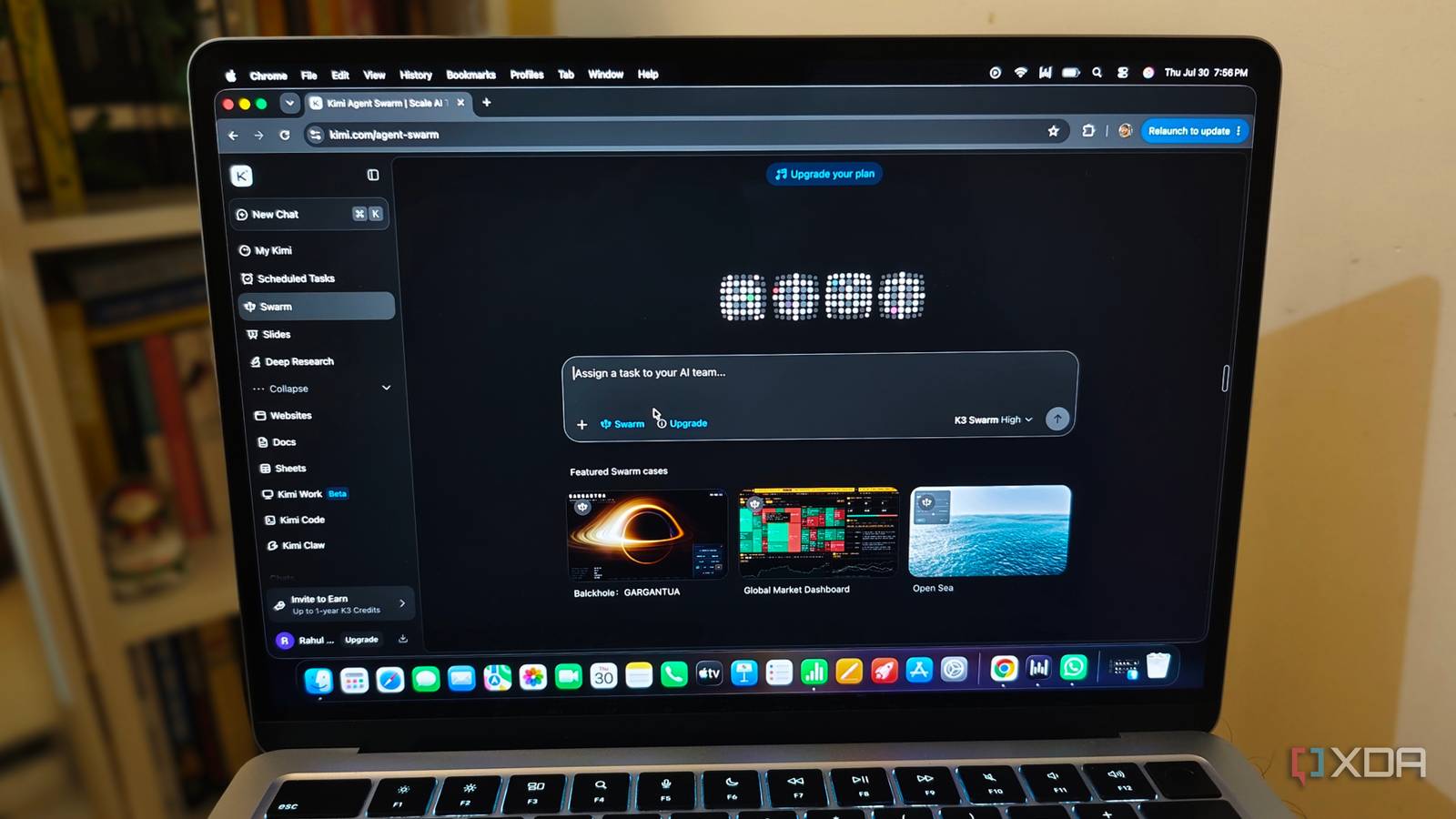
Published Aug 1, 2026, 10:30 AM EDT Anurag is an experienced journalist and author who’s been covering tech for the past 5 years, with a focus on Windows, Android, and Apple. He’s written for sites like Android Police, Neowin, Dexerto, and MakeTechEasier. Anurag’s always pumped about tech and loves getting his hands on the latest gadgets. When he's not procrastinating, you’ll probably find him catching the newest movies in theaters or scrolling through Twitter from his bed. You would have noticed a slight panic among frontier AI labs since Moonshot released Kimi K3. It’s an open-weight model with 2.8 trillion parameters, and it’s capable of doing the same things you can do with Fable 5 or GPT Sol. Even executives from these frontier labs have admitted that the model is quite good. OpenAI’s head of strategic futures even called on the U.S. government to increase scrutiny of the model to discourage businesses from buying it, which should tell you how good it is. The benchmarks aren’t the only evidence. I’ve been using this model for the same tasks I previously handled with GPT and Claude, and its performance is right up there. I would say it’s 90% there. Compared with GPT Sol, it’s almost as good, although I’ve seen Fable 5 beat it at certain tasks, but that’s not the point. Kimi K3 is arguably the most powerful open-weight model we’ve seen this year, and while that’s good news, you still can’t run it at home. Moonshot’s Kimi K3 is here for Anthropic & OpenAI’s lunch Frontier performance at a far lower price Kimi has absolutely no competition in the open-source world. It’s the world’s first open-weight model to reach 2.8 trillion parameters, and that number isn’t just impressive for an open-weight model but also when compared with models from frontier AI labs. Moonshot’s results place it close to leading closed models, particularly on coding and agentic tasks. K3 scored 88.3 on Terminal-Bench 2.1, compared with 88.8 for GPT-5.6 Sol and 88.0 for Claude Fable 5. It also beat both on Moonshot’s reported BrowseComp results. I would, of course, not base my whole argument on the company’s own benchmarks. I have used Kimi K3, GPT-5.6 Sol, and Fable 5 to build the same landing pages, write the same code, and fix similar bugs, and Kimi’s performance has been competitive. Kimi K3 performs really well for agentic workflows. It can understand an existing project, make changes across multiple files, and verify whether the final result works without requiring constant intervention. Fable 5 and Opus 5 still have an advantage on some of the hardest tasks, but the difference is small enough that Kimi rarely feels like a compromise. For an open-weight model, that is a major achievement. The API pricing makes Kimi even harder to ignore. Kimi K3 costs $3 per million uncached input tokens and $15 per million output tokens, while cached input drops to $0.30. GPT-5.6 Sol costs $5 and $30, Opus 5 costs $5 and $25, and Fable 5 costs $10 and $50 for the same input and output token counts. Agentic workflows can consume a lot of tokens, so the final cost still depends on how long each model takes to complete a task, but Kimi is comfortably the cheapest model here based on API pricing. Self-hosting Kimi K3 is a distant dream Unless you can afford a mini data center I find it fascinating that you can simply download a 2.8-trillion-parameter model and self-host it if you have the necessary hardware. Then again, you can do a lot with the right hardware, and in Kimi’s case, that phrase is doing a lot of heavy lifting. The model may be open-weight, but the hardware required to run it is very much heavyweight. The electricity bill alone is baffling, so let me put things into perspective. Self-hosting Kimi K3 would require a small data-center installation. This is less of a PC build and more of an accidental career change into cloud infrastructure. The official minimum is eight B300/GB300-class GPUs or eight AMD MI355X GPUs, providing roughly 2.3TB of combined GPU memory. An Nvidia DGX B300 weighs about 370 pounds, occupies 10 rack units, contains eight 288 GB GPUs, and draws up to 14.5 kW. It also produces almost 49,500 BTU of heat every hour, requiring just over four tons of continuous cooling. You would need a dedicated 200–240V power setup with multiple high-current circuits, continuous cooling, and an isolated location capable of handling data-center fans. Three-phase power is commonly used in data centers, but it is not strictly required, as the AC version of the DGX B300 can run on a compatible 240V residential service. A standard wall outlet is nowhere near sufficient. It would tap out long before Kimi finished loading. Eight-GPU B300 servers currently start at around $470,000, with other configurations exceeding $500,000. Once you include taxes, shipping, a suitable rack, UPS equipment, cooling, and electrical work, a realistic project budget would be approximately $550,000–$700,000. The server and cooling system together could consume approximately 13,000–15,000 kWh per month if kept near full load around the clock. The average U.S. residential electricity price reached 18.44 cents per kWh in May 2026, which works out to approximately $29,000–$33,000 per year. Someone living in a state where electricity costs 30 cents per kWh could spend between $3,900 and $4,500 per month. It’s safe to say that while Moonshot has made self-hosting Kimi K3 technically possible, for an ordinary consumer, it remains true to the company’s name — a moonshot. You can still run capable models at home Lots of options out there Kimi K3’s hardware requirements don’t mean that running AI locally is out of reach. Open-weight models now range from those designed for smartphones to those that require their own data-center rack. If you want something capable of running on hardware you could realistically own, you need to look at models with around 12 to 30 billion parameters. Gemma 4 12B is one of the more practical options for a laptop with 16GB of VRAM or unified memory. Google has designed it to run locally on consumer hardware, and it can process text, images, audio, and video. If you have a desktop with an RTX 4090 or a Mac with 32GB of memory, you can move up to models such as Devstral Small. Mistral built it specifically for agentic coding, so it can understand an existing codebase, modify multiple files, and use development tools. An RTX 4090 is hardly budget hardware, but there is still a considerable difference between buying an expensive graphics card and spending half a million dollars on an eight-GPU server. Qwen3-Coder 30B-A3B is another strong option for local coding when used with a suitable quantization. It contains 30.5 billion parameters but activates only 3.3 billion per token, reducing the required computation. However, all weights still need to be stored in memory, and longer context windows further increase memory usage. A word of caution While Kimi K3 is definitely an open-weight model, claims that it is open source are more complicated. You can download and run the model because its weights are openly available, but Moonshot has not released everything needed to rebuild it from scratch. A model needs to provide more than its weights to be considered fully open source.
The most powerful open-source model of the year just dropped, and you still can't run it at home
Full Article
Original Source
Read the full article at Xda-developers →KhanList aggregates and links to publicly available news content. We do not host full articles from third-party sources. Always verify important information with original sources.