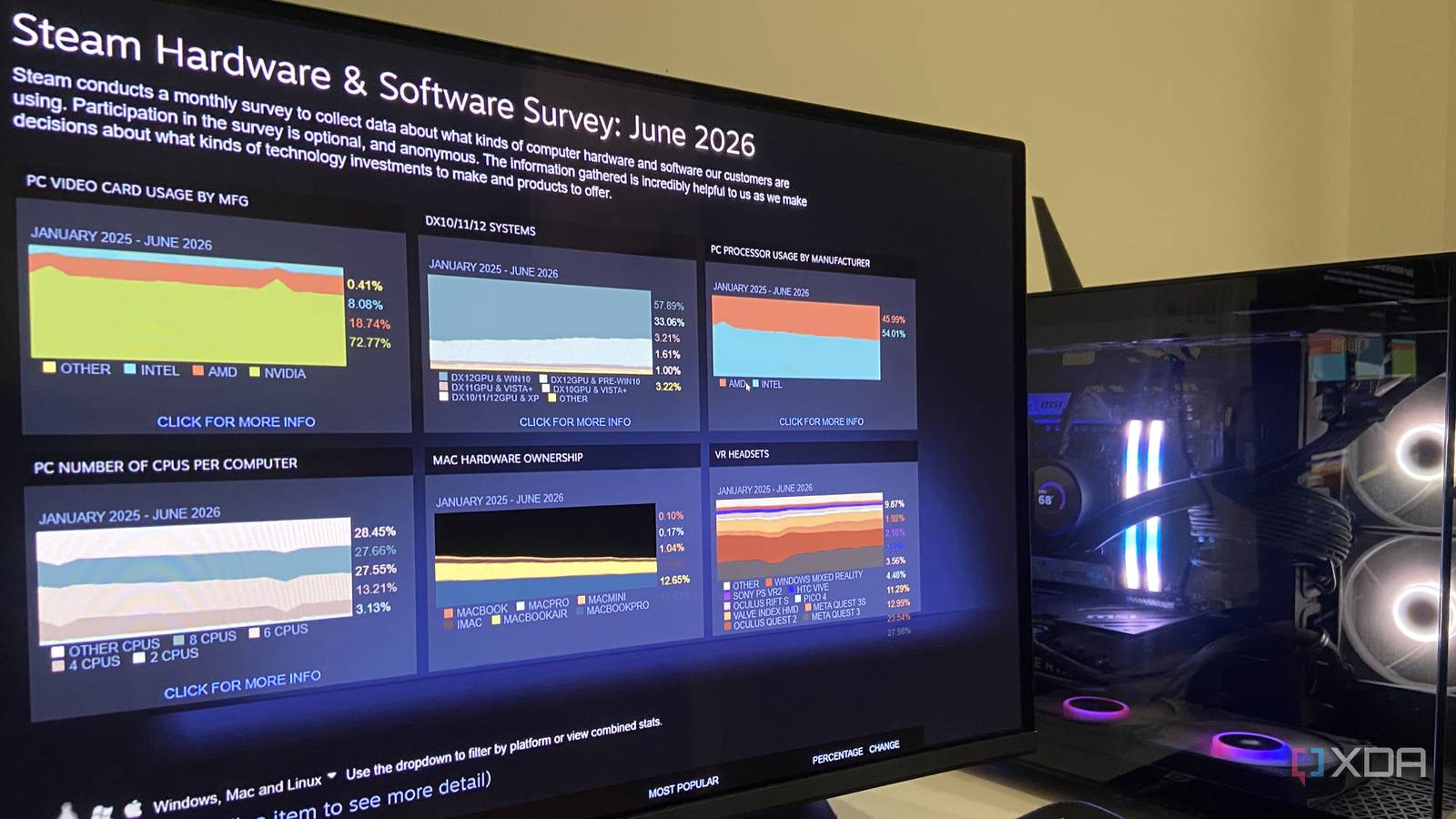
Published Jul 16, 2026, 7:00 PM EDT Abhinav pivoted from a career in banking to pursue his first love in writing. Even while working full-time, he continued contributing as an editor-at-large, a role he has held for more than 7 years. A lifelong tech enthusiast who has built three gaming and productivity powerhouse PCs since 2018, his passion for technology keeps him closely following the semiconductor industry, from NVIDIA and AMD to ARM. His MSc dissertation explored how artificial intelligence will reshape the future of work, reflecting his curiosity about the wider social impact of emerging technologies. If you've had even a cursory glance at the PC hardware pricing over the last few months, you'll already know that times are tough for the consumer market. DRAM prices have already tripled and show little signs of rising, consumer DDR5 memory has drifted out of reach for the mid-range and budget bracket, NAND pricing is following a similar trajectory, and GPUs are experiencing their own kind of shrinkflation. What we hadn't seen before, however, was the data proving what all of this has done to the PC itself, and Valve's latest Steam Hardware Survey has provided some alarming insights into that. For perhaps the first time in its history, the world's most popular gaming GPU isn't a desktop graphics card at all. It's a chip that sits inside a laptop, and how we got here tells you everything about the state of the PC in 2026. The latest Steam Hardware Survey revealed an ominous pattern For the first time, a laptop GPU topped the charts As per the June 2026 Steam Hardware Survey, the RTX 4060 Laptop GPU now appears in 3.81% of the surveyed systems, ahead of the desktop RTX 3060 at 3.73%. In the entire history of the survey, the top slot has never been taken by mobile silicon. For the most part of the last decade, that position has been exclusively reserved for the entry-level xx60-series GPUs. The GTX 1060 eventually handed the spot to the RTX 2060 shortly before the RTX 3060 began its own multi-year reign. The fact that a laptop GPU has displaced them isn't remarkable in its own right because of the 0.08-point margin, but because it signals the end of a trend that has persisted for almost ten years. Now, this trend does have a missing piece of data, without which jumping to conclusions would feel myopic. The whole picture becomes a little more interesting when you place Steam's survey alongside the macroeconomic indicators of the DIY PC market. DRAM contract prices rose 90–95% quarter-over-quarter as we entered 2026, and motherboard shipments, which are the clearest indicators of new desktops being built, fell by more than 25%. The survey's data also revealed that the combined share of the Ada Lovelace and Blackwell GPUs still sits below 30% after two launch cycles. GPUs have become unaffordable, and the data proves it Gaming is growing, but desktops are stuck in the past Credit: Pexels The signs of a regressing PC market are now everywhere, and the latest survey seems to merely confirm what was already anticipated at the start of the year. The average gaming rig is still equipped with a GPU that ships with 8GB of VRAM, still renders at 1080p, and carries 16GB of system memory. This is a configuration that would've been unremarkable two years ago, and yet, it is something that a silent majority is holding on to. This does not signal fading enthusiasm towards gaming in general, and it would be a mistake to assume so. If anything, the opposite is true. According to estimates from Alinea Analytics, first reported by PC Gamer, Steam generated a record-breaking $11.1 billion in gross revenue during the first half of 2026 alone, making it the strongest half-yearly performance ever. The natural question therefore becomes, if consumers are indeed gaming more than ever before, then why are they reluctant to invest in hardware that guarantees a better experience? The prevailing signs point to the fact that gaming GPUs now have a rather insurmountable entry barrier in place that's preventing desktop upgrades at their usual pace. One possible explanation for the rise of the 4060 laptop GPU lies in where consumers are buying their hardware. Desktop builders are exposed to spot retail consumer pricing. On the other hand, laptop manufacturers procure memory under long-term supply agreements negotiated months and even years in advance. These provide a path of least resistance to those wanting to enter the desktop ecosystem. This is the exact reason as to why mini PCs with DDR5 configurations are still much cheaper than an equivalent system assembled through a DIY approach. The entry barrier has more to do with value and less to do with pricing Budget GPUs don't provide enough value for consumers If you look closely to see exactly how the entry barrier was built, you'll have some interesting insights. Looking at only the MSRP at the time of release of the GPUs in the table would give you an incomplete dataset that doesn't justify consumer spending (or the lack thereof), because a key aspect of the GPU market is that the silicon rarely sells at the MSRP suggested by the manufacturer, which is exactly why it uses the prevailing street prices at the time of release instead of MSRPs. SKU Launch Date Street Price (At the time of release) VRAM GTX 1060 July 2016 ~$249 6GB RTX 2060 January 2019 ~$349 6GB RTX 3060 February 2021 ~$650–$700 (Cryptocurrency boom) 12GB RTX 4060 June 2023 ~$320-$349 8GB RTX 5060 May 2025 ~$409-$419 8GB There's no denying that the cost of entry has ballooned over the years, but there's an interesting observation sitting in the final column as well. Entry costs have climbed, however, the memory capacity has stood still over the last two generations. At the same time, modern games and professional software have become increasingly demanding year-on-year, and the latest AI features that make the same expenditure worthwhile, such as DLSS, Frame Generation and RTX HDR, all seem to introduce their own VRAM penalty in a buffer that continues to become more and more constrained. Manufacturers continue to disappoint the retail market If consumer spending patterns shed any light on the value proposition math, it's the simple truth that consumers can, and often will pay premiums for products they trust. Neither Nvidia nor AMD has earned that trust as of late. Gaming brought $16 billion in fiscal 2026 for Nvidia, which is an important 7% of their revenue. AMD's gaming line, on the other hand, brought in $3.9 billion in 2025. Yet, fascinatingly enough, neither partners in the duopoly have translated that success into a compelling value proposition for desktop gamers.
The most popular gaming GPU on Steam isn't a desktop card anymore, and it tells you everything about 2026
Full Article
Original Source
Read the full article at Xda-developers →KhanList aggregates and links to publicly available news content. We do not host full articles from third-party sources. Always verify important information with original sources.