
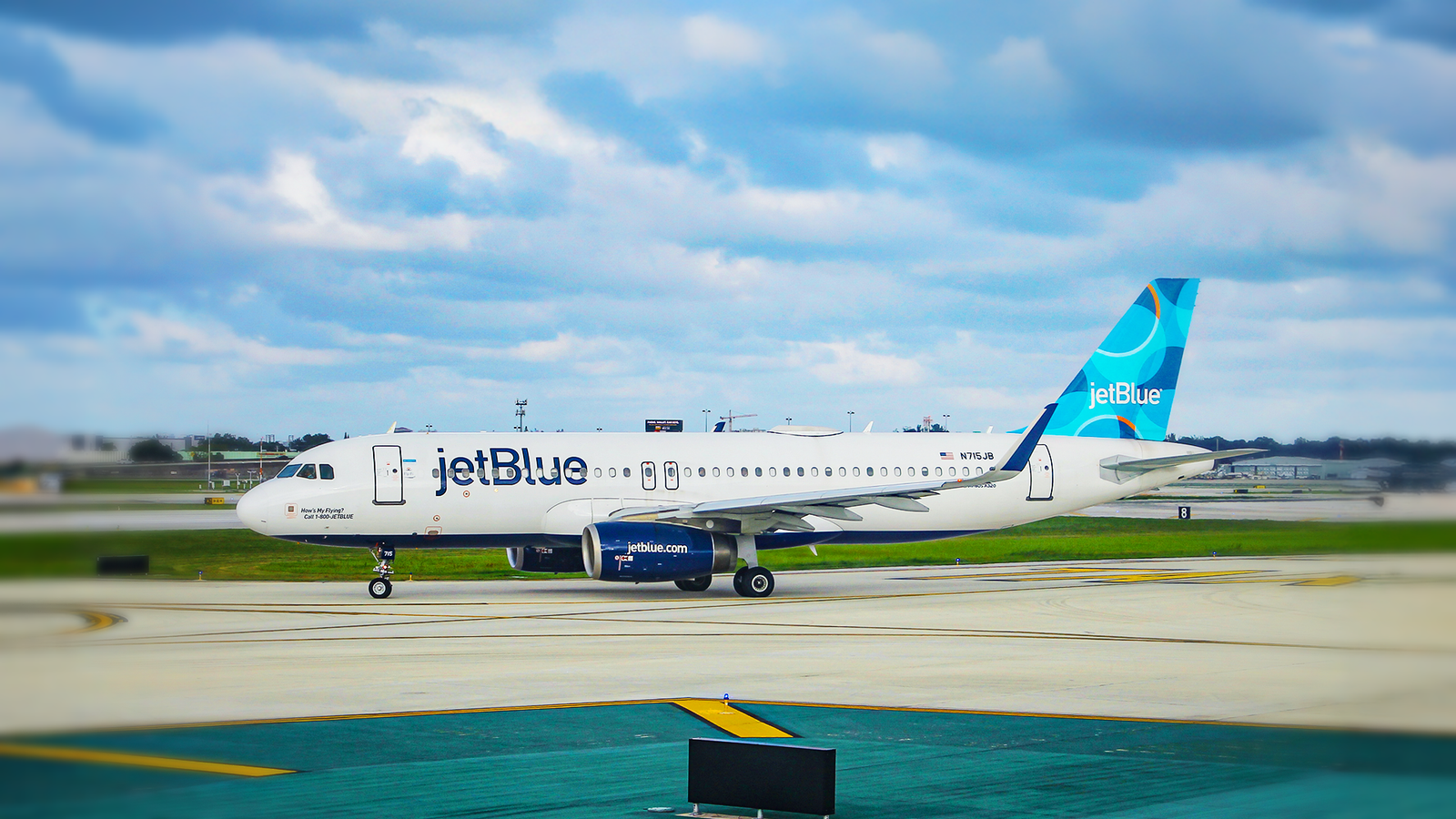
Published Nov 25, 2026, 7:00 PM EST Passionate about promoting aviation, the beauty of flight and the science behind it, Antonio is an avid reader of aviation magazines and books, and he loves visiting airshows all over the world, taking photos and writing about airplanes and helicopters as well. He is currently based in Palermo, Sicily. Sign in to your Simple Flying account JetBlue’s busiest Airbus A320 route in 2026 is not a transcontinental link between two major business centers. According to Cirium, it is Orlando–San Juan, a leisure-heavy connection that recorded 3,562 flights in both directions in the supplied flight-tracking dataset. More revealing still, all 11 busiest A320 city pairs touch Florida, putting the airline’s New York roots alongside a network heavily concentrated in the Sunshine State. That pattern raises a question a route ranking alone cannot answer: is JetBlue deliberately building a deeper Florida operation, or taking advantage of a gap left by the defunct Spirit Airlines while trying to improve its financial performance? The answer involves Orlando’s reach, Fort Lauderdale’s rapid expansion, the difference between counting flights and measuring capacity, and the A320’s role as JetBlue reshapes its fleet. Orlando–San Juan Shows How JetBlue Builds High-Frequency Leisure Routes Credit: Ceri Breeze | Shutterstock Orlando–San Juan sits at the center of the pattern because it combines frequency with meaningful distance. JetBlue operated 1,782 flights from Orlando International Airport (MCO) to Luis Muñoz Marín International Airport (SJU), offering 286,596 seats, and another 1,780 in the opposite direction, offering 286,380. Together, that is 3,562 flights and 572,976 seats across an average sector length of 1,189 miles (1,914 km). The route generated approximately 681.3 million available seat miles (ASMs), or around 1.1 billion available seat kilometers. ASMs multiply the seats offered by the distance flown; they measure capacity, not passengers carried. The near-identical totals in each direction also suggest demand is relatively balanced rather than dominated by one-way seasonal traffic. The route links two of the five cities where JetBlue described itself as a leading carrier in its January 2026 announcement: Orlando and San Juan. Leisure travelers and people visiting friends and relatives give the route more than one source of demand, helping support frequency without relying on traditional corporate traffic. But the lead over Fort Lauderdale–LaGuardia is only 212 flights, or about 6%. Why, then, is Fort Lauderdale becoming such a consequential part of the airline’s plans? Fort Lauderdale Has Become JetBlue’s Florida Growth Engine Credit: Marcus Mainka | Shutterstock Fort Lauderdale’s importance is rooted in JetBlue’s history as well as its current expansion. The airline’s first revenue flight in February 2000 connected New York-JFK with Fort Lauderdale. More than 25 years later, Fort Lauderdale–LaGuardia remains one of its busiest A320 corridors, with 3,350 combined flights and 542,688 seats across 1,076 miles (1,732 km). Fort Lauderdale–San Juan follows with 3,280 flights and 531,288 seats over 1,046 miles (1,683 km). The immediate catalyst is Spirit Airlines’ collapse. JetBlue moved to fill part of the gap and said it intended to reach around 150 daily departures from Fort Lauderdale by year-end. Its July announcement put summer departures near 130, more than 75% above 2025 levels, while adding service to destinations including Baltimore, Charlotte, Cleveland, Nashville, Detroit, Houston, Chicago and Ponce. CBS Miami reported on the expansion as an effort to fill gaps left by Spirit. City pair Combined flights Combined seats Average distance Orlando–San Juan 3,562 572,976 1,189 mi (1,914 km) Fort Lauderdale–LaGuardia 3,350 542,688 1,076 mi (1,732 km) Fort Lauderdale–San Juan 3,280 531,288 1,046 mi (1,683 km) Orlando–JFK 2,304 371,808 944 mi (1,519 km) Orlando–LaGuardia 2,257 358,722 950 mi (1,529 km) The plan is about more than replacing individual routes. As documented by Aviation Week, JetBlue has discussed as many as 370 connecting itineraries through Fort Lauderdale, giving the airport a larger role in the network. The fixed flight dataset may under-represent recently launched services, so the current route mix is a snapshot rather than a final picture of the expansion. The leading routes nevertheless show how Florida connects to JetBlue’s wider network: Orlando Reveals How Deep JetBlue’s Florida Network Has Become Credit: Marcus Mainka | Shutterstock Orlando’s footprint is broader than the leading San Juan route suggests. Across the six city pairs in the 11-route group that cross Orlando, the airport accounts for 14,507 flights. Fort Lauderdale accounts for 10,981 across four pairs, while West Palm Beach contributes another 2,156 through its Westchester service. JetBlue’s Florida presence is therefore spread across three airports rather than resting on one dominant base. Orlando represents about 52% of the flights in the 11-route group. Fort Lauderdale’s role is different: it combines New York services with Caribbean flying and a fast-growing list of new destinations. New York remains the other half of the pattern, with seven of the 11 city pairs connecting a New York-area airport — JFK, LaGuardia, Newark, or Westchester — with Florida. Boston and San Juan account for two pairs each. The New York side is changing too. JFK’s New Terminal One has slipped to early 2027, while Terminal 6 is expected to host JetBlue, according to Simple Flying reporting. With service spread across four New York-area airports, the airline must balance geographic coverage against overlapping capacity. And flight totals alone cannot show which routes contribute most to the network’s capacity: how does the picture change when distance is included? Seat-Miles Show Why Flight Counts Can Be Misleading Credit: Felix Mizioznikov | Shutterstock A flight count treats every departure equally, whether it covers 944 miles (1,519 km) or 1,237 miles (1,991 km). ASMs provide another perspective by multiplying seats offered by distance flown. Orlando–San Juan remains the largest route on this measure, at approximately 681.3 million ASMs. Fort Lauderdale–LaGuardia follows with 583.9 million, while Fort Lauderdale–San Juan generates about 555.7 million. The movement further down the network is more revealing. Fort Lauderdale–Boston recorded 2,151 flights over an average distance of 1,237 miles (1,991 km), producing about 430.7 million ASMs. Orlando–Boston operated more flights, at 2,222, but its shorter 1,121-mile (1,804-km) sector generated approximately 398.9 million ASMs. Fort Lauderdale–Boston therefore contributes more capacity despite operating fewer flights. JetBlue’s third-quarter 2026 results underline why capacity and profitability must be considered separately. The airline reported an 18.4% increase in revenue per available seat mile (RASM), while average fuel reached $3.91 per gallon, 57% higher year over year. Its third-quarter results release also said BlueFirst, its new domestic first-class product, would begin operating on Boston–Fort Lauderdale on December 8. That longer route gains importance when capacity is measured in seat-miles, and the premium product suggests JetBlue sees an opportunity to earn more from at least some of its Florida services. What does the A320 cabin itself reveal about how the airline matches capacity to demand? A320 Seat Counts Reveal How JetBlue Uses Different Cabin Configurations Credit: JetBlue Airways JetBlue and Simple Flying show two A320 layouts: the Classic configuration with 150 seats and the Restyled version with 162. The supplied flight data offers an indirect way to estimate where each may be used more often, although it cannot identify individual aircraft. Fort Lauderdale–LaGuardia, Fort Lauderdale–San Juan, Fort Lauderdale–Newark, and Westchester–West Palm Beach average close to 162 seats per departure, pointing toward the higher-capacity Restyled aircraft. Orlando–LaGuardia is different, averaging 158.9 seats per flight. If the two published layouts are the only configurations in the dataset, that average would be consistent with roughly one in four departures using the 150-seat Classic. This remains an inference, not a confirmed aircraft assignment, because aircraft swaps and schedule changes can affect route averages. The 12-seat difference still matters at scale. Across 3,562 Orlando–San Juan flights, operating the 162-seat aircraft instead of the 150-seat version on every departure would represent as many as 42,744 additional seats. JetBlue continues to market 32 inches (81 centimeters) of economy pitch, but additional seats only improve the economics if they can be sold at fares that cover fuel, labor, and other operating costs. With the A320 accounting for 129 of JetBlue’s 298 aircraft as of September 30, 2026, how might the arrival of more A220s change that equation? Fleet Changes Could Reshape JetBlue’s A320 Florida Network Credit: Ryken Papy | Shutterstock Fort Lauderdale’s expansion is expected to take the airport beyond 150 daily departures this winter. According to Simple Flying, citing Cirium schedule data, Fort Lauderdale is now JetBlue's busiest airport by scheduled departures, ahead of JFK and Boston, with roughly 21,500 winter departures against nearly 13,700 a year earlier. JetBlue’s July announcement included new services to Barranquilla and Cali in Colombia, Indianapolis and Columbus, alongside routes launched earlier in the year. A Mint-equipped San Diego service was scheduled for November 19, while Caracas remained without a confirmed start date in the supplied material. Not every new route will use an A320, however. Mint class requires the A321, and more premium flying from Fort Lauderdale could direct some growth toward larger aircraft rather than simply adding A320 frequencies. Meanwhile, JetBlue’s fleet plan lists seven A220 deliveries in 2027, nine in 2028, 10 in 2029, and two in 2030. The smaller A220 gives the airline another capacity option for markets where demand may not justify an A320, potentially allowing it to reserve larger aircraft for stronger corridors. The fleet transition is taking place while JetBlue is still working to improve its finances. The supplied analysis cites Air Data News for a third-quarter loss of $257 million and a fall in cash from $1.95 billion at the end of 2025 to $1.26 billion in September; JetBlue is targeting sustained profitability in 2027. Yet the airline also reported that Fort Lauderdale’s RASM increased nearly 15% in the third quarter despite capacity growth of more than 65%. The test is whether that revenue performance can hold as more flights enter the schedule. If JetBlue keeps adding capacity to established Florida routes, the network may become even more concentrated around Orlando and Fort Lauderdale. If A220 deliveries allow it to open thinner markets while reserving A320s and A321s for stronger corridors, the pattern could diversify. The route data captures a moment of rapid change; the next fleet and schedule decisions will show whether Florida is becoming JetBlue’s lasting growth engine or simply its biggest opportunity in 2026.
The Most Frequent JetBlue Airbus A320 Routes In 2026
Full Article
Original Source
Read the full article at Simpleflying →KhanList aggregates and links to publicly available news content. We do not host full articles from third-party sources. Always verify important information with original sources.