
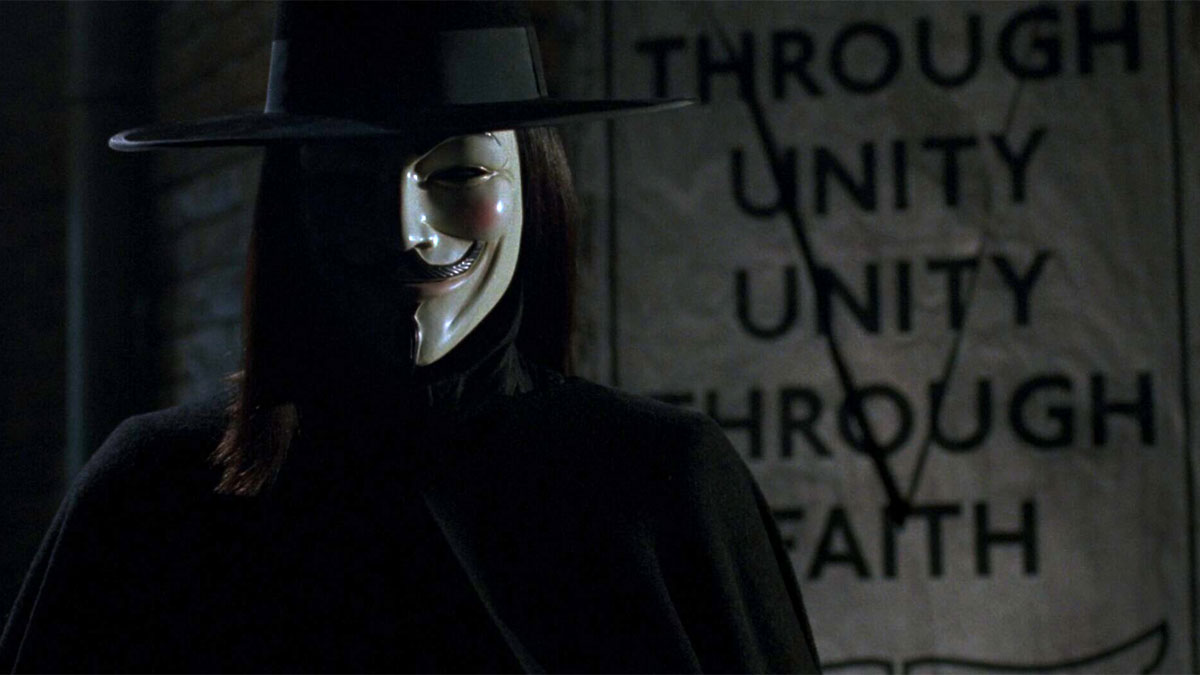
The dystopian thriller V for Vendetta, based on the graphic novel by writer Alan Moore and artist David Lloyd, is currently celebrating its 20th anniversary with a special theatrical re-release. But it still proves chilling today because of how familiar so many of its most disturbing moments feel. It’s something director James McTeigue acknowledges in a new interview with Consequence: “The tools of any government that leans authoritarian are the same. The things that Alan Moore discussed during the Thatcherite period, we discussed during the Bush period, and you could discuss now. The fear of otherness, the endless war, the fear of immigration. All the things that are in [V for Vendetta] are happening at this moment. You can watch the movie then, and you can watch it now, and it’s completely resonant to what is happening.” As fans of the source material, the Wachowskis first began writing the script for V for Vendetta in the 1990s, prior to the smash success of The Matrix. According to McTeigue, the initial draft he saw was 170 pages long — the common math for screenplays is that one page equals one minute of screen time, so that was clearly a bit long for a commercial film in the mid-2000s. Thus, further drafts dropped some subplots and honed in on a central narrative: a young woman (Natalie Portman) and a masked vigilante (Hugh Weaving) fighting back against the oppressive rule of High Chancellor Adam Sutler (John Hurt) and his fascist government. What wasn’t lost in the adaptation process was the comic’s rich array of details in the background. McTeigue and the filmmaking team didn’t hold back in creating a totalitarian London: Throughout the film, photographs of Sutler are visible in the homes of many citizens, while propaganda posters featuring slogans like “Strength Through Unity/Unity Through Faith” are seen on walls. Scrolling digital displays remind citizens of curfew hours and other important government messages. The all-seeing government feels like a tangible force throughout. “If you look really hard, you’ll see a bunch of stuff in there that you probably don’t notice on the first viewing or the second viewing,” McTeigue says. “There’s lots of stuff in the background.” Something the team found freeing was the fact that V for Vendetta takes place in a nebulous near-future. (The graphic novel begins in the year 1997, but the movie’s timeline is much vaguer.) “You can put old things in there, and new things, things that you haven’t seen before,” McTeigue says. Another benefit was that McTeigue had a good shorthand with production designer Owen Paterson, who he’d met even before prior to collaborating together on The Matrix films. (McTeigue was second unit/assistant director on the sci-fi classic.) Together, they created something that spoke to McTeigue’s aim, with his first film, to execute it similarly to “the first album concept. It was 35 years of everything that I’ve liked about politics and music and film all put into this one movie.” This desire emerges most powerfully in the sequences that take place in V’s home base (known as the Shadow Gallery) and a secret archive of art hoarded by closeted talk show host Gordon Deitrich (Stephen Fry). Both spaces are packed with artwork and other artifacts on display — leading to the dark realization that even innocuous things like an old movie posters are hidden there because there is no place for them in this heavily restrictive society. As McTeigue notes, “Okay, if the government has this list of objectionable materials, what is that? What paintings? What photographs, what music, what sculptures? We discussed all that with the set dresser, Peter Walpole.” Like so many authoritarian governments, those in power in this world believe firmly in “the suppression of minorities.” Hence these exhibits include photography by Robert Mapplethorpe alongside banned art by Francis Bacon and other subversive works: “Stuff that was made by and for the so-called people who are ‘other.’ Because otherness is the thing that authoritarian governments go after.” There are also fictional creations on display in both the Shadow Gallery and Deitrich’s secret room, such as a movie poster for The Salt Flats, a movie starring a doomed actress whose story Evey learns during her imprisonment. Many other pieces were fabricated for rights issues, or in order to fit into this fictional world. One of the more eye-catching examples in Deitrich’s collection is a large graphic print referencing Jamie Reid’s infamous album cover for The Sex Pistols’ God Save the Queen. The twist is that instead of the Queen, it features John Hurt in character as Sutler, wearing a crown — clearly created by a subversive artist protesting the current government. McTeigue says that he did not actually ask Hurt to wear a crown for the print — it was added to a photograph of him later. But he does think that Hurt would have done so if requested. “He was funny, Johnny — he was a great guy. And he did a great job — he’s so ridiculous as Sutler. I wanted him to be over the top… Of course, I thought I was going over the top then, but there’s no way I can compare him to politicians of now, and how ridiculous and over the top they are.” That leads again to the most haunting aspect of V for Vendetta — how relevant it all is to today. McTeigue attributes this to the idea of there being “cycles” in international politics. “You have a good cycle, you have a bad cycle. It doesn’t really matter what side of the political spectrum you’re on, you can see it for what it is.” Although McTeigue does believe that we’ll get out of this cycle eventually, “because we always do,” he acknowledges that “maybe it’s been more insidious this time around.” Endemic to the mess we’re currently in, he points out, is gaslighting — something depicted frequently in V for Vendetta, such as the government response to V blowing up the old Bailey. “You know, what I say is white, you say is black… I think if you take a step back, you can see the ridiculousness of it if you care to look underneath the surface. You can see that there is this constant lying that goes on, and that baseline of truth has disappeared out the window for the next little while.” Even if the movie stands out as a too-real reflection of today, McTeigue thinks that the movie’s central message remains an optimistic one. “That’s the Evie story, right? She goes through hell for what she believes, but comes out at the end of it with hope.” That, and the fact that historically the “bad cycles” have not lasted forever, keep him from feeling completely helpless. You have to have hope, he says, because “otherwise you’d feel like you had an 80-pound anvil pressing down on the back of your neck every day.” There’s another message from the movie that McTeigue takes comfort in: Governments should be afraid of their people. “I think that’s true. They should be, right?” he says. “I think when the disparity between the working people and the people who are in power becomes too much, that there’s power in numbers.” Or, to put it in 2026 terms: “All those tech bros should be careful about what they wish for.” V for Vendetta returns to theaters for its 20th anniversary on November 1st and 5th, thanks to Fathom Entertainment. Visit the Fathom website for tickets and more information.
The Most Chilling Details About V for Vendetta’s Future
Full Article
Original Source
Read the full article at Consequence →KhanList aggregates and links to publicly available news content. We do not host full articles from third-party sources. Always verify important information with original sources.