
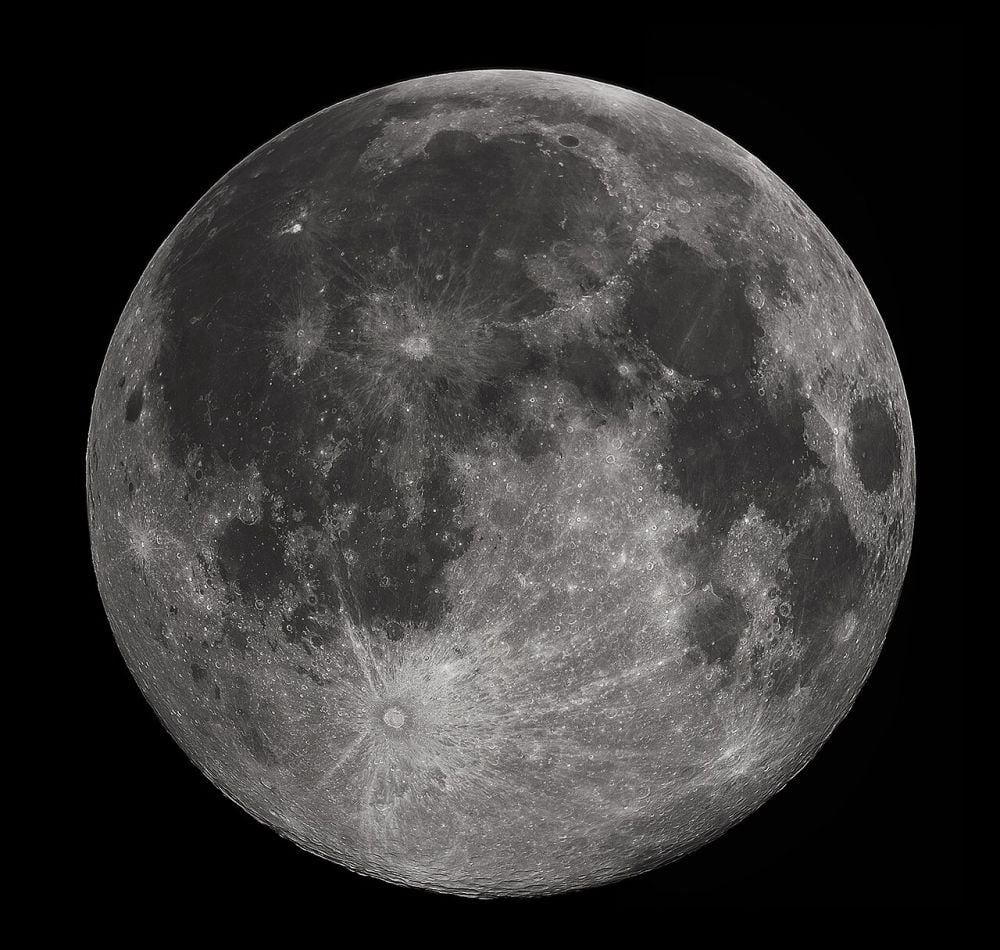
Scientists have known for years that the Moon is shrinking. Surface features called young thrust fault scarps tell the tale. Though each one is small, collectively, they let planetary scientists calculate the rate of shrinkage. New research in The Planetary Science Journal calculates an updated rate of shrinkage for the Moon. It's titled "Thrust Faulting and the Late-stage Contraction of the Moon," and the lead author is Thomas Watters. Watters is from the Center for Earth and Planetary Studies at the Smithsonian’s National Air and Space Museum. "Lunar Reconnaissance Orbiter Camera images have revealed thousands of young thrust fault scarps in the highlands and mare," Watters and his co-researches write. "These relatively small-scale faults are the expression of a period of late-stage lunar global contraction." NASA's Lunar Reconnaissance has been observing the Moon for 17 years, and is the longest-running lunar orbiter. It follows a near-polar orbit, and has mapped more than 98% of the Moon's surface in 100-meter resolution, excluding shadowed regions in polar craters. Its primary imaging system is the Lunar Reconnaissance Orbiter Camera, which has a Narrow Angle Camera (NAC) and a Wide Angle Camera (WAC). The NAC provides most of the data on thrust faults in this work. "The Moon has a global network of thousands of small fault scarps," the researchers write. The LRO's images have uncovered both the quantity of these features and their distribution. The widespread distribution of these faults was only revealed when the LRO began operations in 2009, though the Apollo missions did find a small handful of them. "Lobate scarps are positive relief, morphologically simple landforms that express contraction and thrust faulting of crustal materials," the authors write. They're not complicated features, and they rise above the surface by tens of meters. They're most common in the Lunar highlands. These panels show four of the Moon's lobate thrust fault scarps in the lunar highlands. For A through F, the column on the left contains NAC Stereo Digital Terrain Models showing elevations, and the column on the left is simple NAC images. From top to bottom, the figure shows the Pitiscus scarp, the Fowler scarp, the Morozov scarp, and the Mouchez scarp. For the Mouchez scarp, G is a ShadowCam DTM and H is a ShadowCam image. Image Credit: Watters et al. 2026. PSJ. The researchers say that though the Moon has been contracting for a long time, though only little by little, the contraction hasn't been pronounced enough to create these faults until more recent geological time. "Evidence suggests the Moon has undergone a small amount of radial contraction over the last 3.6 Ga, since the transition from a dominantly extensional to compressional stress bias," the authors write. That means that at first, the Moon's crust was mostly being pulled apart. Graben and straight rilles are the evidence for this. These are long, narrow, depressions or trenches that can be hundreds of kilometers long. They can be caused by heat from radioactive decay. But eventually, that heat source diminished, and that phase of the Moon's geology ended. Then it transitioned to a cooling phase where it suffered the compressional stress bias, creating the faults the LRO has documented. For this reason, the faults are young, only about 300 to 400 million years old. "If thrust faulting had been occurring since 3.6 Ga, it might be expected that lobate scarp thrust faults would have grown larger than presently observed, with some perhaps approaching the scale of those found on Mercury and Mars," the authors write. Mars has lobate scarps that reach hundreds of meters in height and from tens to hundreds of kilometers in length. This is the Rima Cauchy straight rille in the Moon's Sea of Tranquility (Mare Tranquillitatis) region. It's about 170 km long, and is an example of the type of feature generated when the Moon still experienced heating from radioactive decay. Image Credit: NASA/GSFC/Arizona State University As the Moon cools and contracts, some material is forced upward by the contraction, creating these faults. According to Watters, the number of faults revealed by the LRO and its NAC is larger than thought. Over time, the number of these scarp faults will continue to rise, as the Moon continues to cool and contract. “The number of these young faults revealed in LROC images is much greater than I ever imagined,” Watters said. “As the interior of the moon continues to cool and contract, it is expected that the growth of existing faults and formation of new faults continues today.” This figure is a global map of fault scarps. It also shows small mare ridges (SMRs), a different type of compressional landform generated by cooling. They're like the mare-terrain counterpart to the lobate scarps found in the highlands. A) North pole LROC WAC stereographic mosaic, with lobate scarps shown as red polylines. (B) South pole LROC WAC stereographic mosaic. (C) Global WAC mosaic, with Mollweide projection lobate scarps shown in red, SMRs shown in blue, and projection center longitude 0°. (D) GRAIL crustal thickness map (M. A. Wieczorek et al. 2013). The fault scarps are shown as black polylines. Image Credit: Watters et al. 2026. PSJ. The results show that the Moon is contracting by about 6 to 11 centimeters per million years. That's about 0.1 micrometers (0.0001 millimeters) per year. That's a tiny amount compared to the average amount that the Earth's plates move, about 1.5 centimeters per year, which is also driven by heat loss. Lunar contraction and faulting creates a potential hazard for missions to the Moon's surface, so understanding it is more than purely academic. These faults are likely the source of the shallow Moonquakes (SMQ) detected by the Apollo 12 Passive Seismic Network and are also connected to landslides. "The spatial correlation between very recent landslides (detected in LROC temporal image pairs) and young thrust faults suggests seismic shaking from slip events on these faults is what likely triggered the landslides," the authors write. If there are thousands of faults, there could be thousands of potential seismic hazards. Since cooling is ongoing, so is faulting and landslides. "The possibility of active faulting on the Moon provides a strong justification for a Lunar Geophysical Network to characterize the sources of seismic events and their potential hazards," the authors conclude.
The Moon is Still Shrinking as it Cools. That Could Create a Hazard for Lunar Mission.
Full Article
Original Source
Read the full article at Universetoday →KhanList aggregates and links to publicly available news content. We do not host full articles from third-party sources. Always verify important information with original sources.