
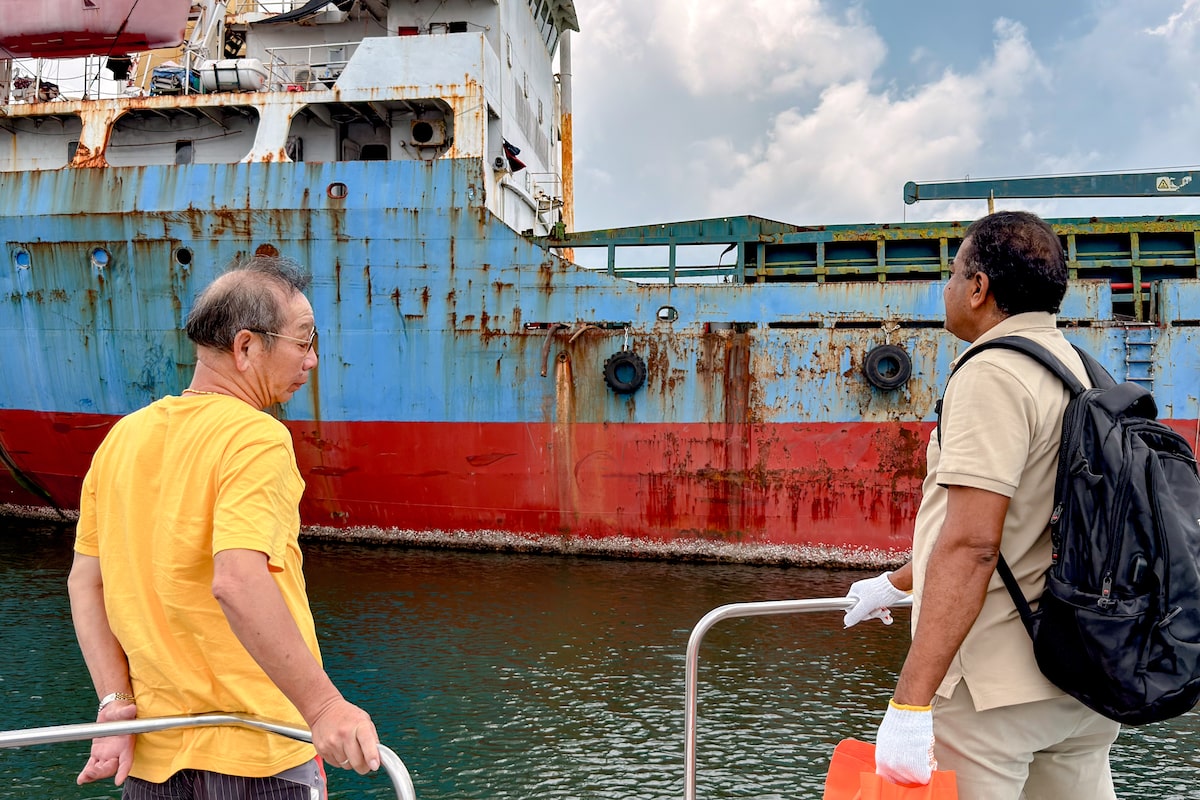
The deck of the red cargo ship loomed high above Valan Arockiaswamy as he yelled a greeting up through pouring rain. Three times a week, no matter the weather, the Indian-born Catholic priest takes a small boat out to visit vessels moored in the waters around Hong Kong, one of the busiest shipping ports in the world. On average, he estimates, he visits more than 500 ships a year. From the deck of the red ship, a crew member dressed in high-visibility gear and a white helmet lowered a long rope ladder down the sheer hull, allowing Father Valan and a Globe and Mail journalist to climb the 10 metres to the top. On board, the priest handed out snacks, newspapers and pamphlets, before taking tea with the captain. Open this photo in gallery:Father Valan climbs up a rope ladder to board a large cargo ship and visit with the crew.James Griffiths/The Globe and MailFather Valan, 57, is part of a small coterie of priests and lay volunteers − of multiple denominations, including Anglicans and Jehovah’s Witnesses − who cater to the world’s 2½ million seafarers. That includes visiting with sailors, mostly men, in hospital or prison, working with unions to advocate for their rights and, as Father Valan said, simply “making them feel welcome in a strange place.”“Any problem you have, anywhere in the world, just give us a call,” he told a shy crew member who approached him as he was leaving, later regretting that he did not have more time to spend with ordinary seafarers that day. A member of the missionary Society of the Divine Word, Father Valan is nonetheless unassuming when it comes to talking about religion, allowing the topic to come up naturally. “Casual conversations lead to deeper questions about God, religion, work,” he said. “They ask me what led me to be a priest. Maybe my answers open them to the faith.” Crews on hundreds of ships in the Persian Gulf stuck at sea, many in dire conditionsIt’s never been easy to be a seafarer, but this has been a particularly tough year. The war in Iran has massively disrupted global shipping, essentially halting traffic through the Strait of Hormuz, making passage through the Red Sea increasingly dangerous and sending ships on long detours that can add months to the time a crew spends at sea. Some 6,000 seafarers remain stranded near the Strait of Hormuz, according to the International Maritime Organization.At the same time, many of the countries that provide the bulk of international crews − including India, the Philippines and Indonesia − are suffering economically as a result of the war, so the remittances sent home by seafarers must stretch further than ever. “Those guys in the Gulf, they’re taking their lives in their hands every day,” said the captain of the red ship, whom The Globe and Mail is not identifying because he was not authorized to speak publicly. All of this is on top of the problems regularly plaguing the global shipping industry: piracy, accidents, shipwrecks, labour disputes and ship abandonment, “one of the most important issues which afflict the mental health and well-being of seafarers,” according to the Mission to Seafarers, an Anglican charity. That’s what happened to the crew of the MV Grand Sunny, a 22-year-old, Sierra Leone-flagged cargo ship currently rotting at anchor off the island of Hei Ling, in southwestern Hong Kong. The eight men on board, all Indonesian nationals, have gone without pay for three months now, and the situation is growing increasingly dire. The men are reliant on supplies delivered by priests and the seafarers’ union, as well as what fish they can catch off the back of the ship. Their generator often breaks down, leaving them with no lights or fans to break through the stifling Hong Kong summer heat. “When it doesn’t rain, we have no shower, no washing,” said Suwarta, the chief engineer, who like many Indonesians goes by a single name. The current crew are not the first Indonesians to have been abandoned by the Grand Sunny’s owners. In August, 2024, the vessel, which had spent much of the previous year in the South China Sea, made an emergency entry into Hong Kong waters, with the crew saying they had not been paid in months and were running out of food and water. That incident was resolved after the ship’s owner, Thousand Star International (TSI), was pressured by Hong Kong and Indonesian authorities to repatriate the crew. Replacements were brought in and left with no issue, even as the Grand Sunny became unseaworthy and essentially stuck at anchor, the assumption being that TSI was planning to sell the vessel for scrap. Then the owner disappeared. Corporate records show TSI’s Hong Kong entity is essentially defunct, and efforts by The Globe to reach the company’s representatives and its single listed director, Chan Kwun-yu, were unsuccessful. “The owner seems to have run away,” said Jason Lam, a Hong Kong-based inspector with the International Transport Workers’ Federation who was also involved in the 2024 incident. Open this photo in gallery:Father Valan speaks to Santos, captain of the MV Grand Sunny. Santos and his crew have been stranded without pay for three months now after the ship's owner seemingly disappeared.James Griffiths/The Globe and MailMr. Lam and Father Valan connected the current crew with a lawyer and are helping them pursue a case at the Hong Kong High Court. If the ship is deemed abandoned, the court will confiscate it and sell it for scrap to help pay the costs of repatriating the crew and paying them their back wages. The Grand Sunny’s captain, Santos, cursed when asked about the owner. “We have families, children to look after,” he said. “They leave us here for so long with no money.” Clemens Triaji Bektikusuma, a spokesman for Indonesia’s consulate general in Hong Kong, said diplomats are in regular communication with the local authorities and the crew about the case. He said the men “were well-informed of the condition and history of MV Grand Sunny prior to undertaking their assignment on board the vessel” and urged seafarers to “carefully study any available employment opportunities, including the risks that they entail.” The MV Grand Sunny's galley, where the crew gather for meals. The men are reliant on supplies delivered by priests and the seafarers’ union, supplemented by what fish they can catch off the back of the ship. James Griffiths/The Globe and Mail On a recent visit to the ship, sitting in the dark, stuffy galley where the crew had been sharing a small breakfast, Father Valan briefed them on the current state of the court case. “You have to stay for now,” he said. “I know you’re frustrated, but if you leave you could lose the money. Two, three more months. Your health is okay? If you need anything, you call us.” He asked the men their religion, and after they all said Islam, asked if they pray. They nodded. “Good,” Father Valan said. “We try our best down here, but sometimes we need help from above.”
The mission: making seafarers ‘feel welcome in a strange place’
Full Article
Original Source
Read the full article at Theglobeandmail →KhanList aggregates and links to publicly available news content. We do not host full articles from third-party sources. Always verify important information with original sources.