
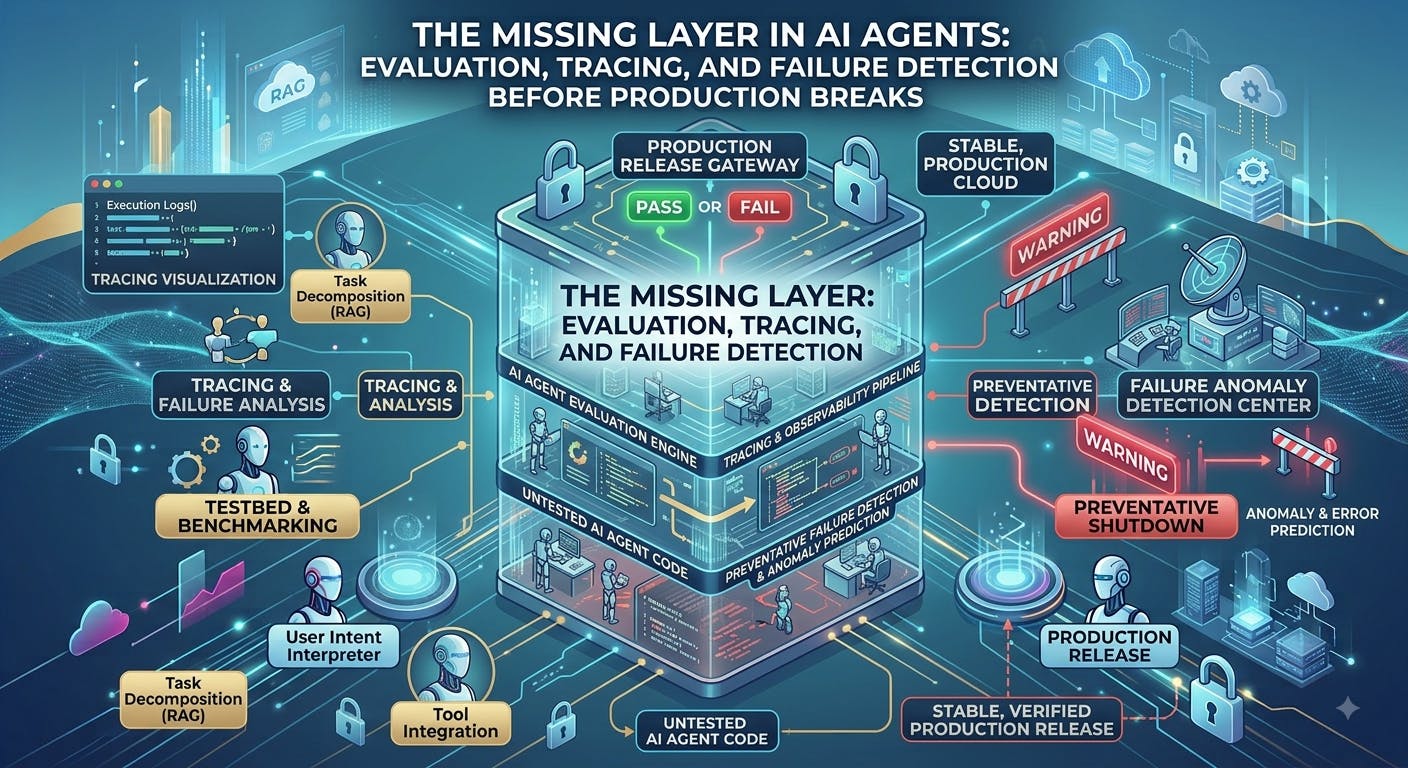
Most AI agent articles stop when the demo works. The model answers a prompt, maybe calls a tool, returns something sensible, and the article calls that progress. But the hard part of AI systems is not getting a first response. The hard part is knowing whether the system keeps behaving correctly after the fifth prompt, the tenth tool call, the bad user input, the partial failure, the model update, and the unexpected edge case that nobody thought to test. That is the layer this article is about. If you are building AI agents that actually ship, you need more than prompts and tools. You need an evaluation and observability system that tells you when the agent is drifting, where it is failing, what it is doing before failure, and whether a release made the system better or worse. In other words, you need a way to answer a deeper set of questions. Did the agent do the right thing? Did it use the right tool? Did it call the tool with safe arguments? Did it recover from failure correctly? Did this new prompt, model, or tool version improve the system? This article shows how to build that layer. The goal is not to create a flashy benchmark dashboard. The goal is to build a production feedback loop for agents: traces, replay, scoring, regression testing, and failure analysis. That is what separates a prototype from a system you can trust. By the end of this article, you will understand why agent evaluation is different from ordinary software testing, how to trace model and tool behavior end to end, how to build practical evaluation sets for real workflows, how to detect regressions before users do, and how to turn production traffic into continuous improvement. Why Agent Evaluation Is Harder Than It Looks Traditional software is deterministic. If a function takes the same input, it should produce the same output. That makes testing straightforward. You define expected behavior, write assertions, and compare results. AI agents are different. An agent may choose different wording on every run, select different tools for similar requests, recover from failure in multiple valid ways, produce a correct answer through several distinct paths, or change behavior after a prompt edit or model upgrade. That means a strict exact match test is often the wrong unit of evaluation. For agents, the interesting question is usually not whether they said exactly one sentence. The interesting question is whether they behaved safely, correctly, and efficiently while reaching a valid outcome. That requires a different testing philosophy. You need to evaluate outcome quality, tool selection accuracy, argument validity, safety boundaries, recovery behavior, latency, and cost. Those are system properties, not just text properties. Treat the Agent Like a Product System A mature agent should be treated the same way you treat a checkout flow, recommendation engine, or fraud system. That means you do not only inspect outputs. You inspect behavior over time. A good agent observability layer should tell you what the user asked, what the model inferred, which tool was called, what arguments were passed, what happened in execution, what the final response was, how long each step took, and whether the result was acceptable. This is the basis of agent ops. Without it, you are flying blind. With it, you can see where the system is strong, where it is fragile, and where the next failure is likely to happen. The Three Layers of Agent Quality When I think about evaluating an AI agent, I break the problem into three layers. The first layer is input quality. This is where you ask whether the agent understood the request. Did it classify intent correctly? Did it identify the needed tool? Did it extract the right entities? Did it recognize ambiguity and ask for clarification? The second layer is execution quality. This is where you ask whether the agent took the right action. Did it call the correct tool? Were the arguments valid? Did it respect permissions? Did it avoid unsafe side effects? Did it recover from errors properly? The third layer is outcome quality. This is where you ask whether the user got a useful result. Was the answer correct? Was the action completed? Was the response clear? Did the workflow finish within acceptable latency? Did the agent avoid unnecessary steps? If you only measure one of these layers, you miss most of the failure modes. A Better Mental Model for Agent Testing Think of agent evaluation as a chain. The chain starts with the user request, then moves through model interpretation, tool decision, tool execution, intermediate result, final answer, and user impact. A failure can happen anywhere in that chain. The model may understand the request but choose the wrong tool. The tool may be correct but the arguments may be malformed. The tool may succeed but the final answer may misrepresent the result. The response may be technically correct but operationally too slow. That is why agent quality needs structured tracing, not just human spot checks. If you only read the final response, you are looking at the last mile while ignoring the road. What to Log for Every Agent Run If you want useful evaluation later, start by logging the run correctly now. At minimum, each agent interaction should record the session or request id, the user prompt, the model name and version, the system prompt version, the tool name requested, the tool arguments, the tool result, latency for each step, token usage if available, the final answer, and the success or failure state. This does not need to become a heavy observability platform on day one. It just needs to be consistent and structured enough that you can replay the run later. A simple trace record in PHP might look like this: prepare(" INSERT INTO agent_traces (request_id, session_id, event_type, payload, created_at) VALUES (:request_id, :session_id, :event_type, :payload, NOW()) "); $stmt->execute([ ':request_id' => $event['request_id'], ':session_id' => $event['session_id'], ':event_type' => $event['event_type'], ':payload' => json_encode($event['payload'], JSON_UNESCAPED_UNICODE) ]); } A trace system does not need to be fancy at first. It just needs to be dependable. A Simple Table for Agent Traces A practical schema can stay small and still be useful. CREATE TABLE agent_traces ( id INT AUTO_INCREMENT PRIMARY KEY, request_id VARCHAR(64) NOT NULL, session_id VARCHAR(64) NOT NULL, event_type VARCHAR(50) NOT NULL, payload JSON NOT NULL, created_at TIMESTAMP DEFAULT CURRENT_TIMESTAMP, INDEX idx_request_id (request_id), INDEX idx_session_id (session_id) ); This table gives you a timeline of each request. That is enough to reconstruct the behavior of the agent step by step and understand where the system drifted. Why Replay Matters The most important benefit of tracing is replay. If an agent fails in production, you want to reproduce the exact run that failed. Replay answers questions like what the original prompt was, what tool the model asked for, what arguments were used, whether the tool failed because of bad input or bad infrastructure, and whether the final answer was generated from a wrong intermediate result. Without replay, debugging becomes guesswork. With replay, debugging becomes engineering. That is a major shift. It turns agent troubleshooting from opinion into evidence. Build an Eval Set That Reflects Real Usage A lot of agent evals are too synthetic. They test clever prompt puzzles instead of real workflows. That is a mistake. If you want evals that matter, build them from actual user behavior. If your agent helps with customer support, your eval set should include password reset requests, refund requests, shipping questions, account access issues, escalation cases, and ambiguous or incomplete requests. If your agent helps with booking, your eval set should include search by date, search by location, booking confirmation, cancellation, invalid payment data, and unavailable inventory. Your eval set should reflect the real distribution of user intent, not just interesting edge cases. That matters because production problems usually come from ordinary usage, not from dramatic corner cases. The Types of Evals You Actually Need In production, I think of evals in three buckets. The first bucket is golden path evaluation. These are the happy path cases. They check whether the system performs the intended task when everything is normal. A user asks for a refund policy, the agent retrieves the correct policy, summarizes it clearly, and uses the minimum tool set required. The second bucket is failure path evaluation. These tests show what happens when something breaks. The tool may time out. The database may return no rows. The API may return malformed JSON. The model may ask for a disallowed action. Permissions may be missing. These tests are often more valuable than happy path ones because they tell you whether the system degrades safely. The third bucket is adversarial evaluation. These are the guardrail tests. They check whether the model can be tricked into doing something unsafe. Prompt injection, tool misuse, data exfiltration attempts, hidden instruction overrides, and malicious parameter values all belong here. If your system cannot pass adversarial evals, it is not ready for production. How to Score Agent Behavior The biggest mistake in evaluation is thinking everything has to be scored with one number. It does not. Instead, score the dimensions separately. Correctness asks whether the agent achieved the intended outcome. Tool precision asks whether it called the right tool. Argument validity asks whether the tool parameters were acceptable. Safety asks whether it avoided dangerous actions. Efficiency asks whether the response time and tool usage were reasonable. Recovery asks whether it handled failure gracefully. This gives you a much clearer view of performance. It also makes it easier to spot tradeoffs. A model upgrade might improve correctness while increasing latency. A prompt change might improve concise answers while making tool selection worse. A scoring system with separate dimensions makes those tradeoffs visible. A Simple Example of Scoring Suppose a user asks: cancel my booking for Friday and email me the confirmation. A well behaved agent should identify the booking, confirm the cancellation rules if needed, call the cancellation tool, generate the confirmation email, and avoid guessing about missing booking details. If the agent performs all of that cleanly, the scores across correctness, safety, and recovery should be strong. If the agent cancels the wrong booking or sends an email before confirming the action, the score should drop in a meaningful way. The point is not the number itself. The point is that the score gives you a repeatable way to compare behavior across versions. Monitor Model Drift A model upgrade can silently change behavior. That is one of the most important reasons to build an eval layer. You may think you are only improving reasoning quality, but the model may also call tools more often, produce longer responses, make riskier assumptions, become less concise, or fail more often on a certain class of requests. This is drift. And drift is why release testing matters for agents much more than for ordinary text generation. A good practice is to compare the current model version with the previous one, along with the prompt version, tool definitions, and eval results by category. If the new version is better at correctness but worse at safety, that is not a simple win. You need to know the tradeoff before you ship it. Production Tracing Should Feed Back Into Evals This is where observability and evaluation become one system. Production traces should not just sit in logs. They should feed a continuous improvement loop. A good loop looks like this. You collect real runs, flag failures or near failures, sample interesting cases, add them to the eval set, rerun the suite on every significant change, and compare scores over time. That is how you make the agent better in a controlled way. The system learns from production, but only after the data is converted into tests. That conversion step is the key. It is what lets you improve without breaking trust. A Practical Architecture for Agent Observability A simple production architecture works surprisingly well. The request gateway receives the user request and assigns a request id. The agent runtime calls the model, executes tools, and produces the final answer. The trace store keeps every significant event. The eval runner replays saved cases against the current version. The dashboard shows failure rate, latency, tool usage, and regressions. You do not need a giant platform to start. You need reliable traces and a repeatable scoring process. That is enough to make the system measurable. What Failure Investigation Looks Like When an agent fails, the investigation should be systematic. Start by asking whether the user request parsed correctly. Then ask whether the model chose the right tool. Next, check whether the tool arguments were valid. After that, inspect whether the execution layer returned the correct result. Then ask whether the model misread the result. Finally, check whether the final response misrepresented the action. That separation matters because it tells you what to fix. If you do not separate them, every failure looks like the agent was just wrong, which is not useful enough to improve the system. A good investigation should let you say this is a model issue, this is a tool issue, or this is a policy issue. That is actionable. Why This Matters for the Industry This is bigger than one implementation. The next generation of AI products will not be judged only by raw intelligence. They will be judged by operational reliability. That means evaluation and observability are becoming core product infrastructure, not optional extras. The teams that win will be the teams that can answer what the agent did, why it did it, whether it was allowed to do it, whether it helped the user, and whether they can prove it from logs. That is a real platform capability. And once you have it, you can ship faster because you are not guessing after every change. A Simple Implementation Checklist If you are building this layer now, start with a small but disciplined foundation. Assign a request id to every run. Log each model and tool step. Store tool arguments and outputs. Create a small eval set from real user traffic. Score quality by dimension. Replay failed cases after every change. Compare model versions on the same dataset. Add adversarial tests for prompt injection and unsafe actions. That is enough to build a strong foundation. You do not need a perfect benchmark suite on day one. You need a repeatable system. Conclusion AI agents are only useful if they remain reliable after the demo. That is why evaluation, tracing, and failure detection are not side tasks. They are the missing production layer. If you build that layer well, you get more than a dashboard. You get confidence. You get the ability to improve the system without breaking it. You get a way to prove that the agent is safe, correct, and useful in real workflows. That is the real frontier now. Not just building agents that can act. Building agent systems that can be measured, trusted, and improved.
The Missing Layer in AI Agents: Evaluation, Tracing, and Failure Detection Before Production Breaks
Full Article
Original Source
Read the full article at Hackernoon →KhanList aggregates and links to publicly available news content. We do not host full articles from third-party sources. Always verify important information with original sources.