
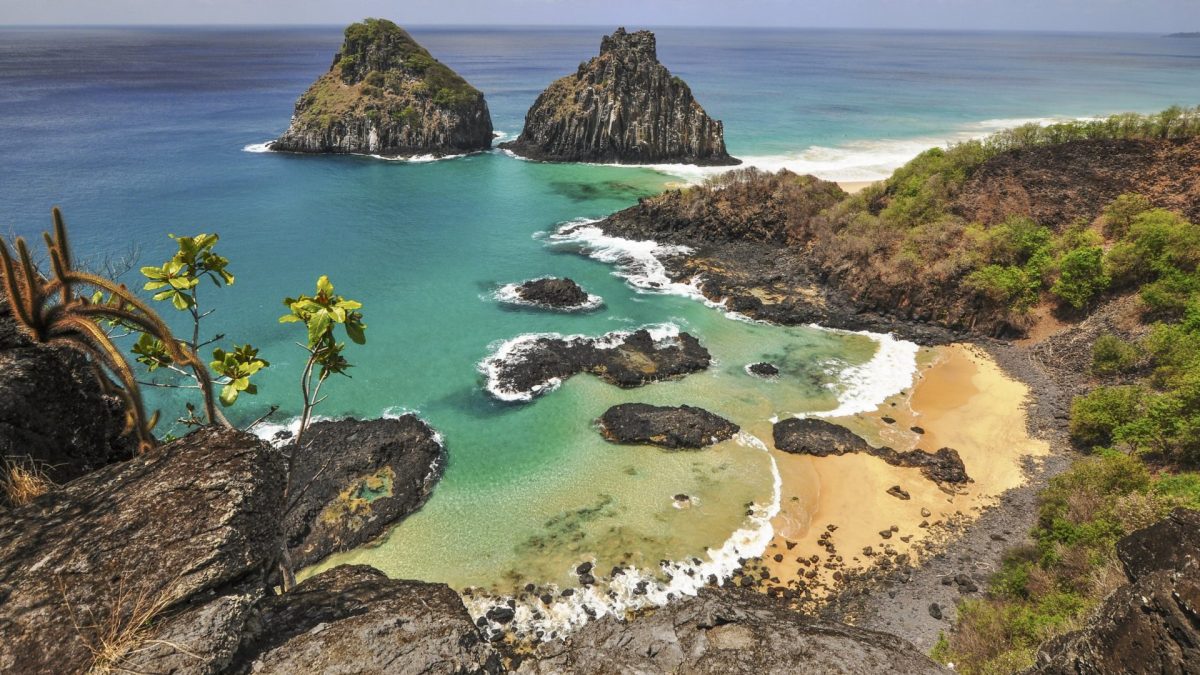
“Darwin came to this island in 1832, three years before he went to the Galápagos,” says my guide, Vithor Macedo, as we meander along a grassy emerald cliff, electric-blue waves crashing on a charcoal bay below, silhouetted lighthouse visible in the distance. “These islands have been compared to Ecuador’s famous archipelago: we have frigatebirds, three species of boobies, sea turtles, octopuses, dolphins, manta rays and several shark species, not to mention the islands’ own endemic birds and fish. But we’re still relatively undiscovered to international travellers.” Fernando de Noronha, where we’re hiking, is the only inhabited island in the volcanic archipelago of the same name. Sprinkled across the South Atlantic, 220 miles off Brazil’s northeast coast, these 21 remote specks of land are marked out by their apple-green slopes, volcanic rock formations and flour-sand beaches. The Portuguese, Dutch and French all fought over their strategic location and the main isle served as a prison for more than two centuries. It was also used as a military base in the Second World War. Shorts Today, Noronha still has mythical status among Brazilians, but for a different reason – 70 per cent of this secluded, peaceful island is now a protected Marine National Park, meaning its beaches are pristine, nigh-on empty and devoid of development. A rainbow of colourful marine life makes the island one of Brazil’s most renowned spots for diving and snorkelling. The wider archipelago also lays claim to the highest concentration of tropical sea birds in the Western Atlantic – one of several factors that gave it Unesco status in 2001. A bluestriped grunt fish shoal and reefs in Fernando de Noronha sea (Photo: cabuscaa/Getty) It’s undeniably exclusive, not least because getting here is a little pricey. On arrival, visitors are required to pay a conservation tax of around ℝ80-100 (£12-15) per day, while those wanting to enter the Marine Park must buy a 10-day ticket for ℝ384 (£56 for foreigners). Other environmental initiatives include a limit on single-use plastic and a number of wildlife conservation projects, while the hiking trails that lace the park have to be booked in advance at the visitor centre, with a cap on numbers to protect the rock pools. I travelled with UK-based specialist Journey Latin America, which took the hassle out of planning and meant my taxes and visitor fees were paid in advance. Its landscapes are varied; on one side, cliffs carpeted in vibrant grass tumble above rugged, stony shores, etched out by the Atlantic. On the other, beaches set between swaying palms and aqua-blue sea offer a vision of paradise. Until recently, the only way to get here was to fly from Recife, a coastal city in Brazil’s Northeast. But last year, Latam airlines launched direct flights from São Paulo, whisking travellers to Noronha in less than four hours and making the island more accessible to overseas visitors. Earlier this year, the island’s airport was also expanded, doubling capacity; so now is the time to come before the hordes descend. About 139,000 visitors came to the Marine National Park in 2025 – the highest number since 2015. The idyllic Praia do Bode on the island of Fernando de Noronha, Brazil (Photo: Diego Fiore/Getty) The main draw here is nature, hiking, marine life and beaches. To reach the latter, I explore the Marine National Park by jeep with local guide Romario. Among the highlights is Baia do Sancho – a tucked-away cove named one of the World’s 50 Best Beaches for 2025 and 2026. Set beneath jagged cliffs, the bay is accessed by a series of ladders through narrow splits in the rock, but it’s worth the effort for the view: a curve of honeyed sand wrapped around an expanse of clear turquoise, cliffs above, trees dappling the shore with shade. Praia do Bode is spectacular in a different way. Jet-black boulders stud a long sweep of camel sand. We spot the fin of a lemon shark in the shallows, and it’s soon joined by a cluster of others. It’s an extraordinary sight My hike with Vithor is along Atalaia Pontinha Caieira. One of six government-regulated trails on the island, it’s a gentle four-mile trail along desolate beaches, leafy dirt tracks, weathered coastal paths and rocky shores. Frigatebirds swoop overhead as we pass tidal pools crammed with fish. A green turtle swims through a wreck on Fernando de Noronha (Photo: Global Pics/Getty) Indeed, many of Noronha’s greatest treasures lie in the ocean. There are hawksbill and green turtles (which nest on many of the beaches), sharks, rays and more than 230 fish species, plus the area is a hotspot for spinner dolphins. Projeto Golfinho Rotador (the Spinner Dolphin Project, a local NGO), has been monitoring and protecting the population since 1990. “Dolphins come to the islands in the early morning looking for calm water where they can rest, play and feed their young,” Cynthia Gerling, project coordinator for the environmental education and sustainability programs, tells me. “We manually count the number of dolphins coming into Dolphin Bay. Our record was in 2019, when we registered more than 2,700.” “Hawaiian canoe” trips on double-hull, outrigger boats are the most popular way to see these sleek creatures up close. On a morning excursion with a local operator I find myself surrounded by a pod of about 15 dolphins – a mesmerising scene as the sun glitters on the sea and the rocks rise in pointed pyramids beyond. The roar of water crashing against a cave adds to the ambiance. Later, away from the dolphins, I jump in for a snorkel and spot a nurse shark gliding just metres beneath me. Laura French hits the water in Fernando de Noronha Protecting these populations is among the key goals for the ICMBio, the governmental arm that looks after conservation initiatives on the island, but Cynthia believes more could be done. “Tourism is great for us if it’s done sustainably; 90 per cent of the people who live here rely on tourism,” she says. “But it needs to be managed carefully, especially with the expansion of the airport.” For now, at least, Fernando de Noronha still feels like something of a secret beyond Brazil. While this archipelago might not have quite as many claims to wildlife as its Ecuadorian counterpart, it does have the rugged isolation, unspoilt wildness and soothing serenity. I felt incredibly zen after a few days of living a slower, simpler life here, and I’m still dreaming of the blazing sunsets, luminescent stars and abundant silence of this unique isle. How to do it The writer was a guest of Journey Latin America, which can tailor-make a 15-day trip to Northeast Brazil, with five nights on Fernando de Noronha, from £3,975pp. Includes transfers, domestic flights, excursions, national park fees and good-quality hotels with breakfast. journeylatinamerica.com Latam, Virgin Atlantic and British Airways all fly non-stop from Heathrow to São Paulo; Latam flies to the island from there. Staying there Beco Pousada Boutique guesthouse in Vila de los Remédios, the island’s main town, has B&B doubles from £125.
The mini Galápagos island paradise
Full Article
Original Source
Read the full article at Inews →KhanList aggregates and links to publicly available news content. We do not host full articles from third-party sources. Always verify important information with original sources.