
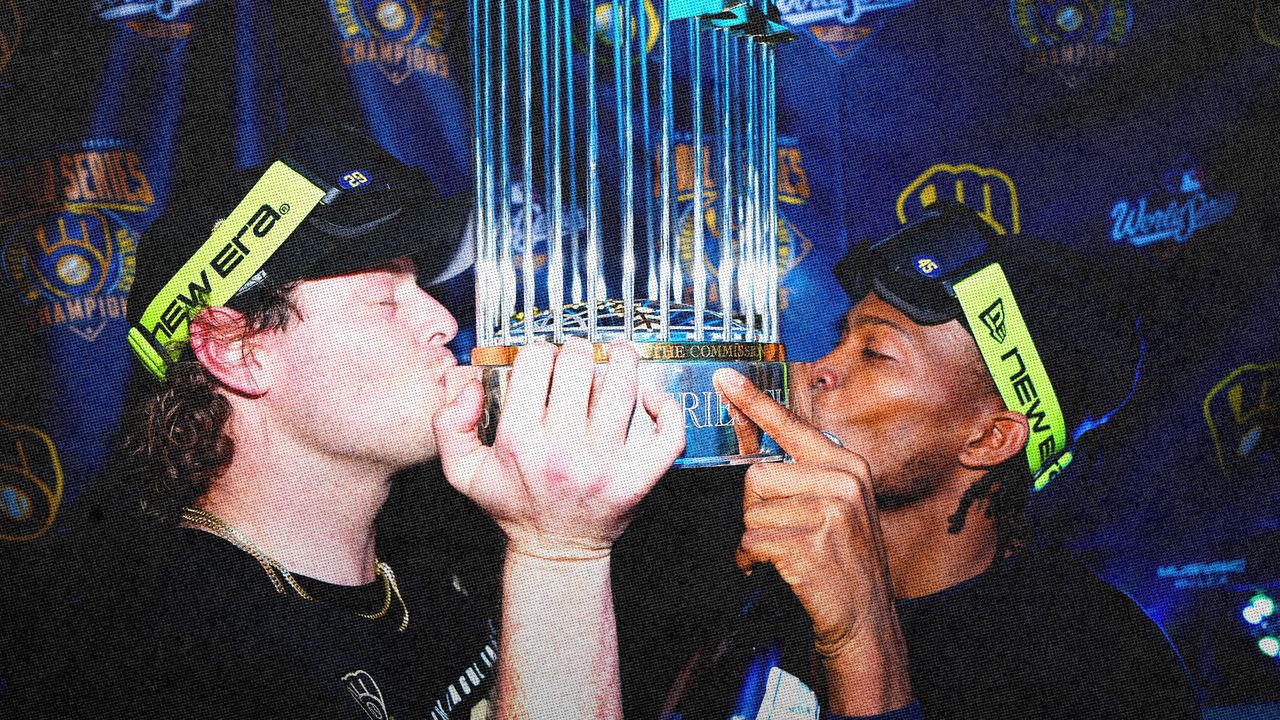
There is something inherently funny about the way the Milwaukee Brewers, of all teams, finally won their first-ever World Series: in ruthless, cold-blooded fashion. This is the small-market, Upper Midwest, rust-belt team perhaps most famous, until now, for (1) a hat logo that everyone loves, (2) a sausage race and (3) a couple of baseball’s most notable clowns: the adored former player and broadcaster Bob Uecker, and the maligned former owner and Major League Baseball commissioner Bud Selig. Their manager, Pat Murphy—“Murph”—looks straight out of central casting for a sitcom about a Wisconsin dive bar. We’re talking about a ball club with some of the friendliest fans in sports, and whose team is among the most merciless in recent baseball history.Just as the Brewers’ sense of timing has been perfect this whole postseason, these stone-cold killers even managed to dispatch the Tampa Bay Rays before Halloween. If you haven’t been paying attention, the Brewers have been praised by the baseball world all year long—even Derek Jeter said so—for playing baseball the “right way”: small-ball, teamwork, manufacturing runs, grinding away at every at-bat. Sounds romantic, right?But what the Brewers have done is revealed what “the right way” actually looks: a bloodbath. And just like in any horror movie, they proved impossible to kill. They trailed games throughout the playoffs, including in every game of their relentless sweep of the Los Angeles Dodgers in the NLCS, in which the Brew Crew appeared to gradually suck the life out of the two-time defending champions.For much of their existence, the Brewers have played second banana to the Chicago Cubs and St. Louis Cardinals, their division rivals. But even these rivalries are one-sided, as the Cubs and Cardinals save most of their hatred for one other. The so-called Border Battle between Milwaukee and the Minnesota Twins is one of Selig’s forced interleague rivalries, but it’s best viewed as a proxy, summertime, low-stakes feud between Vikings and Packers fans. Maybe what’s most promising is that an overlooked team has forged not just a winning formula, but a unique identity consistent with the club and its hometown’s unfussy reputation.Much has been said of the Brewers’ playing style—but still not enough. They are an antidote to the turgid, individualist, power baseball of the 21st century. If the modern game has come to resemble an artillery barrage, in which teams are built around players selected for launch angle and exit velocity rather than strikeouts and batting average, the Brewers (not to mention the Rays) reached the Fall Classic by restoring a pitch-by-pitch knife fight. Nobody punishes teams quite like the Brewers. They battle at every at-bat, working the count and wearing down pitchers. Even with two strikes—no, especially with two strikes—they’re difficult to get out.“They’re not worried about their own stats,” said the 67-year-old Murph of his team during the trophy presentation. “o one cares about that.”What does it look like when it all comes together? It looks like the fifth inning of Game 3in St. Petersburg, with the Brewers leading 2-0. With two outs and a runner on base, Christian Yelich, their aging captain and only full-fledged star, battled back from a ball and two strikes to draw a walk. The Rays brought in pitcher Cam Booser, who’d held opponents hitless with runners on base the entire postseason thus far. The Brewers, though, had other ideas, and what followed could be charitably described as a slaughter: Their next six batters all drove in runs before the Rays finally got another out. When the dust settled, Milwaukee was up 10-0. After two tight World Series games that could’ve gone either way, this was the knockout punch. Tampa fought hard to win Game 4 the following night in a 12-inning, bullpen-draining duel, but it was only a temporary reprieve, as Milwaukee’s pitching and clutch hitting meant the Rays could never really get going in the decisive game.Apropos of their blue-collar image, the Brewers’ best players are largely self-made. Their ace, Jacob Misiorowski, is a lanky, 6-foot-7 second-round draft pick passed over by scouts for being too raw. The Brewers’ vaunted pitching lab, known for giving overlooked and overcooked pitchers an extreme makeover, turned The Miz into this year’s overwhelming Cy Young favorite in just his first full season, one in which he threw more 100-plus mile-per-hour pitches than anyone in baseball.In the ABS era of refuting balls and strikes, their catcher, World Series MVP William Contreras, has perfected the challenge system. In one of the more entertaining sideshows of the postseason, Contreras honed his Terminator-like ability to read the strike zone better than the umpires themselves and regularly got balls turned into strikes, sometimes within eighths of an inch.The team is rounded out by a devastating bullpen that includes Trevor Megill, who closed out Game 5. “10-year-old me would be so proud,” he said moments after winning, while holding a WWE-style championship belt.Of course, the 2026 MLB season is now over, and with owners threatening a lock out until a salary cap is instituted with the next collective bargaining agreement, it’s tempting to wonder where this leaves baseball,. If the Dodgers’ success, enabled by their enormous financial advantage, is an argument for a salary cap, the Brewers’ win (and Tampa’s World Series appearance) would seem to refute it. Theoretically, couldn’t any team do this? Milwaukee is the small-market team that does everything right. They find market inefficiencies with a zeal that would make Malcolm Gladwell proud — when everyone was looking for home run hitters, they built a team out of smart drafting, savvy scouting and salvage opportunities, while avoiding the kinds of costly, long-term contracts that often cripple their rivals.More likely though, the Brewers are the exception that proves the rule. A salary cap and floor won’t change the culture at big- nor small-market clubs governed by lousy owners who are apathetic about winning. It won’t turn poorly run organizations into well-oiled contenders. The owners who treat their ball clubs as private-equity bait, tax shelters and personal ATMs only want a salary cap for the huge increases in team valuations it is likely to produce, and it won’t magically compel some of them to turn their laughingstock franchises into dynasties that compete for pennants year in and year out.In any case, credit the Brewers for seeing us out with a more sustainable vision. Nowadays, fans lament the loss of a two-strike approach, of situational hitting, of strikeouts. Yet these are the traits that brought a rust-belt ball club its first World Series title. Hopefully there’s a lesson there. If nothing else, the Milwaukee Brewers have left the game in a good place, and their maniacal tenacity sets the stage for baseball’s next big battle, not on the diamond but in the boardroom.
The Milwaukee Brewers Are Stone-Cold Killers
Full Article
Original Source
Read the full article at Gq →KhanList aggregates and links to publicly available news content. We do not host full articles from third-party sources. Always verify important information with original sources.