
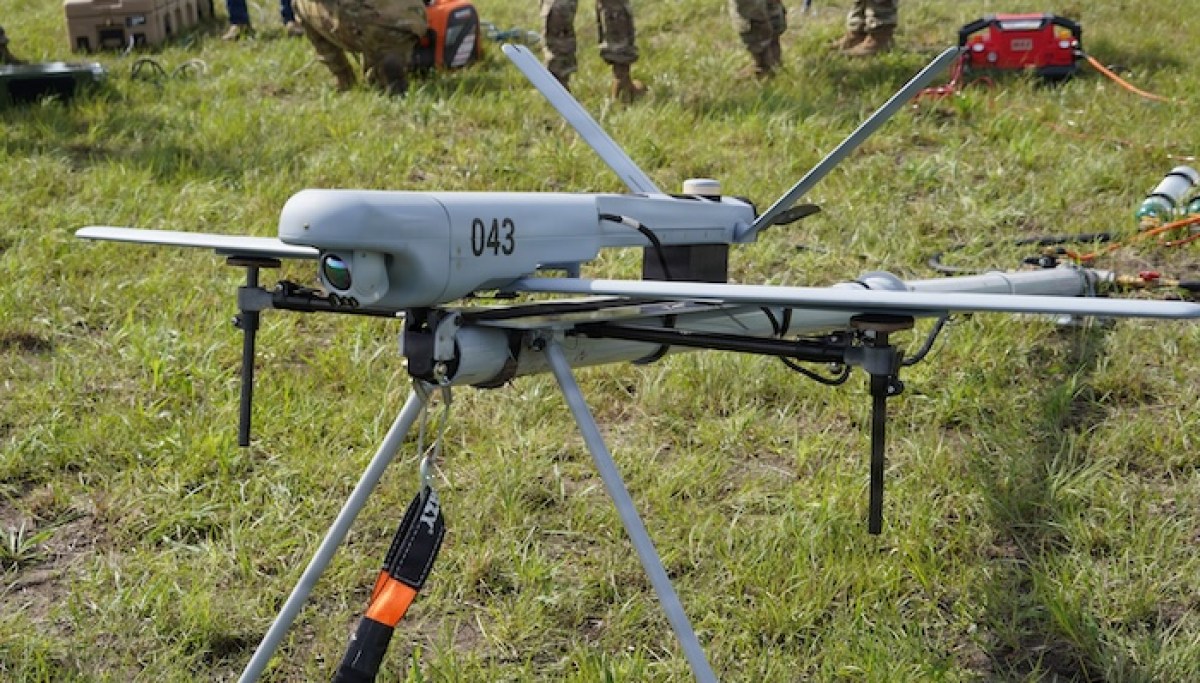
The U.S. military will need hundreds of thousands of drones of various shapes and sizes with different capabilities in preparation for a future war with China that the department hopes it never has to fight.In a hypothetical war in China, the fighting would likely largely occur in the Pacific region, far from the continental United States, which emphasizes the need for long-range capabilities even though countless small, cheap, and attritable drones or quadcopters will play a significant role as well.“We need to at least buy enough drones across all these different echelons to train with, to start, and that’s not an insubstantial number,” Defense Innovation Unit acting Director Travis Metz told the Washington Examiner in an interview. “If you don’t train on these things, you don’t use them, and so there are differences of opinion about how many of these things we need, even on the quad side, but it’s measured in hundreds of thousands just to train.” The ultimate goal is for a handful of companies to be responsible for manufacturing all of the different types of drones the military will need, and from Metz’s perspective, the technology evolves so quickly that they should be immediately delivered into the hands of warfighters because having them sit in warehouses awaiting deliveries will leave them quickly outdated.The DIU is overseeing the Pentagon’s Drone Dominance Program, which is designed to test, fund, and scale the best drones, among dozens of other exercises for different emerging systems. To date, they have already held two competitions, known as Gauntlets, where they placed orders for the winning companies to make drones for them.The Pentagon purchased 30,000 drones for approximately $150 million from 11 different companies following the first Gauntlet exercise, and 60,000 drones valued at $300 million from nine companies following the second competition. There were two parts of Gauntlet II, a deep strike capability and a close quarters combat exercise. The winners, Perennial Autonomy for the deep strike portion and Neros for the close quarters battle, got a Pentagon order to produce 8,000 drones.Sixteen companies have been awarded contracts following Gauntlets I and II. A handful of those 16 defense companies received multiple orders due to how they finished in each of the competitions. The first Gauntlet exercise took place in February, and the department has received most but not all of the drones it ordered following the competition.The Aevex Atlas precision guided drone system ready to be launched at the Joint Readiness Training Center in Fort Polk, Louisiana on April 5, 2026. (U.S. Army photo by Master Sgt. Anthony Hewitt) There are still three upcoming Gauntlet exercises – Gauntlet 2.5, 3, and 4 – in the next year or so, which are additional opportunities for drone companies to impress the department and win contracts as the Pentagon refines its plans.In total, the department anticipates spending $1.1 billion to purchase roughly 300,000 drones from all of the Gauntlet exercises.The goal is for the services to eventually pick a handful of companies, two to four, Metz said, to mass produce small drones for the services in the future. Relying on only one company would pose supply-chain risks that the department wants to avoid.Another hurdle the Pentagon is trying to eliminate is the use of any component in its technology that originates from China, which mass produces key drone technology. As a result, the department has implemented rules to enforce this policy while promoting U.S. companies to begin manufacturing replacement parts to fill the void.The orders that came from Gauntlet II were the first that did not allow the systems to contain Chinese brushless motors or Chinese battery packs.“Sadly, I think many of the visuals that I have of the … different types of potential conflicts we have to prepare for, I think, are quite dystopian in terms of how many of these robots that we will be capable of firing or putting into harm’s way,” he said. “The goal is to be prepared to do so much of it at such scale with such lethality that we use none of it, that we’ve actually figured out how to deter using it.”Another goal the department shares is trying to lower the cost to produce each drone, especially the small ones intended to be used as attack drones that have a one-time use. Metz said the consistent demand signals and orders from the Pentagon will help drive prices down, though he also noted this will be a continuous effort to slash the cost.“The Drone Dominance Program on the short range one-way quads today, its primary objective, in the short term, is not per se to field drones. It is to begin to scale the U.S. industrial base around these things. One to lower the cost, and two to get all of it out of China. All has to come out of China. We can’t build a quadcopter that requires an enemy or potential enemy to sell us stuff. That’s where we need to get to,” he said.Learning from Ukraine but not replicating The Russia-Ukraine war has been the leading incubator for testing and deploying new drone capabilities.Not only have several U.S. military leaders made the trip to Ukraine to meet with their counterparts and learn from them, but Ukraine has brokered several agreements with allies to aid their offensive and defensive autonomous capabilities.Some Ukrainian companies were invited to compete in the Gauntlet exercises.Ukraine has fielded 8 million quad-copters this year alone, Metz said. The sheer amount is hard to fathom: 8 million small drones produced in less than a year and more when including larger autonomous systems.“I think for the Ukrainians, the quad is one of their core asymmetric capabilities. For us, given our problem sets, I think the quad is less important than some of these other modalities of unmanned aerial systems at greater ranges with different capabilities and so forth,” Metz said. “A one-way attack FPV quad in Ukraine, maybe at its extended range, it’s going out [approximately] 30 kilometers, it’s killing Russians and killing Russian trucks with some regularity at 15 to 20 kilometers.”Metz said he doesn’t believe the U.S. will need to field 8 million quad-copters each year because the battlefield conditions between Russia and Ukraine are vastly different from a hypothetical U.S.-China war, where the two countries are thousands of miles apart and separated by an ocean.“We fight differently than the Ukrainians, or we aspire to, or we will,” Metz said. “Maybe FPVs aren’t quite the fulcrum platform for us, but even if you take that into account, do we need 100,000? A million? Ten million? I have no idea.”‘MY REAL NIGHTMARES’: EVOLVING TECHNOLOGY AND WEAPONS ARE CHANGING MILITARY BASES AND FUTURE PLANS“When you look at PACOM and you look at CENTCOM, you’d say the distances required to have effects that change the problem set for our enemies, our potential enemies in those cases, is much different,” Metz said, referencing Ukraine, noting that the DIU issued a solicitation this year for a drone that is capable of flying a minimum of 600 nautical miles.“If you think about what 600 nautical miles means, it solves other meaningful problems that we actually have. We will likely run what we’re going to call mid-strike UAS solicitation or competition in the first quarter of next calendar year,” he added.As the military’s drone capabilities progress, Metz expects the autonomous systems to take more of a role on the flying requirements, that way human operators do not need to be locked in and focused for the entirety of a mission that lasts hundreds of nautical miles.
The military’s $1 billion drone plan to take on China — and how they hope they never have to use them
Full Article
Original Source
Read the full article at Washingtonexaminer →KhanList aggregates and links to publicly available news content. We do not host full articles from third-party sources. Always verify important information with original sources.