
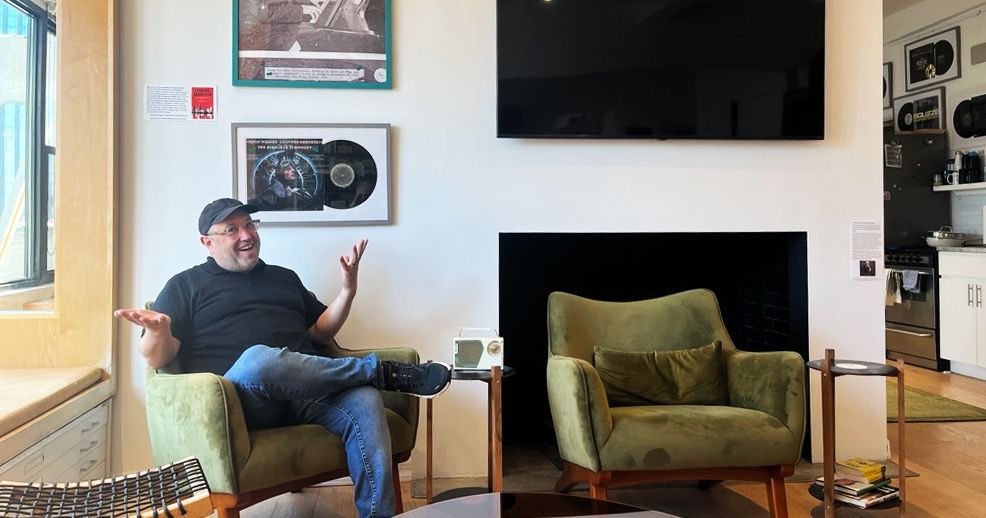
The political consultant Stu Loeser leans into his space’s unexpectedly glamorous past. Stu Loeser in front of his office’s fireplace. You can see the same fireplace in the photo (above his head) of Leonard Bernstein and Marc Blitzstein as they discuss Blitzstein’s The Airborne Symphony — for a performance that was released on an LP that also hangs on the same wall. Photo: Christopher Bonanos Stu Loeser in front of his office’s fireplace. You can see the same fireplace in the photo (above his head) of Leonard Bernstein and Marc Blitzstein as they discuss Blitzstein’s The Airborne Symphony — for a performance that was released on an LP that also hangs on the same wall. Photo: Christopher Bonanos Two years ago, Stu Loeser was looking for new office space. Loeser — former press secretary to Mayor Michael Bloomberg and before that comms director to Chuck Schumer — had been running his namesake political consultancy and PR firm out of the Chrysler Building, which he liked because, he says, nobody ever had to be reminded where his office was. But it was time to expand and relocate, and a place with a terrace would be useful for book parties and other events. As Loeser remembers, “Our broker said, ‘Come see this place — it has roof decks.’” It was a big, bright, top-floor loft at 1239 Broadway, just south of Herald Square. Then the broker dropped a minor detail: It had been the apartment of “some musician.” Who, Loeser very soon discovered, wasn’t any old guitar player: In 1945 and 1946, Leonard Bernstein had lived there. The previous tenant, an architecture firm, had spiffed the place up but it was still fundamentally the space it had been 80 years earlier, with a fireplace at its center and rough brick parapets outside. Lenny, were he able to drop in from the great beyond, would not fail to recognize it. Most everyone in media or government seems to know Stu, a classic Gladwellian connector. (I should disclose that I am among that “everyone”; he and I are friendly enough to have met for lunch a couple of times over the years.) If you live in New York, you probably have a friend who’s a city-lore guy, and Stu is absolutely that guy — a seriously fast-talking, warm if also tough version of that guy. The bookshelves in his office don’t max out with Robert Caro’s The Power Broker; they start with Caro and proceed from there. Bernstein is his kind of character, too: compelling, high-energy, dazzlingly deft with language, forthrightly Jewish. (Loeser is observant; his associates know that he doesn’t take calls on Shabbos.) The Lenny connection may not have been the main reason he liked the space, but it sure didn’t hurt. He signed. The sign that greets you as you exit the elevator at 1239 Broadway. Photo: Christopher Bonanos “If you ever take an office of your own, try to take one from an architecture firm,” he says when I come by to visit. “They figured out the bookshelves, the built-ins.” Still, a new office needs décor, especially if you’re planning to hold receptions and parties there. The Bernstein connection supplied a theme, and very quickly, Loeser became a self-taught exhibition designer. Library trips, eBay searches, dives into various archives — all of it bore fruit that soon filled up a bunch of display cases and frames. Much of what he found got edited into big illustrated posters of wall text. Pause next to that central fireplace now, and next to it is an oversize photograph of Lenny at the piano, in front of the same fireplace, looking at the score for a Marc Blitzstein piece called the Airborne Symphony. An LP of the performance he conducted shortly thereafter, with Orson Welles providing narration, is framed and hangs under the photo. As you step out the door to a terrace, you see another pair of photos of Bernstein by the parapet, which has barely changed. Turn around, and in one niche, there’s a blown-up image of one of Bernstein’s first interviews, published in Seventeen, in which the reporter meets the charismatic young conductor at “his apartment, which is a stunning penthouse on top of a tall office building in a business section.” There are framed concert-ticket stubs, Playbills, LP jackets. Visual jokes, too: A unisex restroom door has icons indicating not men and women but a shark and a jet. Another is marked in all-caps “Lavatory Bathroom,” with the initials L.B. emphasized. Dotting the shelves around it all is a pleasing little array of media hardware from the Bakelite-and-vacuum-tube era, not , not Bernstein-specific but definitely appropriate to a comms office: a movie projector, press cameras, vintage radios. “The first time Kathy Wylde came and visited,” he says, “she’s like, ‘I knew you’d have an office like this.’” The terrace, seen with Bernstein and today. The brick parapet wall behind him has been skim-coated but remains recognizable. Photographs: Christopher Bonanos. The terrace, seen with Bernstein and today. The brick parapet wall behind him has been skim-coated but remains recognizable. Photographs: Christopher ... The terrace, seen with Bernstein and today. The brick parapet wall behind him has been skim-coated but remains recognizable. Photographs: Christopher Bonanos. This “stunning penthouse” was not, I should clarify, either of Bernstein’s two most famous homes. In the 1960s and early ’70s, he and his wife, Felicia, lived with their family on Park Avenue, where, in 1970, Tom Wolfe attended That Party and covered it, savagely. A few years later, the family moved to the Dakota, where Bernstein spent the remainder of his life (and, if you believe the billionaire crackpots who live there now, continues to hover). This instead was a young artist’s apartment, his first after he moved to New York, the place he moved into about a year after a legendary call came in 1943, his first real moment of international recognition. Bruno Walter, scheduled to conduct the New York Philharmonic, had come down with the flu, and Bernstein stepped onto its podium, age 25, on just a few hours’ notice. It was so late that the programs had to be corrected by typewriter. He wore his one good suit, a gray sharkskin, because he didn’t have time to get the full eveningwear rig. A little over a year later, he moved into this apartment. On the Town, his first musical-theater hit, had just opened. Signage with a sense of humor. Photographs: Christopher Bonanos. Signage with a sense of humor. Photographs: Christopher Bonanos. Loeser is an animated, chatty tour guide, and it’s pretty entertaining to just let him run, skipping from anecdote to anecdote The RCA Victor console radio-phonograph unit by the door? “Made in Long Island City! It was in Yonkers, and then I brought it back here. Its entire life has been within ten miles of where it was built.” An end table with a Bernstein LP as its top was custom-built by an Etsy maker; Loeser went out of his way to find a damaged record to give to the carpenter, because “you don’t want to have someone’s perfectly good one. So you’re on eBay and they say, ‘It’s scratched — it doesn’t play.’ ‘No problem.’” Photo: Christopher Bonanos He seems most tickled as he walks me through one corner’s worth of displays, probably because it echoes his own experience of managing City Hall battles in the press every day. In 1943, Mayor Fiorello La Guardia — an opera enthusiast — had directed some public funding to a new institution, the New York City Symphony, housed at City Center. (It’s unrelated to the orchestra of the same name that operates today.) It was meant to be a people’s institution, more accessible and with cheaper tickets than the Philharmonic up at Carnegie Hall. Bernstein was, during the time he lived at 1239 Broadway, the NYCS’s conductor, and made some slightly inaccurate remarks to a reporter about its level of subsidy, after which La Guardia publicly corrected him. It was a minor tiff, a day’s scuffle at most, getting a brief bit of attention in the Times — and, now, rediscovered, it fills up an entertaining niche in what Loeser has started calling the Leonard Bernstein Microseum. Bernstein’s first musical-theater smash, On the Town, was playing at the 44th Street Theatre when he lived in these rooms. Photo: Christopher Bonanos My experience of people in high-profile jobs suggests that most of them look forward, seeing the past mostly as it pertains to their own narratives. Loeser, though, has a historian’s long view, an appreciation for a city as it exists in the river of time. I asked him how he thinks he got that way, and he thinks for a moment. He mentions having immigrant grandparents who had been uprooted from Europe, and yearning for a sense of connection to place. Say you spend a day around the Seaport, as kids on field trips do: “You’re a block from George and Martha Washington’s house — but it’s gone, and the street doesn’t exist. It’s under the Brooklyn Bridge.” Whereas in, say, Athens, you’re surrounded by antiquity, here glass towers stand right next to historic sites: “In a city that’s constantly re-re-rebuilding, renewing, you have this extraordinary ability to be in the present and in the past. I liked the space because it was that. I like that it’s the only museum to Leonard Bernstein anywhere in the world. And I like that it’s a fun place to visit, because if you’re a wallflower or don’t have anyone to talk to at a cocktail party, there are things to look at.” Oh yeah, I say: You’ve got 200 icebreakers in here. “Right. Or just something to read on your own, if you don’t feel like talking to anybody.” The Midtown Office That’s Also a Leonard Bernstein Museum Your product is saved! You’ll receive emails when your saved products go on sale. Manage preferences.
The Midtown Office That’s Also a Leonard Bernstein Museum
Full Article
Original Source
Read the full article at Curbed →KhanList aggregates and links to publicly available news content. We do not host full articles from third-party sources. Always verify important information with original sources.