
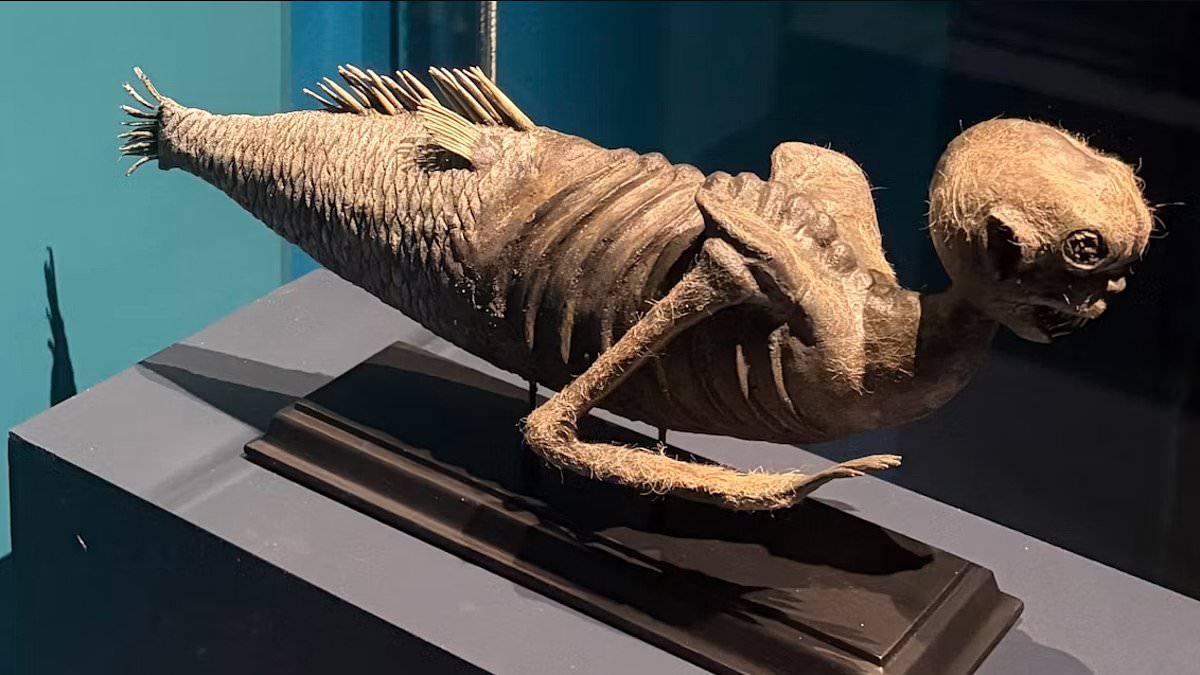
Published: 08:04 EDT, 5 November 2026 | Updated: 08:05 EDT, 5 November 2026 A grotesque creature that appeared half mammal, half fish once convinced audiences around the world that mermaids might really exist.Known as the Feejee Mermaid, the bizarre specimen was displayed in museums and travelling shows during the 19th century, where it was promoted as evidence of a mysterious creature lurking beneath the waves.Some even hailed it as a possible 'missing link' between humans and aquatic animals at a time when scientists were grappling with new ideas about evolution.But according to Jack Daly, a lecturer in writing and rhetoric at the University of Colorado Boulder, the creature was never a genuine biological oddity at all.Instead, it was a carefully constructed hoax created by stitching together the torso of a young monkey with the tail of a fish.'The Feejee Mermaid, as it blended human and animal characteristics, folklore and science, spectacle and empiricism, displays how a monstrous hoax inspired fierce intellectual debates in 19th-century America,' he wrote on The Conversation. Known as the Feejee Mermaid, the bizarre specimen was displayed in museums and travelling shows during the 19th century While some observers viewed it as a possible evolutionary link, modern scientists reject any such interpretationThe Feejee Mermaid was first brought to America in the 1800s by the showman P. T. Barnum.It was presented as 'The Greatest Curiosity in the World' at the American Museum and was said to have 'originated in the Feejee Islands'.The horrifying specimen was deliberately designed to be unsettling, bearing little resemblance to the beautiful mermaids of folklore.Mr Barnum once described it as 'an ugly dried-up, black-looking diminutive specimen, about three feet long - its mouth was open, its tail turned over, and its arms thrown up, giving it the appearance of having died in great agony.'But at the time, many visitors were prepared to believe extraordinary claims about natural history and evolution.And despite its appearance, the fake mermaid became a global sensation and attracted huge crowds eager to glimpse the supposed wonder.Showmen marketed it as an authentic discovery from distant oceans, capitalising on public fascination with exotic creatures and unexplored parts of the world.A different Feejee Mermaid was brought back from Japan by an American sailor and donated to the Clark County Historical Society in Springfield, Ohio, in 1906. It has a grimacing face, strange teeth, oversized claws, fish-like lower half, and downy layer of grey hairWhile some observers viewed it as a possible evolutionary link, modern scientists reject any such interpretation.Detailed examination has shown it to be an artificial creation assembled from the remains of different animals.'Feejee Mermaids, as displayed in America, are characteristic of a 'sideshow gaff' that interested Victorian audiences due to debates about evolution and science,' Mr Daly concluded.An extract from Mr Barnum's autobiography even reveals how he requested a naturalist's opinion of the genuineness of the animal.'He replied that he could not conceive how it was manufactured; for he never knew a monkey with such peculiar teeth, arms, hands, etc., nor had he knowledge of a fish with such peculiar fins,' Mr Barnum writes.Despite the naturalist's opinion, Mr Barnum explained that he decided to 'believe in the mermaid' – and went on to fool the rest of America.Scans previously carried out on a separate Feejee Mermaid revealed it was part fish, part monkey and part reptile.
The 'mermaid' that fooled the world: Scientists reveal the true identity of a bizarre creature once hailed as a missing link between humans and fish
Full Article
Original Source
Read the full article at Dailymail →KhanList aggregates and links to publicly available news content. We do not host full articles from third-party sources. Always verify important information with original sources.