
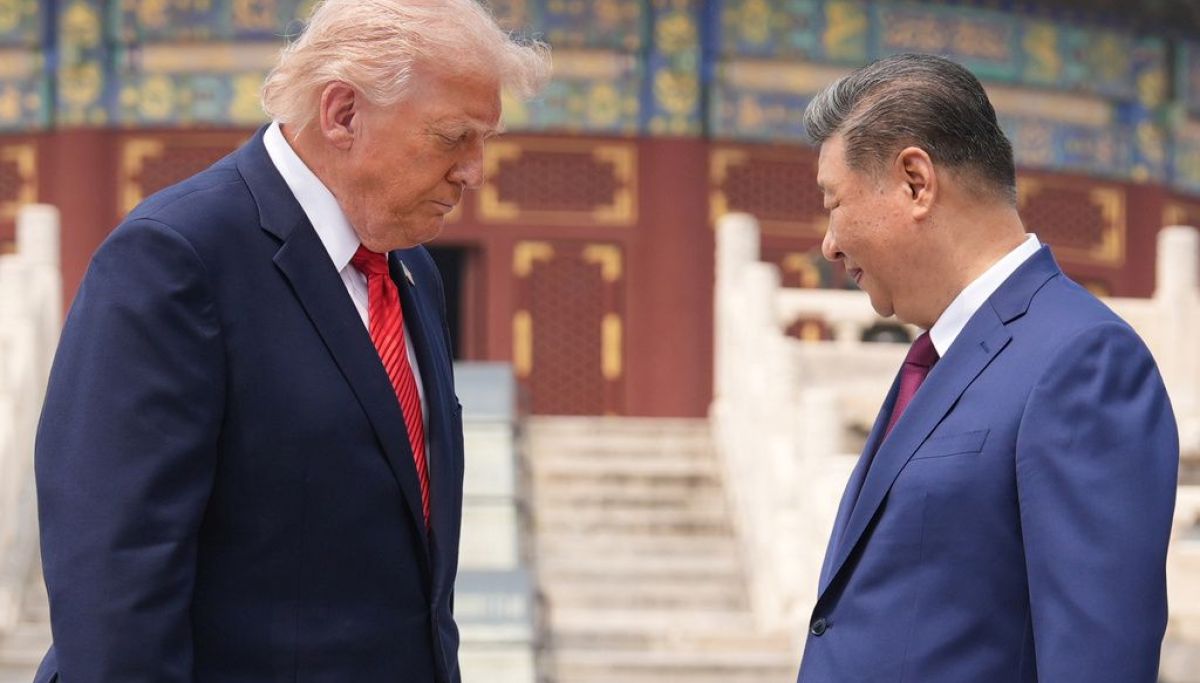
When President Donald Trump hosts Chinese President Xi Jinping for their high-stakes White House summit, the legacy media will call it chaos or “Trumposterous.” Critics always look at the president’s fluid style and claim he lacks a grand strategy.They are wrong. What Washington bureaucrats call chaos is actually a highly disciplined, tactical choreography. Trump approaches the global stage like an elite master of fencing, specifically the weapon of epee.In epee fencing, there are no rigid “right of way” rules. Whoever controls the distance, dictates the timing, and counter-punches wins the point. As America faces a multifront geopolitical challenge, this agile strategy is exactly what we need to keep Beijing on its heels. We are not just dealing with an isolated trade dispute. We face a unified axis of disruption. China acts as the economic lifeblood for the Russian war machine. Beijing is the top buyer of Iranian crude oil. It continuously bankrolls North Korea’s regional provocations.Traditional diplomats prefer slow, segregated bureaucratic committees. Trump’s strategy is different. He executes what fencers call a flèche, a sudden, explosive advance that changes the whole parameters of the bout. By explicitly bundling China’s economic goals with its geopolitical behavior, Trump changes the calculation. The message to Xi must be unyielding: Beijing cannot expect stable U.S. trade terms or tariff relief while financing rogue regimes. It forces China to choose between its own economic survival and its secondary alliances.We see this same tactical precision in the Indo-Pacific. Ahead of the summit, Beijing attempted to dictate terms. It threatened to disrupt meetings over crucial U.S. arms deals to Taiwan. In fencing, when an opponent lunges aggressively, the master response is a stop-thrust, a lightning-fast, preemptive strike that halts the enemy’s momentum.By refusing to back down on Taiwan and maintaining a fierce commitment to our allies, the administration delivers a decisive diplomatic stop-thrust. It establishes a firm boundary before the leaders sit down, signaling that American deterrence in the Indo-Pacific is nonnegotiable.Finally, consider the math on trade. Treasury Secretary Scott Bessent and Vice Premier He Lifeng are already discussing reciprocal tariff cuts on specific sectors such as energy and agriculture. Critics view tariffs as a blunt, permanent instrument. In a fencer’s hands, they are a remise, a continuous, immediate second attack delivered the moment an opponent fails to properly parry the first one.The threat of sweeping economic penalties must remain live and active on the strip. Keeping the pressure constant ensures that Beijing cannot simply nod along to empty promises. It must follow through on structural trade commitments and verifiable intellectual property protections.TRUMP WANTS IRAN TO FOLD — XI JINPING WON’T ALLOW IT. HERE’S HIS MISSING MOVETraditional foreign policy elites favor long, drawn-out matches that result in dense, unenforceable treaties. But the public is tired of watching Washington play defense while foreign adversaries rewrite the rules of global commerce.Trump’s foreign policy succeeds because it rejects institutional decorum in favor of real-world results. By mastering the art of the diplomatic duel — using strategic unpredictability, economic leverage, and rapid counter-punching — the administration is uniquely positioned to secure a favorable, long-term balance of power that puts workers first.Eric Wargotz, MD, is a political analyst, writer, and commentator focused on trade, national security, international relations, and health.
The media think Trump is playing chess. Xi Jinping knows he’s fencing
Full Article
Original Source
Read the full article at Washingtonexaminer →KhanList aggregates and links to publicly available news content. We do not host full articles from third-party sources. Always verify important information with original sources.