
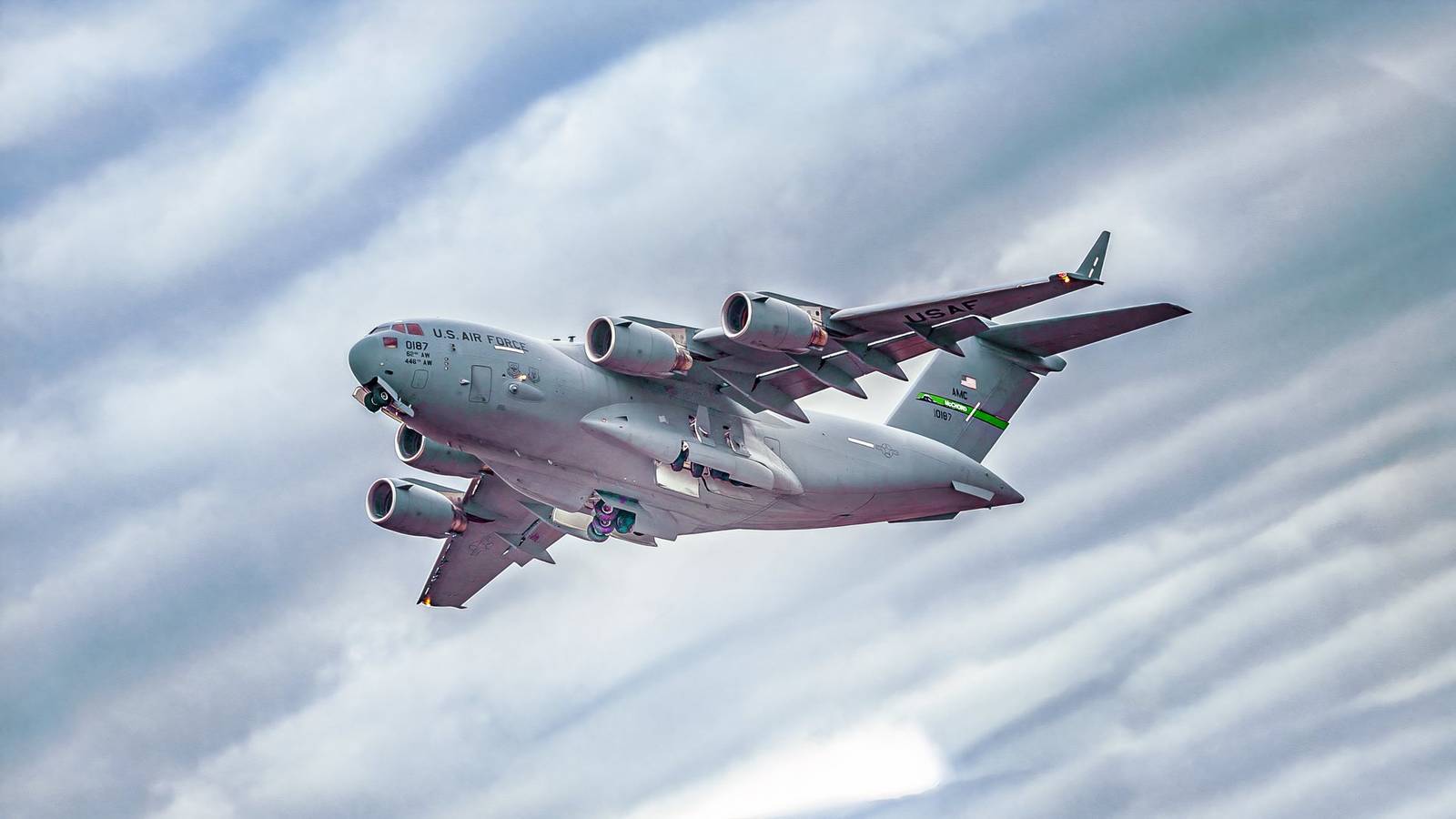
Credit: Wirestock Creators | Shutterstock, Simple Flying Published Oct 9, 2026, 10:01 AM EDT Chris earned a Master’s degree in Defense and Strategic Studies (Highest Honors) from the University of Texas at El Paso. His graduate work concentrated on Global and National Security, Low-Intensity Conflict, Modern Warfare, and US grand strategy. He also undertook extensive regional studies, analyzing how key regions integrate into the broader US security architecture. This rigorous program provided him with a comprehensive understanding of U.S. military operations, global strategy, and weapons systems. Additionally, he gained a strong appreciation for great power competition.—an increasingly central force shaping international relations and conflict for the foreseeable future. Sign in to your Simple Flying account The most future-proofed hardware in the United States (US) military arsenal was designed by a company that legally stopped existing in 1997, and the Pentagon keeps writing bigger checks to keep it flying. McDonnell Douglas may have disappeared nearly three decades ago, but many of its military aircraft remain firmly embedded within the US arsenal. From the C-17 Globemaster III and F-15 Eagle to the EA-18G Growler and T-45 Goshawk, these airframes continue performing critical missions for the US military. Through modernization programs, structural improvements, and service-life extensions, the Pentagon is preparing these aircraft to remain operational well into the 2030s, 2040s, and beyond. C-17 Globemaster III: The 80-Year Airlifter Credit: US Air Force Today, the C-17 Globemaster line is getting up there in age; given that the first production model was delivered on June 14, 1993, the C-17 line is now on the wrong side of 30 years. It certainly is not, as some have stated, a flying time capsule like the B-52, but we can safely say the Globemaster line is middle-aged. While that's true, Colonel Daniel L. Magruder, Jr. (USAF) states that “Air Force Materiel Command assessed the service life as 45,000 flight hours as opposed to the initial 30,000 flight hours projected by the manufacturer.” This strongly indicates the aircraft has significant remaining service-life potential, particularly since it has no viable replacement in the near term. The vitality of the Globemaster is one of its greatest attributes, considering that its intended replacement, the Next Generation Airlift, will not be ready to fly until 2041 at the earliest. The prospect of simply restarting C-17 production is hardly an inexpensive alternative, either, with the estimated nonrecurring cost of restarting the production line reaching between $2.1 and $2.7 billion (£1.59–£2.04 billion) in 2011 dollars. This further illustrates why extending the life of the existing fleet remains an attractive option, particularly when the Air Force already operates hundreds of C-17s. Presently, the Air Force — which operates a fleet of 222 of the aircraft — is planning on keeping it in operation until 2075, and a component of this effort is the modernization of the flight deck, which will be handled by Boeing. The estimated lifetime value of the award could be worth as much as $400 million (£302 million). This program aims to address avionics obsolescence and enhance cockpit capabilities across the fleet by introducing a Modular Open Systems Approach (MOSA), which will standardize interfaces and modular components. This will simplify future upgrades without requiring multi-year recertifications. Under the program, Intellisense Systems has been selected by Boeing to provide MOSA-compliant data concentrator units built around “a high-performance multicore single-board computer architecture and advanced video interfaces designed to connect the aircraft mission computer with primary flight displays.” Further, Intellisense will install the company's 15-inch multifunction display, which incorporates advanced video and data-processing capabilities combined with both touchscreen and tactile bezel controls for ease of pilot interaction. F-15: The Fighter That Refuses to Retire...And For Good Reason Credit: US Department of War The Boeing F-15 program has its roots set in the Vietnam War, when jets of the time often doubled as strike aircraft and were very heavy. By 1965, the Air Force requested a new fighter, and McDonnell Douglas was tasked with designing and manufacturing it. The sole purpose of this new plane was to dominate the skies and eviscerate enemy formations. Particular attention focused on Soviet aircraft, especially MiG and Sukhoi fighters, as well as Tupolev and Ilyushin bombers. Since those early days, the F-15 has proven to be an excellent air-dominance platform, so much so that it is projected to remain in the USAF's arsenal through the 2040s as the F-15EX, a highly modified variant of its predecessors. There are numerous reasons for this decision, and one primary reason is that the F-15C and F-15D fleets are aging and, in many cases, approaching or exceeding their intended service lives. These older models face increasing structural concerns, including fatigue-related issues, wiring degradation, and parts obsolescence. A US Department of Defense Modernized Selected Acquisition Report notes that readiness goals for the F-15C/D are increasingly difficult to achieve “due to continuous structural inspections, time-consuming repairs, and ongoing modernization efforts.” The report further states that the average F-15C/D is approximately 38 years old, with a majority of the fleet exceeding its 9,000-hour certified service life. The F-15EX is a low-risk, rapidly deployable replacement for older models and complements the capabilities of platforms such as the F-35A Lightning II, B-1B Lancer, andB-2 Spirit. As it stands, the Air Force intends to more than double the size of its F-15EX fleet, with the planned procurement program increasing from 129 aircraft to 267 airframes. Presently, there are roughly 25 F-15EXs in the USAF's inventory, and the FY27 budget request seeks to add 24 additional airframes at a cost of $3 billion (£2.4 billion). According to Boeing, the F-15EX “. . . features digital fly-by-wire controls, an all-glass cockpit, modern mission systems and software, open mission systems architecture and the ability to carry hypersonic weapons.” And with a payload capacity of 29,500 lb (13,381 kg), the aircraft can carry more ordnance than any other fighter in the US arsenal, another important reason it will remain in the air for years to come. EA-18G Growler: Electronic Warfare Into 2046 Credit: US NAvy The Boeing EA-18G Growler, which made its first flight in October 2004, is the Navy's tactical electronic warfare aircraft. It is used to jam enemy radars and communications on missions such as Suppression of Enemy Air Defenses and escorting strike aircraft; these actions prevent an enemy from detecting and tracking US and allied military forces. The Growler shares the F/A-18F's airframe and many of its avionics and was built on the same assembly line. The EA-18G was designed to replace the EA-6B Prowler, which first entered service in 1971 and flew its final flight for the Navy on June 27, 2015. For its missions, the Growler is equipped with a modified EA-6B Improved Capability III ALQ-218 receiver system, ALQ-99 jamming pods, a Communication Countermeasures Set System, an Electronic Attack Unit, and an Interference Cancellation System that supports communications while jamming. For kinetic attack, the jet can be equipped with the High-Speed Anti-Radiation Missile (HARM) and the AIM-120 Advanced Medium-Range Air-to-Air Missile (AMRAAM). EA-18G Growler General Specifications Related Data Contractor The Boeing Company Date Deployed Initial operational capability in September 2009 with first deployment for VAQ-132 in November 2010. Unit Cost $68 million (£51.3 million) Propulsion Two F414-GE-400 turbofan engines. 22,000 lb (9,977 kg) static thrust per engine Length 60 feet, 2 inches (18.34 meters) Height 16 feet (4.87 meters) Wingspan 44.9 feet (13.68 meters) Weight Weight empty: 33,094 lb (15,011 kg); Recovery weight: 48,000 lbf (21,772 kg) Ceiling 50,000 feet (15,240 meters) Range Combat: 850+ nautical miles with two AIM-120, three ALQ-99 TJS, two AGM-88 HARM, two 480 gallon (1,817 liters) external fuel tanks Crew Two Armament Two AIM-120, two AGM-88 HARM, three ALQ-99 TJS In order to keep these highly capable jets in the air, Boeing inducted the first Growler into the Modification Program on March 19, 2021. The inducted aircraft received upgrades that enabled Next Generation Jammer compatibility. Further, the Growler's own Block II modernization will introduce an Advanced Cockpit System, improvements to aircraft processing and electronic-warfare algorithms, and enhancements to its Airborne Electronic Attack suite, while the Growler is also being integrated with the Next Generation Jammer. The Block II effort is now moving individual capabilities into production. In September 2026, the Navy awarded General Dynamics Mission Systems a contract worth up to $184.25 million (£138.9 million) for full-rate production of the Next Generation Electronic Attack Unit (NGEAU), an upgraded electronic-attack processor forming part of the Growler Block II modernization. The work for this contract will be performed at General Dynamics' facility in Bloomington, Minnesota, through September 2032. T-45 Goshawk: Training's Aging Workhorse Credit: US Navy The Goshawk is the US Navy derivative of the British Aerospace Hawk aircraft. The T-45 replaced the T-2C Buckeye and the TA-4J with an integrated training system, which included not only the aircraft, but also operations and instrument simulators, academics, and a training integration system. The Goshawk entered service with the Naval Air Training Command in 1991 and continues its important role of supporting the instruction of new Naval Aviators and Naval Flight Officers. Currently, the Navy operates 193 of the trainers, and the sea service will now enter the aging jet into its Service Life Extension Program (SLEP) because of what has been described as significant aircraft, engine, and component obsolescence issues. James Bock, the Business Development Office director with Fleet Readiness Center Southeast (FRCSE), Naval Air Systems Command (NAVAIR), stated that the trainer will require “. . . a full-service life extension repair; there are 17 technical directives that must be accurately completed, underscoring the complexity and importance of the collaboration in support of fleet requirements.” One immediate life-extension effort will be to provide the aircraft with reworked wings. According to NAVAIR, the T-45 will fly to FRCSE and exchange its worn wings with a pair that have already been put through a rigorous inspection and repair process. In doing so, this aspect of the SLEP program will ensure more efficient turnaround times. McDonnell Douglas' Legacy Continues Into The Future Credit: US Navy The continued service of these aircraft demonstrates how far the US military can extend the usefulness of proven designs when modernization keeps pace with changing requirements. The C-17 is planned to remain in service until 2075, while the F-15, EA-18G, and T-45 are also receiving significant investments intended to keep them operational for years to come. For McDonnell Douglas, the company itself may have disappeared in 1997, but its legacy remains firmly embedded within the US military. Rather than simply replacing these airframes, the Pentagon continues to invest in their structures, avionics, electronic-warfare systems, and training capabilities, ensuring that designs conceived decades ago can continue serving well into the future.
The McDonnell Douglas Military Airframes The Pentagon Is Flying Deep Into The 2040s & Beyond
Full Article
Original Source
Read the full article at Simpleflying →KhanList aggregates and links to publicly available news content. We do not host full articles from third-party sources. Always verify important information with original sources.