
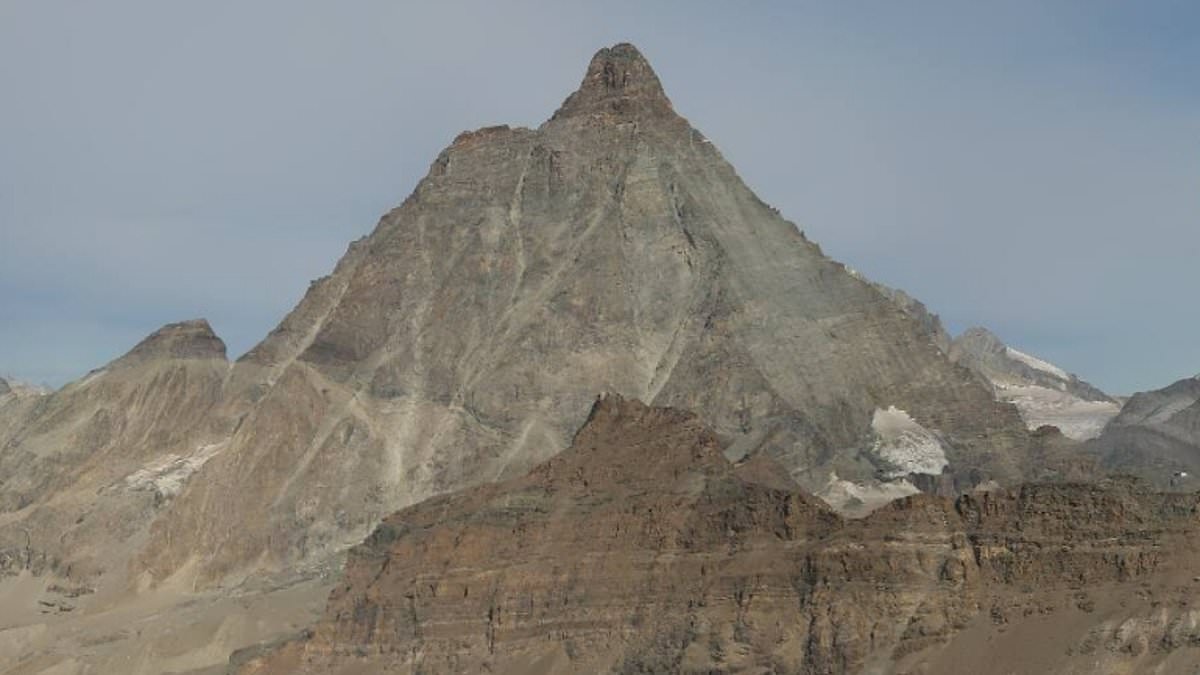
Shocking images have revealed that the Matterhorn is snow–free amid Europe's sweltering early autumn heat.The iconic mountain, famously featured on the Toblerone packaging, is stunningly bare of ice and snow despite it being well into the normal snow season.In a normal year, mid–September would have brought early autumn snowstorms and freezing temperatures to cover the summit and lower rocks in ice.On social media, one user shared a photograph captured by a webcam at the Cervino Ski Paradise resort, writing: 'No, that is not a mountain in some desert. That is the Matterhorn on September 27, 2026.'Other users shared images of what the Matterhorn looked like exactly one year ago, revealing its flanks covered with a deep coat of white snow. Shocking images have revealed that the Matterhorn is snow–free amid Europe's sweltering early autumn heat. Pictured: The Matterhorn on September 29 This comes as Europe sits under a high–pressure heat dome that is trapping dry, stable air over the continent.Parts of central and southern Europe have seen temperatures above 40°C (104°F) earlier this month, and conditions remain well above seasonal averages.Although the Matterhorn is often relatively free of snow through the summer, it is much more unusual to see the summit completely snow–free – especially so late into autumn.In 2022, during an exceptionally hot summer heatwave, local climbers told German media that the mountain's 14,692–foot (4,478m) summit was completely bare.Anjan Truffer, mountain guide and head of the Zermatt mountain rescue service, told Der Spiegel that this had only happened four or five times in his 30 years working on the mountain.However, years with exceptionally low levels of ice and snow are now becoming more common as the planet warms due to human–caused climate change.In June last year the freezing level – the altitude at which temperatures remain below zero – in Switzerland hit its highest level on record for the time of year.Amidst extremely high temperatures, the freezing level around the Matterhorn rose to 16,732ft (5,000m).This led to the Matterhorn becoming almost snow free at the summit, with climbers reportedly able to reach 13,780ft (4,200m) without crampons.This image was taken exactly one year ago today September 29, 2025, revealing how the Matterhorn should look at this time of year The Alps aren't the only mountains missing snow. In 2024, Mount Fuji was left snowless until November 6 (pictured), the latest date on record However, this trend of increasingly snow–free mountains is not limited to Europe's rapidly melting peaks.In 2024, Mount Fuji in Japan remained completely snowless at the summit as late as November 6.This marked the latest date that the mountain had remained bare since record–keeping began 130 years ago, beating the record of October 26 seen in 1995 and 2016.According to the Kofu Local Meteorological Office, snow typically forms on Mount Fuji by October 2 and settles around October 5.But these hot conditions are not just ruining the view; they are turning popular climbing routes into deadly hazards.Earlier this year, exceptionally hot weather caused some of Europe's tallest mountains to crumble, creating deadly rock falls.Extremely popular climbing routes such as Mont Blanc, the tallest mountain in the Alps, and the Matterhorn have been the worst hit.By late August, three climbers had already been killed on Mont Blanc and local authorities ordered lodges on the most common route up the mountain to close. Europe's scorching summer has created a deadly risk for climbers in the Alps, leading to dangerous rock falls on the Matterhorn (pictured) Hot temperatures caused by climate change have pushed up the altitude above which the temperature drops below 0°C (32°F), destabilising frozen rock faces At the same time, mountain guides suspended climbing tours of the Matterhorn after a series of massive landslides.According to a new analysis, the number of rockfalls in the Mont Blanc massif alone is now expected to reach 450 this year.The previous record for Mont Blanc stood at 300 rockfalls in a year, and was set in 2022 when a severe heatwave hit the Alps.Dr Ludovic Ravanel, of the French National Centre for Scientific Research, previously told the Daily Mail: 'That is an absolutely staggering figure, given that just 10 or 20 years ago, there were only a few dozen.'A large majority [of the rockfalls] can be attributed to the climate crisis.'During the intense heatwave across Europe this summer, Switzerland's Basel–Binningen region recorded the hottest temperature ever measured in the northern Alps, hitting 39.7°C (103.5°F).Meanwhile, in the popular French climbing region of Chamonix, temperatures have regularly climbed above 30ºC (86°F).This causes the permafrost, ice that has remained frozen in cracks between rocks for thousands of years, to melt.At the same time, high temperatures cause glaciers to retreat and lose thickness, removing the stabilising pressure that had held the rock wall in place.
The Matterhorn is snow-free: Shocking images reveal how the mountain - famously featured on Toblerone packaging - is bare amid autumn heat
Full Article
Original Source
Read the full article at Dailymail →KhanList aggregates and links to publicly available news content. We do not host full articles from third-party sources. Always verify important information with original sources.