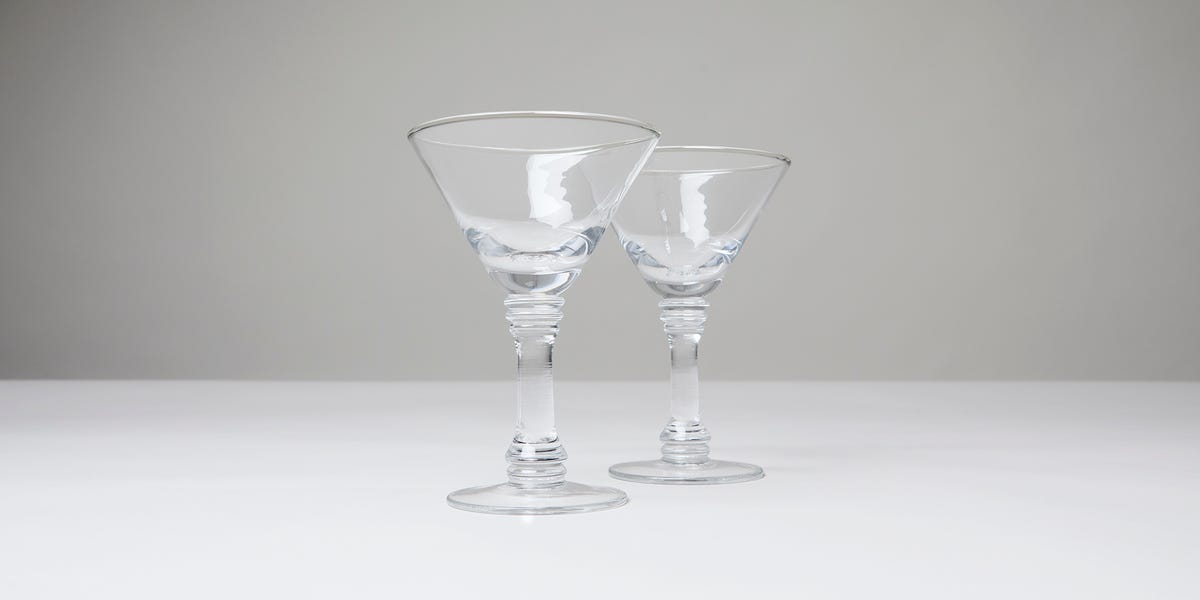
Every product was carefully curated by an Esquire editor. We may earn a commission from these links. Here’s how we test products and why you should trust us.Florence Sullivan4 min readShop $45, ralphlauren.comWelcome to the Esquire Endorsement. Heavily researched. Thoroughly vetted. These picks are the best way to spend your hard-earned cash.Think about how few people know anything concrete about specific design periods. Could you, for example, explain the Art Deco ethos to me? Could you—quickly, please, because this is a test—give me one example of an iconic object that came out of the period? The average man could not. An intelligent man would say the Chrysler or the Empire State Building. But a genius, a wino savant, would stand up from his bar stool and hold out his martini glass. This, he would say, is what the period was all about.When the martini glass debuted in 1925 at the International Exhibition of Modern Decorative and Industrial Arts in Paris, it was considered the modern glass—a new-age man’s answer to the champagne coupe. The postwar boom was in full swing. The worst conflict the world had ever seen was over; the ’20s were roaring, and easy money was flowing. Art Deco celebrated that. It was obsessed with machines and progress, but in a very commercial way. It was all about geometric perfection with symmetry, straight lines, and angularity. Look at a martini glass, and you see that clearly. It’s V-shaped and masculine, like a man in a suit with sharp, straight peak lapels. It gives a cocktail, especially a fragrant gin martini, a lovely bloom. The stem lets you hold it without warming the drink with your hand. It’s sexy!But again, it was conceived in the 1920s; famously, no one was too concerned with details at the time. The massive rim makes it easy to spill, and the thin glass makes it brittle, especially when frozen—a crucial step in an at-home martini.Plenty of martini glass makers have solved these problems, but none better than Ralph Lauren. Of course, the maison of American elegance makes the perfect martini glass, a blend of both Art Deco suave and modern usability. There’s no other brand I’d expect to get this balance right. And luckily, it does so at a price that won’t make your eyes water.Florence SullivanIt’s Laid-back, Perfect for At-homeThe first thing you notice with these glasses is the weight. I don’t have numbers (too tipsy to get them), but they are significantly heavier and sturdier than the martini glass at your favorite hotel lobby bar. That makes them a bit less elegant, but also much easier to hold by the stem, especially with larger hands. After that, you see that the rim itself is a bit thicker, like a pint glass; that makes it more difficult for a nudge to send liquid over the mouth when you set it down. As much as I love acting like I’m higher class than I am by holding a martini glass by its dainty stem, I really could not be asked at home. Sitting in my rocking chair, I want to be able to grab it off the side table—or set it back down—without thinking too hard. Once it’s back in your hand, the flutes on the top and bottom of the stem, which are antithetical to the whole streamlined Art Deco thing but fit the billing in symmetry and ornamentation, give it more grip. You can hold it right under the cup or at the bottom of the stem, and it’s pretty difficult to drop (if you don’t go past a drink or two).And most importantly, all that weight makes it more durable in the freezer. Glass gets brittle when frozen, and a typical wide, dainty martini glass is a disaster waiting to happen. The Ralph Lauren Ethan, though, can take a knock. It can take a knock when you dig it out of that Frigidaire, if you accidentally knock it over at the end of the night, or if it slips from your hand as you unload the dishwasher. It’s unfussy. At home, this is exactly what I want.Shop $45, ralphlauren.comFlorence SullivanBut It Still Hits the High Marks of DesignThat said, we’re still talking Ralph Lauren here; we’re still talking about a martini glass. I’m not going to totally give up form in favor of function. Though the Ethan line is casual—more Gatsby’s home on Long Island, less the Manhattan bars he frequented—it’s still a beauty and fit to put in the hand of any guest.And though each is a relatively modest forty-five dollars per glass, they are Polish made, which is synonymous with quality. The glass itself is perfectly transparent, and it’s easy to keep that way. If you run them through the dishwasher (no shame, like I said, they’re good for that), all you need to do is give them the occasional vinegar soak or steam and shine. And once they look like new, you realize it’s actually those more laid-back flutes and heavy glass that give these glasses their beauty; the way the light reflects through them is infinitely more interesting than your average super-streamlined fancy cocktail bar glass.So, what we have here is a reinterpretation. The original idea of the martini glass is, in my eyes, flawed. Its focus was too much on form, not enough on function. It was made to celebrate a machine, not the human anatomy. Though it’s one of the most enduring shapes of the period, it could be made better. And as with anything good we’ve ever had in this country, Ralph Lauren is the company that did the improvement. It kept the elegance of the shape but added a much-needed nonchalance.Shop $45, ralphlauren.comPhotographs by Florence Sullivan
The Martini Glass That Finally Resolved My Long-Standing Gripe With Martini Glasses
Full Article
Original Source
Read the full article at Esquire →KhanList aggregates and links to publicly available news content. We do not host full articles from third-party sources. Always verify important information with original sources.