
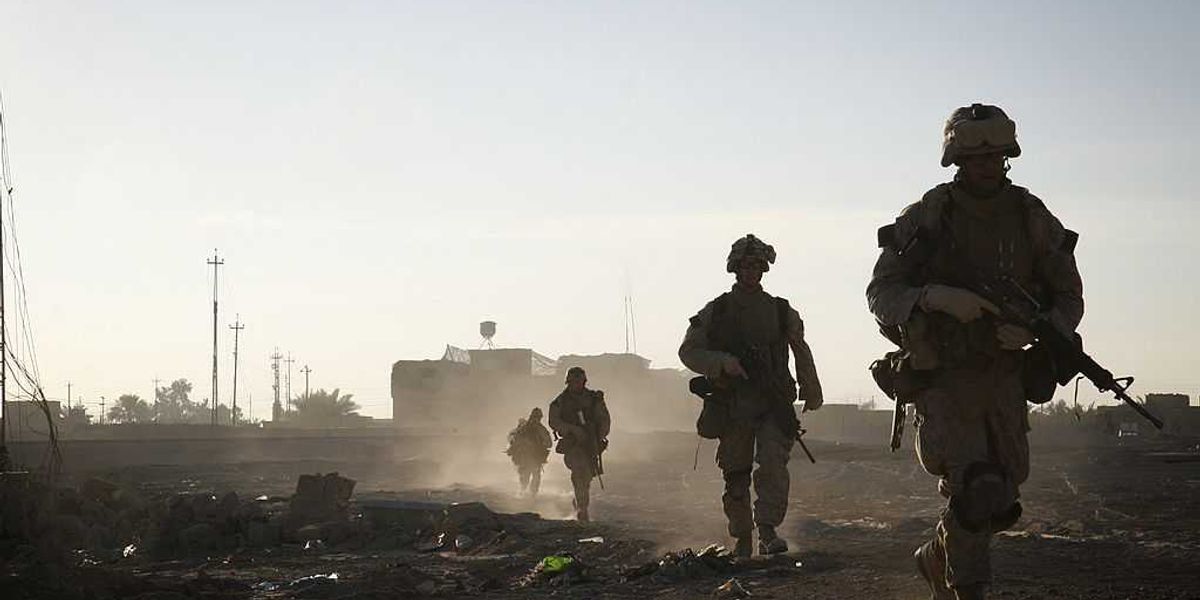
In Ramadi, Iraq, Scott Huesing’s Marines could face the enemy five, six, even seven times in a day. A doorway, a rooftop, an ordinary street corner could erupt into a firefight that lasted for hours. Twenty years later, Americans can argue about the Iraq War from a comfortable distance. The men who fought in Ramadi never had that luxury.I’ve never served in the military, although members of my family serve today. I’ve never carried a rifle into combat or decided how to get a platoon through a street under fire. Verbal bullets don’t count. So when retired Marine Maj. Scott Huesing joined me on my “Dangerous Laughter” podcast to discuss the 20th anniversary of Ramadi, I wanted to hear what he had to say.A war becomes a debate between politicians and pundits; the people who endured it become names in a casualty report, if they are remembered at all.Huesing spent 24 years in the Marine Corps and completed 10 overseas deployments. In 2006 and 2007, he commanded Echo Company, 2nd Battalion, 4th Marines, in one of the Iraq War’s most punishing urban battles. Roughly 250 Marines fought through a city of more than 300,000 people, with insurgents hiding among civilians, threatening residents who helped Americans, and turning homes into fighting positions. Imagine Georgetown in Washington, D.C., except every intersection might conceal an ambush and every occupied house poses a question that could get someone killed. Huesing’s Marines fought their way through neighborhoods, sometimes room by room, while trying to protect civilians caught between the two sides. That was the assignment. They had to do it again the next morning.Back home, the 2006 midterms were approaching. Washington debated the war, its cost, and the political fortunes of the Bush administration. In Ramadi, the questions were simpler and more frightening. Who is behind that wall? Is the building occupied? Who covers the next street? How do I bring my Marines back alive?I asked Huesing what courage feels like in the middle of a firefight. We talk about bravery as though it were the absence of fear. That sounds like a definition invented by someone who has never been shot at. Huesing described men concentrating on the mission and the Marine beside them. Training and trust carried them from one decision to the next. Nobody had time to admire his own courage.The hardest part of our conversation had nothing to do with tactics. Eight Echo Company Marines died during the deployment. One was Cpl. Dustin Libby, killed in December 2006. Huesing has written about calling Libby’s family from Iraq. After a firefight ends, somebody has to speak to a mother, father, wife, or brother whose life has just changed forever. Those conversations do not end when the deployment ends.RELATED: The GOP lost young men. American Ascent wants to win them back. DesignRage/iStock/Getty ImagesHuesing wrote about that burden in “Echo in Ramadi: The Firsthand Story of the U.S. Marines in Iraq’s Deadliest City.” The book is full of combat, but its real subjects are the Marines: the men who fought, the men who died, the friendships that sustained them, and the families who waited through every day of the deployment. His dedication honors Echo Company and the people who loved them. You understand why.Not every story from Ramadi ends in loss. Huesing told me about Samawi “Big Sam” Al Helli, an Iraqi interpreter who worked alongside American forces despite threats from al-Qaeda. Sam came to the United States, became a citizen, and in 2021 was commissioned as a lieutenant in the Navy Reserve. He risked his life helping American Marines. Then he put on an American uniform himself.Huesing continues helping veterans tell their stories through Solid Copy Media. He knows how quickly the men who fought a war can disappear beneath the arguments made about it. A war becomes a debate between politicians and pundits; the people who endured it become names in a casualty report, if they are remembered at all.RELATED: America’s war on sense is a war on beauty Erik McGregor/LightRocket via Getty ImagesWe also talked about a harder question: What did winning in Iraq and Afghanistan actually mean? Marines could take a street, break an insurgent position, protect their comrades, and accomplish the mission assigned to them. Washington’s larger objectives were harder to define. That question should not be buried beneath a patriotic tribute. It deserves an answer from the people who sent those men to war.Asking whether our leaders knew what they hoped to achieve does not slight the Americans ordered to achieve it. It honors them enough to take their service seriously. We can recognize the courage of the men in Ramadi and still demand an accounting of the decisions that put them there.I cannot tell you what it felt like to fight through that city. I can listen to someone who did. And I can ask other Americans to do the same. Twenty years ago, young Marines walked into streets where danger waited behind doors and windows, while their families waited for news from half a world away.The men who died cannot tell their stories. The men who came home can. We owe them more than a passing thank-you. We owe them our attention.
The Marines of Ramadi deserve more than a thank-you
Full Article
Original Source
Read the full article at Theblaze →KhanList aggregates and links to publicly available news content. We do not host full articles from third-party sources. Always verify important information with original sources.