
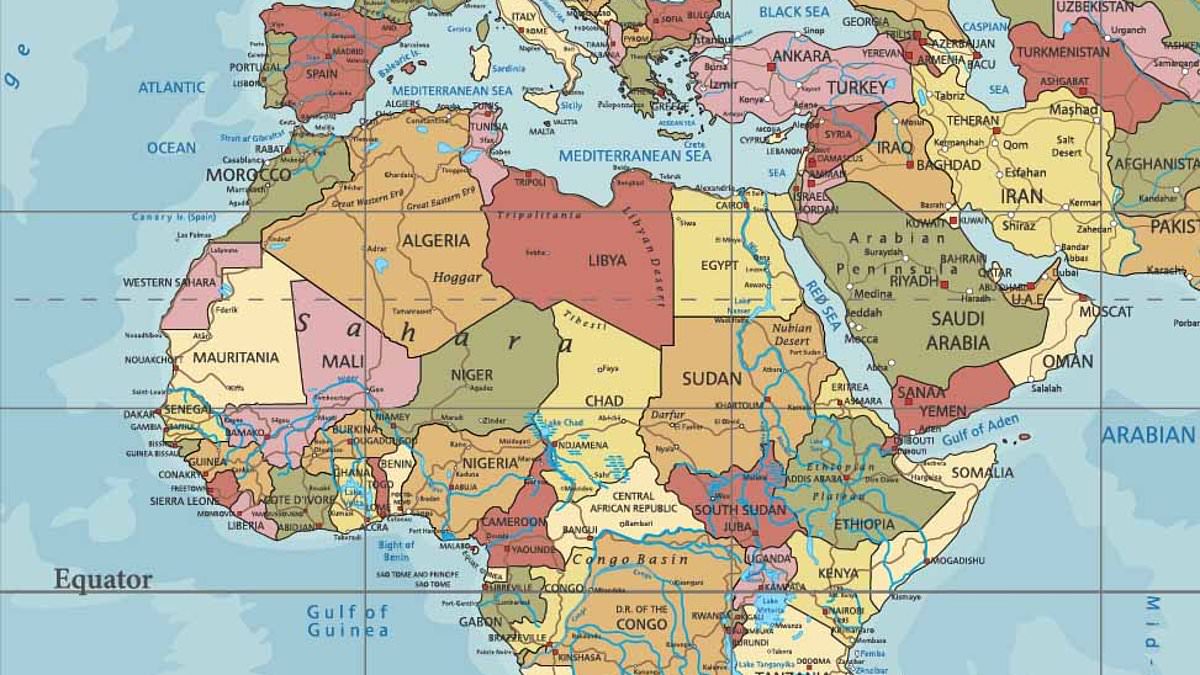
The familiar map of the world could be dramatically redrawn under a UN resolution calling for countries to adopt designs that more accurately reflect their true size.The UN General Assembly is due to vote on Friday on a proposal to move away from the traditional Mercator projection, which makes Africa and other equatorial regions appear smaller while exaggerating the size of northern landmasses. The draft resolution calls on governments, schools, international organisations and technology companies to adopt the Equal Earth projection and other equal-area maps when the true scale of continents matters.It aims to establish more proportionally accurate maps as a new global norm, but does not seek to ban the Mercator projection outright.The Mercator map, which is used around the world, becomes increasingly distorted the further a region lies from the equator.Africa, which sits across the equator, therefore appears comparatively smaller than it really is, while Europe, North America, Greenland and Russia are shown as substantially larger.One of the most striking examples is Greenland, which can appear roughly similar in size to Africa on a Mercator map despite Africa actually being 14 times larger than the Danish territory.Latin America, India and other equatorial regions are similarly shown as much smaller relative to northern countries than their true land area. The UN General Assembly is due to vote on Friday on a proposal to move away from the traditional Mercator projection (pictured), which makes Africa and other equatorial regions appear smaller while exaggerating the size of northern landmasses The draft resolution calls on governments, schools, international organisations and technology companies to adopt the Equal Earth projection and other equal-area maps when the true scale of continents mattersThe resolution was brought forward by Togo with the backing of the African Union, according to the country's foreign minister Robert Dussey, who said the issue went beyond geography.'A map is never neutral,' Mr Dussey told the African Group at the UN this week.'It shapes perceptions, influences how the place of peoples and continents in the world is understood, and may, sometimes from the earliest years of schooling, perpetuate representations that do not correspond to geographic reality.'He added: 'Africa is not asking for preferential treatment. Africa is asking that its reality, aspirations and contribution to the international system be duly taken into account.' Mr Dussey urged African delegations to broaden support for the resolution ahead of Friday's vote, describing it as a test of the continent's ability to act with one voice at the UN.Togo also hosted a reception for all UN member states on the eve of the vote as part of its push to secure support. Asked whether he expected opposition, Mr Dussey said he hoped to achieve as broad a consensus as possible. A petition for #CorrectTheMap campaign has gathered around 11,000 signatures ahead of the vote. The African Union endorsed the campaign in August 2025 and asked Togo to lead efforts for its adoption at the UN.Historians and geographers have long criticised the Mercator projection, with some campaigners using the term 'cartographic colonialism' to describe its perceived effects.German historian Arno Peters became one of its most prominent critics when he launched an alternative based on the Gall-Peters projection in 1973. The latest campaign instead backs the Equal Earth map, developed by an international team of cartographers in 2018, which supporters say provides a more accurate representation of the relative size of continents.Mr Dussey linked the campaign to another African Union-backed resolution passed by the UN in March, which described the transatlantic slave trade as the 'gravest crime against humanity'. It was approved by 123 states, with three voting against and 52 abstaining.If the map resolution passes, Togo's government plans to hold an event in Lomé with Unesco, the African Union and technology companies including Google Maps in the first quarter of next year to discuss how the change could be implemented.
The map of the world as you know it will completely change to show countries' true sizes under UN resolution - with Africa much larger
Full Article
Original Source
Read the full article at Dailymail →KhanList aggregates and links to publicly available news content. We do not host full articles from third-party sources. Always verify important information with original sources.