
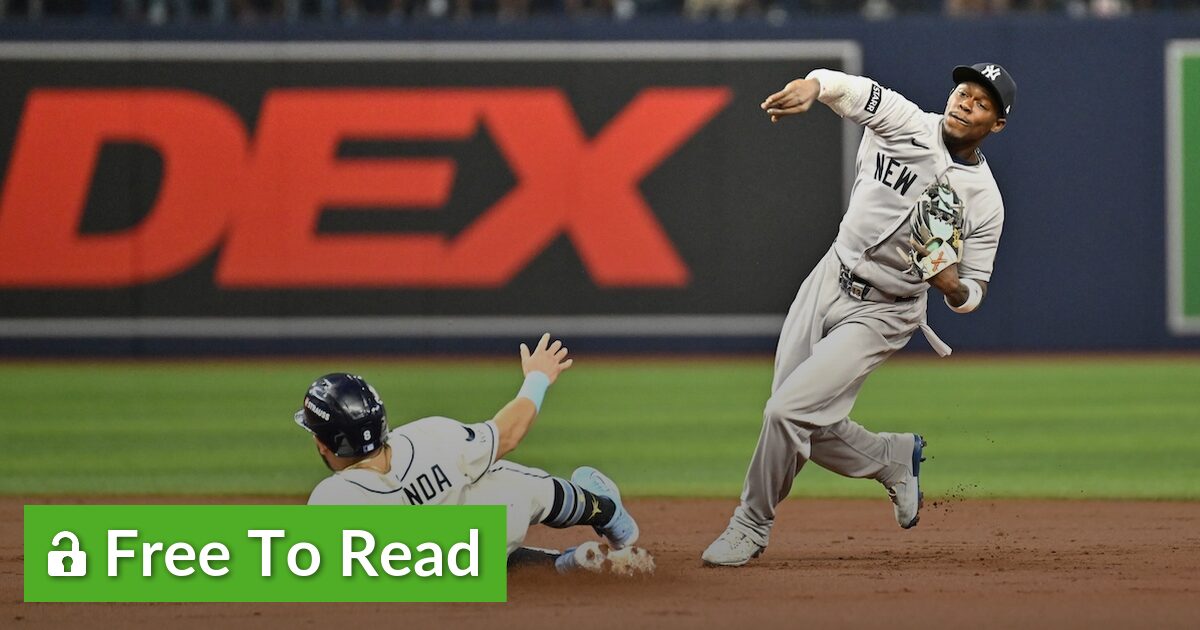
Jonathan Dyer-Imagn Images Do you ever stop and think about how baseball would be different if the ball smelled delicious? Imagine that Major League Baseball, in its never-ending quest to abase itself for sponsorship dollars, forges an innovative partnership with Willy Wonka. In exchange for the title of Official Chocolate of Major League Baseball and the right to outfit the umpires in his trademark violet velvet coats, the eccentric chocolatier uses his quasi-supernatural confectionary gifts to impart one of several dozen mouthwatering aromas to each and every baseball used in a game. This baseball smells like warm chocolate chip cookies, the next one like toasted marshmallows, and the one after that like snozzberries. You get the idea. Now imagine you’re pitching in the World Series. The umpire reaches into the pouch that dangles from their belt (but awkwardly, because they first have to flap the side of their knee-length velvet coat out of the way), grabs a new pill, and fires it out to you. Millions of eyes are on you. The game is on the line. The season is on the line. You’d still raise the ball up to your face for a whiff before you got settled on the mound, right? You’d have to. Would you really be able to go without smelling the ball? You know it smells amazing, but you don’t know how. If you didn’t sniff the ball, wouldn’t the curiosity about its scent be so distracting as to have a deleterious effect on your ability to pitch? Could you really say you’re putting your all into each pitch if you’re not acquainting yourself as fully as possible with the one and only tool of your trade? I imagine that sniffing the ball would be something of a flex for infielders. Those who gloved a grounder with time to spare would earn the right to take a healthy waft before firing it over to first. I further conjecture that throwing the ball around the horn after a strikeout would take longer because the outfielders would insist on being included too. More importantly, I imagine that the error rate might tick down just the slightest bit. I’m not saying that major league fielders lack motivation to hold onto the ball as things stand right now, but I hardly think it would hurt to supply them with an additional reason to give it their all. Letting a ball go right through your legs feels terrible, but it probably feels just a little bit worse when you know that along with hurting your team, you’ve fumbled away a transportive sensorial experience. Maybe that would push you to take that extra round of infield practice, to lock in on every single pitch, to lay out for that ball. Anyway, that’s what I was thinking about in the shower this morning as I reflected on the fact that last night, in the biggest game of the season, the New York Yankees played as if the ball smelled like a butt. The Yankees were credited with five errors in Game 2 of the ALDS, and Michael Baumann has already laid out just how those mistakes affected the outcome. With that important work taken care of, I’d like to take you on a guided tour around the Tropicana Field turf, making sure to highlight both the big ticket items and some of the smaller muffs, misses, and miscues that might have gotten overshadowed. We’ll make it a countdown, based on defensive position. 9. Spencer Jones Right fielder Spencer Jones didn’t make any errors, but according to at least one source, his defense cost the Yankees in a fairly big way. The Rays did the majority of their damage in the fifth inning, putting up four runs and chasing Cam Schlittler from the ballgame after just 4 1/3 innings. It all started with a single from Jonathan Aranda. Now Aranda clearly put some topspin on that ball, which likely caused it to sink a little sooner than Jones may have expected. As a result, he got caught in between. He pulled up and tried to smother the ball like he was being attacked by a furious, leaping garden gnome. According to The Athletic’s Chris Kirschner, Jones’ jump graded out at 13.4 feet below average. Again, this was a legitimately tricky ball, and after the game, manager Aaron Boone defended Jones, saying it wasn’t catchable. But Jones said after the game that he hesitated and should have had it, and the jump data agrees. 8. Trent Grisham You could make a strong argument that center fielder Trent Grisham was the only Yankees defender who didn’t make a single defensive miscue. But he did suffer from his own bad bounce, and that bounce cost the Yankees. Later in the fifth inning, Richie Palacios laced a two-run single into center, and Grisham did everything perfectly. He charged the ball, got a good hop, and made a quick, strong throw that was no more than two feet offline. Right, I forgot to mention that Grisham’s throw – which, again, was otherwise really good – hit the mound and bounced off at an oblique angle. To be clear, making sure that the ball doesn’t hit the mound is very much Grisham’s responsibility, but that doesn’t mean there’s no luck involved. I would argue that had it cleared the mound, Grisham had a really good shot at catching Jonny DeLuca at the plate. Take a look at where DeLuca is at the moment the ball hits the mound. Let’s say he’s 35 to 40 feet from home plate. The ball is 60 feet away, and it’s traveling a whole lot faster than DeLuca. The video shows Chandler Simpson telling him to get down because the play is going to be close. When the ball doinks off the mound, it loses a ton of its velocity and it pops way up into the air. Even so, look where DeLuca is when Austin Wells catches it at the approximate depth of home plate. DeLuca is just crossing the plate. Even though the ball took a deflection that slowed it down in a big way, it arrived at the plate at roughly the same moment as DeLuca. This wasn’t the most important play of the game. DeLuca’s was the fifth run in a game where the Yankees only scored two, but it sure looks like it could have ended up as an outfield assist for Grisham. 7. Cody Bellinger Now here’s a play that really has to be chalked up to a bad bounce. DeLuca led off the bottom of the second by golfing a Schlittler curveball from his shoe tops to the left field wall. Cody Bellinger closed on the ball and pulled up right on the edge of the warning track so he’d have room to react to the carom. But the carom had other ideas: The wall has three sections. There’s the main padded section that deadens the bounce somewhat. There’s the mesh above the main section that deadens the ball even more. Then there’s the hard yellow railing at the top. This ball hit the railing flush and bounced right past Bellinger. It’s a fluke. None of this was consequential. Bellinger wasn’t going to catch the speedy DeLuca at second even with a perfect hop. Once the ball made its great escape and DeLuca considered heading to third, the odds that Bellinger would successfully throw behind him for an out were negligible. But all the same, Bellinger made sure of that by unleashing a ball with a launch angle of approximately -8 degrees toward second base. Maybe, after witnessing the disaster of the first inning, this was Bellinger’s way of making sure that at least one ball wouldn’t get thrown away. 6. George Lombard Jr. Welcome to the middle infield. We’re going to be here a while. For awhile, it looked like George Lombard Jr. was the one holding things together for the Yankees. Then the fifth inning happened. With one out, a runner on third, and Chandler Simpson at the plate, the Yankees brought the infield in. Simpson hit a slow bouncer to short, and the rushing Lombard whiffed on it. This play was originally scored an infield hit, then later changed to an error, and then ultimately ruled a fielder’s choice with no error. Personally, I think infield hit was the right call. Not only was this ball hit very slowly, but it forced Lombard way over to his right. Even if he had gloved it cleanly and fired, I’m not sure he had a play at either home or first. Here’s the moment that he raised his hand to throw, before realizing that it was empty. You can see catcher Austin Wells pointing to first base. He doesn’t think Lombard has a chance at catching the runner at home. Simpson isn’t quite halfway down the baseline yet, but I would remind you that he’s Chandler Simpson. He’s one of the fastest players in the game and the foremost purveyor of the infield hit. Lombard is charging hard both in and to his right. Do we really think he can get enough on this ball, on the run, in the wrong direction, to beat Simpson? Unfortunately, that wasn’t the last slow bouncer Lombard saw in the bottom of the fifth. Two batters later, DeLuca bounced his own three-hopper to Lombard’s right. As the broadcast crew discussed whether or not the first ball was actually an error, Lombard fielded the ball and made a wide throw to Luis García Jr. at first base. Now, I would argue that García is probably more to blame than Lombard here, and I will make that argument when we get down to no. 3, but the error went to Lombard, and you can see why. This was a bang-bang play, and he definitely had to hurry. DeLuca has speed and this was a slow chopper. But this hurts a lot. If Lombard makes the first play, Schlittler probably remains in the game. If he makes either play, the Yankees escape with the deficit at 3-1 rather than 5-1. To be fair, Lombard made some really nice plays. However, for both him and the Yankees, you’re going to see those nice plays soon, because they still ended up going badly for reasons outside his control. 5. Ryan McMahon This has been a tough year for Ryan McMahon. He’s struggled at the plate, and his defense graded out uncharacteristically poorly. He’s just 1-for-7 so far in the playoffs. On Monday night, Yandy Díaz started things off for the Rays by doing what he does best. He slammed Schlittler’s second pitch of the game straight into the turf, sending an easy bouncer to third base. Only something about the bouncer turned out not to be easy. The broadcast booth made a point of noting that this ball had a lot of topspin and that seems to be the case. A ball with a lot of topspin will take off on you unexpectedly, shooting off the ground lower and faster than you expect. At the very last second, McMahon suddenly dropped his glove to get the low hop, but then overshot the mark and the ball actually bounced over his glove. It’s exactly the kind of play that can happen when you’re playing on turf for the first time since mid-August. Asked whether the turf made things tough, Lombard answered, “I wouldn’t say tough. It’s definitely different, but we went out there and practiced and tried to get accustomed to it. It’s different than dirt fields, but that’s the same thing with every other stadium. Every one’s going to play different. That’s part of the game, so you’ve got to make those adjustments.” Backing up on the play, Lombard dropped the ball too, just for fun. 4. Jazz Chisholm Jr. Welcome back to the middle infield. I’m so sorry. After McMahon’s error, and after Aranda ripped a single into left field that would have been an easy double play ball had the Yankees not positioned McMahon on the infield grass (presumably to defend a bunt even though Aranda hadn’t laid down a bunt all season), the ball found Lombard again. Junior Caminero sent another bouncer back up the middle. Lombard gloved it behind second base and flipped it to Jazz Chisholm Jr. at second base. The angle forced Chisholm to catch the ball facing center field. It was a great play to give the Yankees a fielder’s choice. Chisholm wanted more. The second baseman attempted to complete the double play anyway, instead throwing the ball away and allowing the first run of the game to score. You can argue that García should’ve had this ball, but it was preposterous for Chisholm to think he had any chance at catching Caminero, who beat the throw by several steps, and only slightly less preposterous to think he had any chance of firing an accurate throw on what was essentially a turnaround jumper. “Honestly, I’d probably still throw it,” Chisholm told reporters after the game. “I just feel like I could have probably tried to make an even better throw… My back was turned.” I fully agree that making an even better throw is a dynamite idea. Making a better throw is rarely a bad call, but “my back was turned” is, on its own, a pretty strong argument for putting the ball in your pocket. Two batters later, Simpson bounced a ball to Chisholm. With someone other than Simpson running, it was a likely double play ball. Even the best turnaround throw wasn’t going to catch Simpson, so Chisholm just needed to make a decent toss to Lombard at second. Perhaps convinced that another impossible double play was possible, he made a rushed throw that required another nice play from Lombard. Chisholm had two more plays that deserve mention. In the fifth inning, with runners on second and third and no outs, the Yankees had three-quarters of their infield in. The left-handed hitting Liam Hicks was up, and everybody but Chisholm was playing up on the infield grass. Naturally, Hicks hit a slow bouncer to Chisholm, and because he was playing back, he had no choice but to take the easy out at first. The Rays took the lead and never gave it back. Chisholm said after the game that he was told to play back, and while that’s an unusual alignment, it’s not hard to understand what the team was thinking. Presumably, a lefty would be hitting the ball a bit harder when they pull it, so playing the second baseman deeper would give them more reaction time while still leaving enough time to make a play at the plate if the ball was hit hard enough. But this was a night of slow bounces for the Yankees. The last play again featured Chisholm executing a strategy that just didn’t work out. Later in the fifth, Victor Mesa Jr. stole second and Wells unleashed a perfect throw. In fact, the perfection of the throw was its downfall. Chisholm followed a trend that has swept through the game surprisingly recently, allowing the ball to travel as deep as possible in order to make a quicker tag. But Wells’ throw was pinpointed just six inches away from the bag toward first base, and it arrived at the exact same moment as Mesa’s foot, which kicked Chisholm’s glove away and allowed the ball to trickle past the bag. Had Chisholm met the ball just a few inches farther in front, he may have had Mesa. 3. Luis Garcìa Jr. García was not credited with any errors in this game, but he was without question the worst defender on the field for the Yankees on Monday night, and he failed to make two catches that could have changed the complexion of the game. The first came on Chisholm’s ill-advised attempt to turn a double play on Caminero. It was a bad throw, but it wasn’t all that far offline. The ball was well within the cutout of the turf, and I’d remind you that Chisholm didn’t get much on the throw, due to starting out facing the complete other direction. I’d also remind you that García got moved to first base this season because he was a truly dreadful defender at second base. He tried to stay on the bag and stretch for this ball, which left him in no position to field the wide throw. A better, more experienced first baseman would have seen that Caminero was going to be safe by a mile and would have come off the bag ready to catch anything. In the fifth inning, Lombard earned an error for a wide throw on a bouncer from DeLuca. This was a legitimately tough play for García. Lombard put a lot of mustard on the throw from short range, then missed wide. But the ball also hit García squarely in the glove and rattled out. This is one area where Statcast’s new first base receiving metrics would be really useful if they were available, as they assign a catch probability for each throw. For this one, you have to imagine that the blame would be split something like down the middle: 50% goes to Lombard for the imperfect throw, and 50% to García for failing to corral it. 2. Austin Wells Let’s give some credit where credit is due. Wells stole six strikes in Game 2, tied for his third-highest total all year long. He also made this nifty stop and a full arm fake to deke a runner when Brent Headrick missed the plate badly in the fifth inning. That may not show up the scorebook, but it’s fun. However, Wells was credited with the third error of the first inning. Reaching out for what was originally called strike three on Hicks, Wells got his glove in the way of the bat for catcher’s interference. It’s got to be rough when you’re a catcher. The demands of modern framing force you to catch the ball as far out in front as possible, which sometimes means that you get hit in the hand by a baseball bat. And when that happens, you get punished. For getting hit with a baseball bat. 1. Cam Schilttler You’d be hard-pressed to argue that any of this was Schlittler’s fault. The presumptive AL Cy Young winner was credited with four runs, two earned, over his 4 1/3 innings pitched, and as you’ve seen, even those two earned runs might not have happened if a bunch of little things hadn’t gone sideways. But even Schlittler threw a ball away. With DeLuca on third in the bottom of the second, Schlittler threw a very wild pitch that but for the grace of God would have caught Díaz full in the face. If not for the fact that the ball really, really looked like it hit Díaz in the face, DeLuca almost certainly would’ve broken for home and scored, meaning this would’ve gone down as a wild pitch and Schlittler would’ve earned his own little slice of ignominy on this most ignominious of occasions. And that’s it. We’re all out of miscues and misplays. It only took a quick 3,300 words or so to get through them all. I realize that I’m going through every single play and asking what would happen if the Yankees had handled them all perfectly. Maybe that’s too much to ask in a game where the Rays put the ball in play 31 times and stole some bases. But it’s almost certainly what the Yankees expect of themselves, and maybe they could have made it happen if only the ball had smelled better.
The Many Slow Bounces That Baffled the Yankees
Full Article
Original Source
Read the full article at Blogs →KhanList aggregates and links to publicly available news content. We do not host full articles from third-party sources. Always verify important information with original sources.