
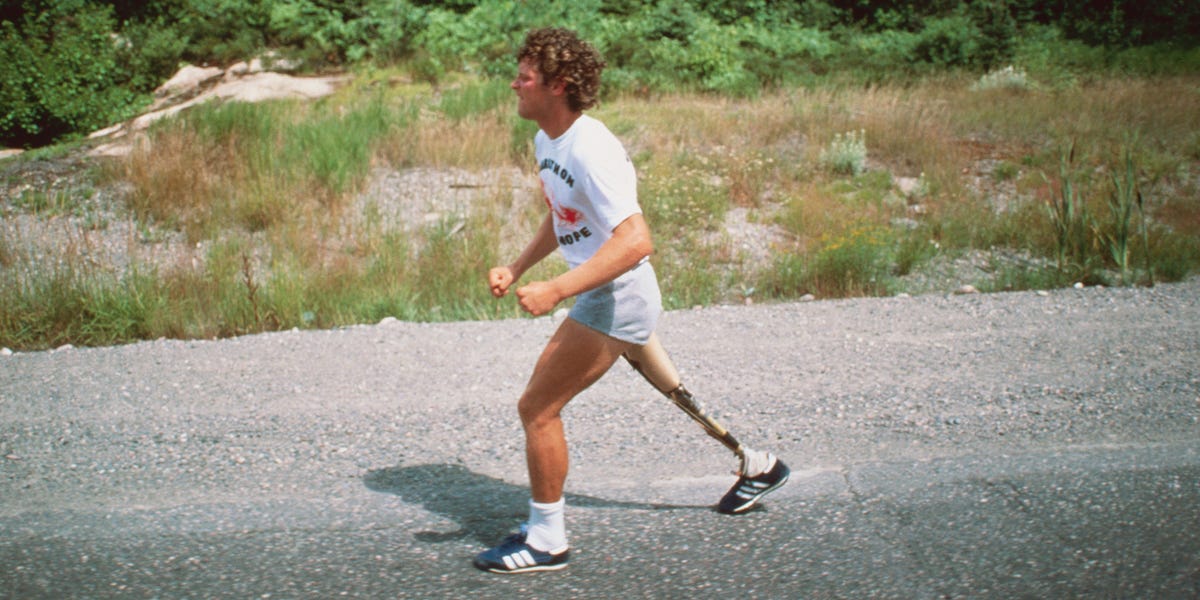
On April 12, 1980, Terry Fox waded into the Atlantic Ocean off St. John's, Newfoundland, and dipped his prosthetic leg into the water. The Canadian college student was 21 years old and three years removed from the cancer diagnosis that had left him an amputee. As the tide settled behind him, Fox stood ready to run west until he reached the Pacific, waiting for him more than 5,000 miles away.The idea to run the entire length of the country took shape in a hospital room as a way to make sense of what was happening to him. The night before his operation, Fox’s high school basketball coach brought him a magazine article about a man who had completed the New York City Marathon with a prosthetic. The story gave him something to hold onto. His leg came off the next day, six inches above the knee. Sixteen months of chemotherapy followed, all of it endured on the strength of a single idea: that whatever came next was still worth reaching for.Fox’s goal took on a different meaning once he noticed the other patients around him. Many of them were children, given odds far worse than his own had been. The experience left him with a sense of duty toward the ones who wouldn't survive.“I could not leave knowing these faces and feelings would still exist even though I would be set free from mine,” Fox wrote in a letter requesting sponsorship for his run. “Somewhere, the hurting must stop … and I was determined to take myself to the limit for this cause.”Bettmann//Getty ImagesThe Marathon of Hope began with little fanfare as Fox set out that morning for Victoria, British Columbia. On his first day, after dipping his leg in the Atlantic, he filled two large bottles with ocean water, intending to keep one as a souvenir and pour the other into the Pacific upon his arrival. From there, he started a routine of roughly 26 miles a day through Canada’s provinces with his friend Doug Alward driving the support van and cooking meals. (Fox and Alward’s relationship strained from the long days spent together, and they eventually invited Fox’s brother Darrell to join them.)It’s worth noting how little Fox’s prosthetic had in common with the equipment amputee runners rely on today. Instead of the flexible, shock-absorbing technology built into modern blades, his old-fashioned steel and fiberglass contraption created a hobbled, herky-jerky gait where he would step with his left foot, then hop again on the same leg while he waited for the prosthetic right leg to swing forward, almost as if he was skipping.Photographs from the run show the toll plainly—dark stains on his shorts where blood had worked through from the friction against his stump—a cost he absorbed daily as he strived to raise as much awareness as his body would allow.“There can be no reason for me to stop,” Fox said at the time. “No matter what pain I suffer, it is nothing compared to the pain of those who have cancer, of those who endure treatment.”Attention built slowly as news of his runs spread ahead of him, and by the time he reached Ontario, thousands were lining the roads to watch him pass. When he’d started, Fox had set a lofty fundraising goal of $24 million, or $1 for every Canadian citizen. What had once sounded like wishful thinking started to look like something he might actually reach. Strangers pressed $100 bills into his hand as he ran by, while a musician with no cash on him handed over his own guitar, saying it was worth $500. Meanwhile, in Gravenhurst, a town of 8,000, residents raised more than $14,000. One man in Hamilton sat in a vat of banana lemon custard and raised $912. On a single day in Ontario, roadside donations totaled $20,000. Isadore Sharp, the president of Four Seasons, pledged $10,000 and challenged 999 other Canadian corporations to match it.Fox’s ambitions, once his alone, were now the country’s as well.Bettmann//Getty Images“People thought I was going through hell,” Fox said. “Maybe I was partly, but still I was doing what I wanted and a dream was coming true and that, above everything else, made it all worthwhile to me.”Throughout his journey, Fox let his own medical appointments slide, convinced the cancer wouldn’t come back. The certainty held until September 1st, when, 143 days and 3,339 miles into the run, Fox began coughing outside Thunder Bay, Ontario, and felt a pain in his chest that didn’t feel like the usual strain.He finished what he could of the day’s miles, then climbed into the van and asked to be taken to a hospital, where doctors found that the cancer had spread to his lungs. Fox cried as he told reporters he wouldn’t be able to finish, before adding: “I’ll fight. I promise I won’t give up.”Fox spent the next 10 months fighting the cancer that had ended his run short. He continued to wear his Marathon of Hope T-shirt in the hospital and refused the many offers to finish in his place. A telethon raised more than $10 million in 48 hours, and he was named the youngest Companion of the Order of Canada, the nation’s top civilian honor, among several other accolades.He died on June 28, 1981, a month short of his 23rd birthday, having raised $24.17 million for cancer research.The annual Terry Fox Run has since become a fall tradition in Canada, drawing more than 650 communities across the country to raise money for cancer research. Earlier this year, the Terry Fox Foundation announced it had surpassed $1 billion in funds raised. A documentary about Fox, titled Run Terry Run, will premiere at TIFF on September 19, one day before the 46th annual Terry Fox Run. It is scheduled for a theatrical release on October 9.“I am not a dreamer, and I am not saying that this will initiate any kind of definitive answer or cure to cancer,” Fox wrote in October 1979, laying out the case for his run before he had taken a single step of it. “But I believe in miracles. I have to.”Bettmann//Getty ImagesJeff Kirshman is a writer, editor, and content strategist based in Chicago. His work has appeared in Runner's World, ESPN, The Classical, and the Casper Star-Tribune.
The Man Who Ran a Marathon a Day for 143 Days—on a Prosthetic Leg
Full Article
Original Source
Read the full article at Runnersworld →KhanList aggregates and links to publicly available news content. We do not host full articles from third-party sources. Always verify important information with original sources.