
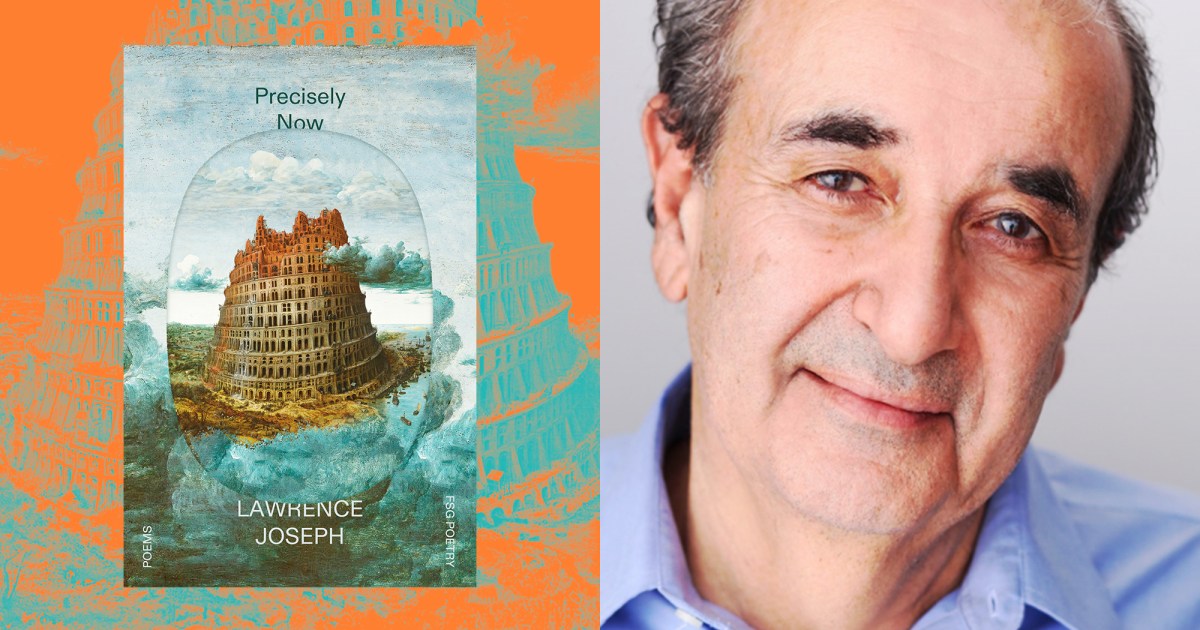
Mother Jones illustration; Portrait by Ted Ely Get your news from a source that’s not owned and controlled by oligarchs. Sign up for the free Mother Jones Daily. It’s been nine years, to the month, since my last conversation with poet and lawyer Lawrence Joseph. Back then, we spoke about his sixth book of poetry So Where Are We? Those poems, published in August 2017—several months into the first administration of President Donald Trump—had been written before Trump was elected and so, rather than reflect on his administration, they reflected the racism, violence, and injustice of the post 9/11 world. He told me then, “The issues the poems address—political economy, labor and capital, racism, war—have since then been exponentially compounded. There is something similar about it and 9/11 for me—the terrible feeling of a collective turn for the worse.” But who could have predicted how very much worse? The magnitude of the violence that Trump’s two terms have inflicted on our country, our democracy, our institutions, and our standing in the world is unprecedented—perhaps worse than even the most jaded among us had imagined. Especially egregious for Joseph—who retired as Tinnelly Professor of Law at St. John’s University School of Law in New York—is Trump’s repeated flauting of the rule of law. Thus inspired, like so many other poets moved to bear witness to a historical moment of extremes, Joseph wrote his newest collection. Joseph is Arab-American, born and raised in Detroit by Lebanese and Syrian Catholic immigrant parents. A prize-winning poet as an undergraduate at the University of Michigan, he attended Cambridge University on a prestigious fellowship before returning to Ann Arbor for law school. The poverty and inequities he witnessed in Detroit became the crucible for his preoccupation with social justice, a passion that informs his approach to law—and poetry. Recent years have been difficult not only for the body politic, but for Joseph’s health—a theme that finds its way into his poems with the same sense of curiosity, erudition, and outrage that infuses his writing about the treatment of immigrants, the landscape of New York, the tyranny and cowardice of corrupt plutocrats, and the receding tide of liberalism and humanity on our shores. I caught up with my old friend prior to the midterms, but we reconvened to talk about those as well. This conversation has been edited for length and clarity. Your book title, Precisely Now, suggests an urgency about the present. What made that particular moment one that warranted your poetry collection? “I want to condense the global, techno-capitalist, political chaos, the lies, corruption, ecocide and genocide…into poems packed with meaning and emotion.” Precisely Now begins where my last book of poems, So Where Are We?, left off—in late 2015, before Trump was elected. Near the beginning is a poem “In This Phase of the 58th American Presidentiad.” A “presidentiad” is the four-year term of a presidency. Walt Whitman uses the word in a poem he wrote in the late 1850s: “To the States, To Identify the 16th, 17th or 18th Presidentiad.” In my poem, I quote from Whitman’s: “What deepening twilight—scum floating / atop of the waters. . . What a filthy / Presidentiad!. . . is that the President?” Whitman was referring directly to the corrupt antebellum presidencies of Millard Fillmore, Franklin Pierce, and James Buchanan, presidents who allowed the expansion of slavery during the turbulent decade leading up to the Civil War. Near the end of my book is a poem, “In This Phase of the 60th American Presidentiad,” set at the beginning of Trump’s second term. Both poems are intended to create a direct analogy between the antebellum crisis of the 1850s and the contemporary American “now” of Trump’s 58th and 60th Presidentiads. Like Whitman, my objective was to find a language that would accommodate the grotesque realities of state power and corruption. That contextualizes your work in the past, but what about the present? The book is dedicated to my wife of 50 years, Nancy Van Goethem, and its epigraph is from Hart Crane’s poem “The Broken Tower,” written in 1932, in the early years of the Great Depression: “And so it was I entered the broken world / To trace the visionary company of love…” At the core of the book is a tracing of the visionary company of love in our present-day broken world, culminating in the final sentence of the book’s final poem, “Now Light”: “Love I compose”—not only love in a personal, intimate sense, but also love as it manifests itself socially, in the acts of those who live their lives morally, resisting injustice and evil in whatever way they can. It is the love that our great American moralists—Martin Luther King, Jr., James Baldwin, and Tony Morrison first come to mind—so deeply attest to. You’ve written powerfully about the often unforgiving experience of growing up Arab-American in Detroit. Now we have senator-elect Abdul El-Sayed. How are you processing that? My grandparents, who emigrated in the 1910s from Lebanon and Syria, were among the first Arab immigrants in Detroit, which became, and still is, the largest Arab-American community in the United States, as Dr. Abdul El-Sayed has reminded the world. My parents were born in Detroit at the end of World War I. I was born there in 1948 shortly after World War II. They lived their entire lives there. Until Nancy and I moved to New York City in 1981, I did too, except for my studies in Ann Arbor and Cambridge. I’ve watched Dr. El-Sayed’s political ascendancy closely for years. He was born and raised in the same Arab-American world I come from. He comes from the social democracy side of the Democratic party in Michigan, which I was politically part of when I lived in Detroit. His politics correspond with mine. How present is your Arab-American inheritance in Precisely Now and its exploration of America’s endemic violence? My Arab-American inheritance is present throughout all my books. The United States has been involved in wars continuously since 1941 and, since 1948, the year I was born, involved in postwar imperialist, colonialist wars in the Middle East, including in Lebanon and Syria. Anti-Arab and anti-Islamic racism permeates the political discourse of the American empire. Violence in America is systemic—in its political and economic structures, in its laws. American-made armaments are genocidally being used in Gaza. Being anti-war and Arab American, I have always opposed this violence. My opposition is and always has been an integral part of my work and my life. Not to be too reductive, but to what extent are these protest poems? Cries of outrage? Despair? Slashing attacks on Trump? Intense moral and political outrage and despair, slashing attacks on Trump and his enablers, yes, these are expressed throughout Precisely Now. But I also wanted to capture the collective feelings of those of us who have resisted and opposed the horrors we’ve experienced, which, of course, we’re still very much absorbed by. You move masterfully within single poems between hurricanes, wildfires, ICE detention camps, and the stock market—how do you decide what belongs in the same breath? It’s a formal decision. Or, more accurately, it’s a result of countless formal, compositional, decisions. I want to take in as much of the world we live in as I can. I want the poems to push back against the pressure of the violence each of us insistently feels. I want to condense the global, techno-capitalist, political chaos, the lies, corruption, ecocide and genocide, so pervasively present in our collective consciousness, into poems packed with meaning and emotion. You use a marvelous amalgam of elegant, sometimes even esoteric, locutions and streetwise slang. And then there are the occasional classical allusions, such as Heraclitus and Lucretius. Stylistically, your poems kind of remind me of jazz. Yes! What jazz musicians do is a great way of describing what I aesthetically try to do—compositionally patch together a flow of quotations and allusions into a seamless, sometimes even dreamlike, mix of sound and language. You allude to God and religion quite a bit. Want to talk about that? Well, God—or how God appears in the book—is a subject. God is in the title poem, “Precisely Now”: “What is, what isn’t, there is and there isn’t / a God in it…” The word God is a single sentence in the title of the poem, “Body. History. Evil. God. Human.” In “In This Phase of the 58th American Presidentiad (United States),” Trump’s first attorney general invokes “not just law/ but God’s law, Paul, Epistle to the Romans 13, / God’s will, the divine order of things demands / government agents treat the poor like inventory…” In “In the Land of Milk and Honey,” “God is / the words in the Book of Job.” “Hell-Time Loose” opens: “A Dante-sense, loose hell-time, / which judgments, properties / of power, which God?” In “These Words Will Be Written One Hundred Years Ago One Hundred Years from Now,” I remember, as a child, my Grandmother taking me to the cemetery where my Grandfather was buried, each of us silent before his grave. “Pray to Grandpa,” / Grandma says, “pray to him, not for him, / Grandpa suffered on earth and now / he’s in heaven, pray to him.” / “Pray for what?” I ask. “For whatever / you want Grandpa to pray / to God for you,” Grandma says.” In “So I Try To Paint the Wind in Words” is “The idea of an / incarnate God, fully human.” In the last poem in the book, “Now Light,” is “Light’s metamorphosis, a God afloat / in azure air.” Are you a believer? Is God shorthand for something else? What is the connective tissue of God within these poems? As I write in the title poem, “What is, what isn’t, there is and there isn’t / a God in it”—it’s not only a subject in Precisely Now, but has been an ongoing subject since the first line of my first book. Am I believer? What you seem to be asking is do I believe in God, which, for me, depends on what you, what anyone, means by God. There’s theology in my work; the God I believe in (or the God I don’t believe in) appears throughout my work. You have write about a health crisis in “September . . . October. . . November” and the harrowing experience of being a patient. Were you imagining this poem at that time? While I was in the hospital, and for quite a while after that, I wasn’t thinking about writing poems, let alone poems about my surgery. The first part of the poem is taken from the clinical, diagnostic, objective language of my hospital’s on-line MyChart, which I compress into couplets of objectified, factual language. The poem then shifts to the subjective, remembered, nightmarish thoughts and feelings I had when I was in the hospital. Then the poem suddenly turns again, ending with two sentences: “Love comes, speaks to me, touches / my face and hair, the tenderness / all through me, keeping me alive. In the body / I am living in I write your love keeps me alive.” The poem wasn’t easy to write, but became easier once it began taking shape and I found the tones of voice I wanted. The quick turn of the poem to “Love comes…” came fast, surprised me. Since I interviewed you in 2017, you’ve stepped down from your law school position. Have you remained professionally engaged? And has your legal experience informed the poems in Precisely Now? Lawyers and law and legal language and rhetoric are in all my books. I retired in 2020. The Covid lockdown occurred during my last semester teaching. My career as a lawyer spanned almost 45 years and included a clerkship with the Michigan Supreme Court, four years of practice as a litigator at a large New York City firm, and, mostly, teaching. I taught a range of subjects over the years, but my love was, and is, labor and employment law, exclusively from the workers’ side. I also was involved in what became a critical field of study revolving around law, language, and literature. I actively keep in touch with lawyer and law professor friends and former students, and keep an eye on what’s happening in the courts and the law business. I recommend every law student and lawyer read Justices Sotomayor’s, Kagan’s, and Jackson’s dissents since 2020. That was when So Where Are We? came out. So let me ask you that question now: Where are we? Precisely now—now, after the midterm elections and before the next Congress is seated—is where we personally and collectively are: in the thick of it all.
The Man Who Can Fit ICE Detention, Hurricanes, and Wall Street Into a Single Stanza
Full Article
Original Source
Read the full article at Motherjones →KhanList aggregates and links to publicly available news content. We do not host full articles from third-party sources. Always verify important information with original sources.