
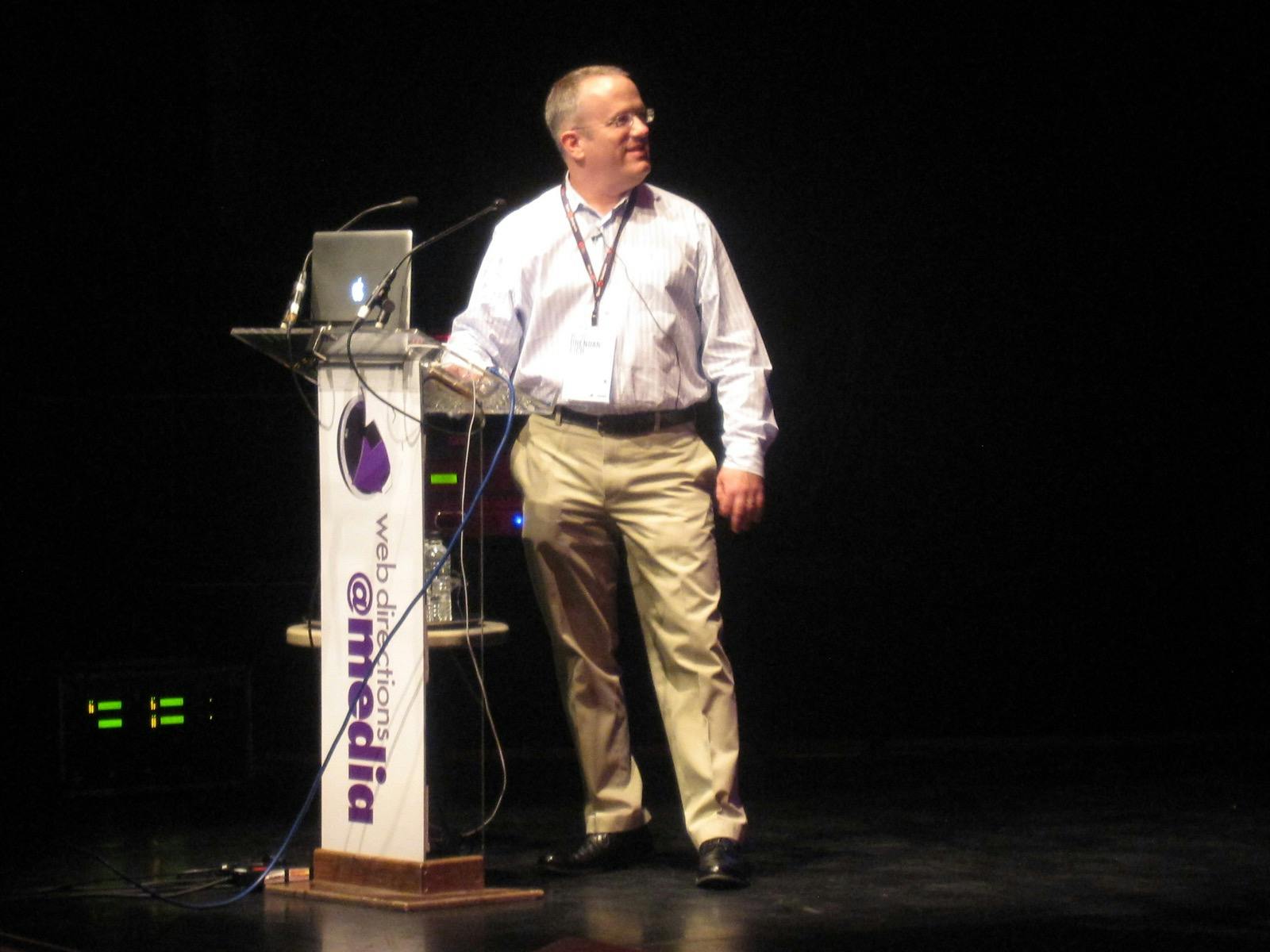
Brendan Eich built the language that runs the world in ten days. Nineteen years later, the internet running on his code needed just eleven to throw him out of Mozilla, the house he built. The industry that purged him over a $1,000 check now asks to be trusted with the future of the species. This is the story of the making, the unmaking, and the return of the web's most stubborn architect, and of a Silicon Valley that has never stopped confusing its power for its virtue. A note on method. The dates, quotes, donations, letters, and resignations in this story are drawn from the public record: Mozilla's own wiki, Eich's blog, contemporaneous reporting, and interviews he gave before, during, and after the eleven days. The interior moments, the things a man thinks while the phone is ringing, are reconstruction by the writer. They are grounded in what he said and did, but they are the writer's, not his. He has never told this story himself. He has said, more than once, that he would rather not. Prologue: The Man Who Isn't There Every time you have ever fallen in love online, he was in the room. Not literally. Brendan Eich is not a man who is ever literally in the room. He is a big, sandy-haired systems programmer with wire-rimmed glasses, the flat affect of a Midwestern weather report, and a habit of answering emotional questions with technical ones. But every scroll, every swipe, every drop-down menu and infinite feed and "someone is typing..." indicator that has ever made you feel something on a screen ran on his code. JavaScript executes on 98.8 percent of the websites on Earth. It runs banks. It runs Netflix. It runs the little heart that fills in red when you like a photo. He wrote the first version of it in ten days in May of 1995, at a desk in a low building on East Middlefield Road in Mountain View, California, on almost no sleep, under orders from a marketing department that told him what it should look like and when it had to be done. Nineteen years later, on the morning of Monday, March 24, 2014, the board of Mozilla, the nonprofit he had co-founded, the cathedral of the open web he had spent fifteen years building brick by brick, named him chief executive officer. Eleven days later he was gone. Not fired. Not demoted. Gone. Out of the CEO chair, out of the building, out of the project that carried his fingerprints on every line, out, out, out. He was not ousted for a bug. Not for a bad quarter or a botched launch. He was ousted because six years earlier he had written a check for $1,000 to a ballot campaign called Proposition 8, which sought to ban same-sex marriage in California, and because when the check surfaced and the whole of the internet he had built turned to look at him and asked him to say he was sorry, he would not say it. That's the story everyone knows. The eleven days. But there is another way to count them. Ten days to build the thing. Eleven days to be unbuilt by it. And in between, a whole life: a Fourth of July baby from Pittsburgh, a physics student who drifted into math, a kernel hacker at Silicon Graphics, a man who thought code was the only thing that counted and who found out, in public, in front of everyone, that it wasn't. Here is that life, compressed into the eleven days that ended it. One day for each chapter, because that is how it must have felt from inside: the whole past rushing up at once to be re-tried. And then, on the twelfth day, something nobody expected. Day One: Monday, March 24, 2014 The Announcement. Pittsburgh, 1961. The press release goes out at 9 a.m. Pacific. Mozilla Appoints Brendan Eich Chief Executive Officer. Brendan Eich, official Mozilla Foundation portrait, 2012. The face on the press release. Eich's official Mozilla Foundation portrait, taken in 2012. Fifteen minutes later, before the coffee is cold, the first tweet lands. He gave money to Prop 8. Mozilla just made a bigot CEO. He sees it. Of course he sees it. He is a man who reads bug reports for fun. He sees everything. What he does not do is respond. Not yet. He has a company to run. He has been running the technical side of it, in effect, since Netscape was still a company. There is a rendering engine to ship, a mobile operating system that is bleeding out, and a search deal with Google that funds the whole enterprise. And there is the tweet, and its siblings, multiplying. By noon there are hundreds. By evening, thousands. He was born on the Fourth of July, 1961, in Pittsburgh, into the Irish-German Catholic working stock of that steel town, a place of rivers and furnaces and men who believed that if you did the job right, the job was its own defense. The family moved, to Maryland and then west. He came of age in Palo Alto in the 1970s, inside the actual crucible of the personal computer, on streets where the garage next door might contain a radio hobbyist, a Homebrew Computer Club member, or a future billionaire. He was not that kind of kid, though. Not the showman. Not the Jobs. He was the kid who took the thing apart to see the mechanism. He graduated from Ellwood P. Cubberley High School in 1979, in the last class the school would ever graduate; the district closed it that year. He went to Santa Clara University, a Jesuit school, and studied physics, then drifted, as the mathematically inclined do, toward mathematics and computer science. He took a master's in computer science at the University of Illinois at Urbana-Champaign in 1985, in the department where, a few years later, an undergraduate named Marc Andreessen would build a thing called Mosaic and change everything. Decades later, the podcaster Lex Fridman would ask him whether he feared death. He said he did not. He was a Catholic. That's the whole man in a sentence. He believes what he believes. He does not think it's your business. He does not think it should cost him anything. By nightfall on Day One, the count of people who disagree has passed ten thousand. Day Two: Tuesday, March 25 The First Boycott. Close to the Metal. A pair of app developers, Hampton Catlin and Michael Lintorn Catlin, a married couple who run a small company called Rarebit, have pulled their apps from the Firefox Marketplace and posted their reasons: "Brendan Eich was an active supporter of denying our right to be married and even to start this business." Hampton Catlin is not a nobody. He wrote Sass and Haml, tools that half the web's designers use every day. This is not a mob. This is the community. His community. Inside the building on Castro Street, the mood goes strange. A few Mozillians take to Twitter to ask their own CEO to step down. Publicly. By name. He reads it in his office. He does the thing he does when he is angry, which is nothing visible at all. He goes back to the code review he was doing. Here is what you have to understand about him, if you want to understand why he would not do the thing they were going to ask him to do. For the first decade of his working life, he lived below the surface of the machine. Seven years at Silicon Graphics, writing operating system and network code. Three years at MicroUnity, writing microkernel and signal-processing code. This is the work of the people who live in the boiler room of the building, who write the code that the code runs on, who know exactly how many nanoseconds a cache miss costs and take it personally. Systems programmers are a priesthood, and the theology is simple. The machine does not care who you are. The machine does not care what you believe. The machine cares whether the pointer is valid. If your code is right, it runs. If it is wrong, it crashes. There is no appeal, no context, no extenuating circumstance. It is the most honest relationship a human being can have with anything. In Peter Seibel's Coders at Work, he talks about it like a tradesman. You have to know the whole stack, from the application down to the metal. The computer is not intelligent; it is a rigid mechanism that requires pristine instruction. When he hires, he does not look for pedigree; he looks for passion and problem-solving. Judge me by the work. That was the creed. That was the whole creed. An SGI Iris Indigo workstation running IRIX. For seven years at Silicon Graphics, Eich wrote the operating-system and network code that machines like this ran on. An SGI Iris Indigo workstation running IRIX. For seven years at Silicon Graphics, Eich wrote the operating-system and network code that machines like this ran on. In the boiler room, it was the only creed there was. It did not occur to him that the building above the boiler room had changed owners. Day Three: Wednesday, March 26 The Blog Post. The Offer. He writes it himself. Of course he does. He writes everything himself. Inclusiveness at Mozilla. He posts it on his personal blog, the same place he has posted release notes and standards-committee war stories for a decade. It is careful. It is, by his standards, almost florid. He expresses "sorrow for causing pain." He commits, in writing, to the things a CEO can commit to: Mozilla's anti-discrimination policies will stand. Its health benefits, including trans-inclusive benefits, will stand. He will reach out to the LGBT community. Read it once and it looks like an apology. Read it twice and you see the hole in the middle of it. He does not say the donation was wrong. He does not say he supports same-sex marriage. He does not say he has changed his mind. He says he will not let his mind affect his conduct, which is what he has been saying, and doing, for fifteen years. The activists read it twice. Netscape had asked him once already, in 1994, when Jim Clark walked out of Silicon Graphics to start a company with a 22-year-old from Illinois named Marc Andreessen. He said no. The mission was insane: the browser would become the operating system. The web would eat Windows. Microsoft would be reduced to, in Andreessen's immortal phrase, "a poorly debugged set of device drivers." To do that, the web had to move. In 1995, it did not. A web page was a brochure. You loaded it, you read it, you clicked a link, you loaded another brochure. Silent. Static. Dead as a catalogue. So in April 1995 Netscape asked again, and this time the pitch was, for a language nerd, pure honey: come to Netscape and put Scheme in the browser. Scheme! The minimalist Lisp dialect of the MIT wizards, the most elegant programming language ever devised, embedded in the thing millions of ordinary people would use. It was like being told you could put a Stradivarius in every Chevrolet. He said yes. He arrived at 501 East Middlefield Road, and within weeks the Stradivarius was gone. A boxed copy of Netscape Navigator at the Computer History Museum. In 1995 the browser was the most important piece of software in the world, and it could not move. A boxed copy of Netscape Navigator at the Computer History Museum. In 1995 the browser was the most important piece of software in the world, and it could not move. Day Four: Thursday, March 27 The Petition. Ten Days in May. A petition organized by CREDO passes fifty thousand signatures. More employees post. The hashtag has a life of its own now. He sees those, too. "Hacking from Mountain View." A sign in Mozilla's Mountain View office, photographed in 2013, the year before the crisis. "Hacking from Mountain View." A sign in Mozilla's Mountain View office, photographed in 2013, the year before the crisis. On May 23, 1995, Sun Microsystems announced Java to the world with the full orchestral swell of a Silicon Valley product launch: write once, run anywhere, the language of the future. Netscape, desperate for an ally against Microsoft, announced the same day that it would license Java for Navigator. Then someone in the building did the arithmetic. Java was a big language, a professional's language: compilers, classes, type declarations. It was not for the twenty-three-year-old designer in Des Moines who wanted the "Submit" button to check that you'd typed your email address correctly. The web needed a glue language. Something small and forgiving that a person who had never heard the word "compiler" could paste into a page and see work. And marketing had a decree. It had to look like Java. It had to be, in Eich's own later phrase, a "silly little brother language" to Java, one that must not get "too big for its britches." And it could not be Scheme. So he was to build, on marketing's orders, a language that dressed like Java and did not act like it, that a designer could use and an engineer would not laugh at, and he was to do it before the Navigator 2.0 beta shipped. Which meant ten days. Ten days in May, 1995. The most storied sprint in the history of software, and the most misunderstood. The legend says he wrote a whole language in ten days. The truth is stranger and better. He wrote the first working prototype, code-named Mocha, in ten days of the sleep-deprived, monomaniacal concentration that only a systems programmer under a deadline can sustain. Ten days in which every decision was permanent, because there would be no time to revisit it, and in which he pulled everything he loved out of his own head and jammed it together into a creature that had never existed before. What He Needed Where He Got It What It Became Something that looked like Java Java, by decree C-style syntax, curly braces, familiar keywords. The costume. Functions you could pass around like values Scheme, his lost love First-class functions and closures. The soul. Objects without the ceremony of classes Self, the research language from Sun Prototype-based inheritance. The skeleton. A way for amateurs to hook actions to clicks HyperTalk, Bill Atkinson's HyperCard language Event handlers like onclick. The hands. A Frankenstein. Forgiving, flexible, dynamic to the point of anarchy, full of quirks that would make purists weep for thirty years, like the type coercion that turns "1" + 1 into "11". All of it locked in during ten days in which one man did the work of a research lab, alone, on a deadline set by people who could not have named a single feature of Scheme. It shipped. In September 1995 it was renamed LiveScript. On December 4, 1995, Netscape and Sun put out a joint press release renaming it, for reasons of pure marketing opportunism, JavaScript. He hated the name. He hates it still. He has called it a "big fat marketing scam." It was the name of a corporate alliance stamped onto the skull of a living thing. And the thing lived anyway. Netscape Navigator 2, the release that carried the first version of JavaScript into the world. Netscape Navigator 2, the release that carried the first version of JavaScript into the world. Day Five: Friday, March 28 The Board Story Breaks. The Bugs. The Wall Street Journal has it by afternoon: three of Mozilla's six board members, Gary Kovacs, John Lilly, and Ellen Siminoff, have left. Half the board. Mozilla says it isn't what it looks like. Two of the three had been planning to leave for some time, one since January and one at the end of the CEO search regardless of who was chosen; the three had argued for an outside CEO with commercial experience, and lost. Some of that is even true. It does not matter. HALF OF MOZILLA BOARD QUITS OVER ANTI-GAY CEO. The nuance dies in the subhead. The story has jumped the fence. It's in the New York Times, it's on CNN. Reporters who a week ago could not have told you what a browser engine was are explaining to their readers that the inventor of JavaScript is a bigot. He has interviews scheduled for next week. He will do them. But tonight he goes home, and if he does what he always does when the world is on fire, he opens an editor and fixes something. Because that is what he did in 1995 and 1996, in the long hangover after the ten days. A prototype is a promise, and the debt comes due. Every shortcut taken in May had to be paid for in June, July, August, in bug after bug. Netscape management, having gotten its silly little brother language, promptly under-invested in it; the real money was in Java, wasn't it? So he maintained the engine essentially alone. In the fall of 1996, when the Mocha codebase became unsustainable, he simply did not come to the office for two weeks and rewrote the whole thing at home, into the engine that would be called SpiderMonkey, the engine that powers Firefox to this day. He has called it a strike against his own company's neglect. Meanwhile, out in the world, the Frankenstein was spreading. It spread because it was in Navigator, and Navigator was on everyone's desk. It spread because it forgave you. You could write terrible JavaScript, and you did, and it ran anyway. Scrolling marquee text. Mortgage calculators. Rollover buttons. It was the first time the web had ever reacted to a human being, and human beings could not get enough. Microsoft noticed. It reverse-engineered the language, bugs and all, and shipped a clone called JScript in Internet Explorer 3. The universal language of the web was about to fork into two proprietary dialects. So Netscape did the thing that would define the rest of his career: it gave the language away. Handed it to Ecma International, the standards body, to be turned into an open specification anyone could implement. And Eich went into the standards meetings to represent Netscape. Microsoft sent, at first, what he calls its "B-team." When the B-team failed to bend the standard toward Redmond, Microsoft sent its "A-team." He sat across the table from the most powerful software company on Earth and refused to let them own his child. In June 1997, ECMA-262, first edition, was published. JavaScript was nobody's property. It was everyone's. That was the fight he was built for, and he won it. What he did not understand, in that Friday-night silence in March 2014, was that this new fight had no standard to appeal to. There was no spec. There was only the question, and the question was: Do you believe we are equal? And his answer was: That's not what we're here to discuss. The unofficial JavaScript logo. The unofficial JavaScript logo. Eich never liked the name. Standardized as ECMA-262 in 1997, the language belonged to no one, which meant it belonged to everyone. Day Six: Saturday, March 29 The Chairwoman Speaks. The Cathedral. Mitchell Baker, Mozilla's executive chairwoman, in 2011. She and Eich had built Mozilla together since 1998. Mitchell Baker, Mozilla's executive chairwoman, in 2011. She and Eich had built Mozilla together since 1998. Mitchell Baker puts out a statement. Mozilla supports marriage equality. Mozilla is a community of people with different beliefs who share a mission. It is a good statement, careful and true, and it is, in the way of good and careful statements, entirely useless. Nobody was asking what Mozilla believed. They were asking what he believed. Baker and Eich go back sixteen years. She was the lawyer at Netscape who wrote the Mozilla Public License; he was the architect who kept the code alive. She is trying to save him. He can see it. He can also see that it isn't going to work. In 1998, Netscape was dying. Microsoft had bundled Internet Explorer with Windows, free, everywhere, forever, and watched Navigator's market share slide from ninety percent toward zero. Netscape's last, desperate, brilliant move was to open the source code of its browser to the world, under a name Jamie Zawinski had invented years earlier as an internal joke: Mozilla. Mosaic killer. Eich was there at the founding. Chief architect. Keeper of the codebase. When AOL bought Netscape's carcass and then, in 2003, shut the browser division down, he and Baker spun the project out as an independent nonprofit, the Mozilla Foundation, with $2 million of AOL's parting money. In 2005, when the Foundation created a for-profit subsidiary, the Mozilla Corporation, to build Firefox, he became its chief technology officer. And Firefox worked. Firefox 1.0 shipped in November 2004 and broke Microsoft's stranglehold on the browser. By 2009 it had a third of the market. Google Chrome, when it came in 2008, came into a world that Firefox had already made safe for browsers again. Fifteen years of Firefox logos, 2004 to 2019. The browser broke Microsoft's monopoly and ran on the JavaScript engine Eich rewrote at home in 1996. Fifteen years of Firefox logos, 2004 to 2019. The browser broke Microsoft's monopoly and ran on the JavaScript engine Eich rewrote at home in 1996. This was the cathedral. This was the thing he built. And the cathedral had a culture, and the culture was the hacker ethos in its purest crystalline form. Eric S. Raymond, who literally wrote the book on it, The Cathedral and the Bazaar, would later describe the ethos in a furious essay about Eich's fall: "You are to be judged by the quality of your work alone. We aspire to be a pure meritocracy, casting aside irrelevancies of race, sex, nationality, and of political and sexual preferences." In that culture, he was not a man. He was a god. He wrote JavaScript. He wrote SpiderMonkey. He held the line against Microsoft, and asked for nothing in return but that the code be good. There were laptop stickers in the Mountain View offices. They said I LIKE EICH. It was a joke. It was also true. A whiteboard covered in Firefox and Mozilla stickers in the Mountain View office, 2013. Sticker culture was the cathedral's folk art. A whiteboard covered in Firefox and Mozilla stickers in the Mountain View office, 2013. Sticker culture was the cathedral's folk art. Day Seven: Sunday, March 30 The Eye of the Storm. The World Changes Under Him. Sunday. Nothing happens on a Sunday, or so it seems. But somewhere in Manhattan, the four co-founders of a dating company called OkCupid are talking it over. By the end of the weekend they have decided. Engineers are writing a page. It will go live tomorrow. It is the single most effective piece of activist software ever shipped, it is going to end his career, and it is written, naturally, in JavaScript. He does not know this. It is a Sunday in Lent. He is a Catholic. Presumably he goes to Mass. While he was building cathedrals, the language was building the world. Year What Happened What It Meant 1995 JavaScript created The web moves for the first time. 2004-05 Gmail, Google Maps, "Ajax" Web pages become applications. 2008 Google's V8 engine JavaScript becomes fast enough for anything. 2009 Node.js JavaScript escapes the browser and runs servers. 2013 React, Electron JavaScript builds the interfaces of Facebook, Slack, VS Code. 2018 TensorFlow.js Neural networks run inside the browser. The silly little brother had eaten the house. Twitter ran on it. OkCupid, where the splash page was being built, ran on it. The infinite scroll that kept you reading about Brendan Eich at two in the morning ran on Brendan Eich's code. The mob had come for him with torches made of his own invention. And with the language, the culture around it had changed too, in a way he had somehow, sitting in his standards meetings, managed not to see. Silicon Valley in 1995 was a fringe. Cyber-libertarians and kids with ponytails who believed that information wanted to be free and that the government was a bug to be routed around. Its politics, insofar as it had any, were: leave me alone and let me build. In that world, a man's private beliefs were private the way his medical records were private, and asking about them was gauche. Silicon Valley in 2014 was the center of the world, the richest and most consequential industry on the planet, and it had the self-consciousness that comes with that. It had discovered that it had values. It had come to believe, sincerely and often furiously, that a technology company was a moral actor, that its leaders represented its community, that a CEO was not a manager but a symbol. And a symbol that had written a check against you was intolerable. The old meritocracy had a rule: we don't ask. The new culture had a different rule: we already know, and we'd like you to answer for it. He had spent twenty years in a world with the first rule. He had eleven days to learn the second, and he never did. Eich at O'Reilly's ETech conference in 2005, in a T-shirt at a podium, at the height of the hacker era he thought would never end. Eich at O'Reilly's ETech conference in 2005, in a T-shirt at a podium, at the height of the hacker era he thought would never end. Day Eight: Monday, March 31 OkCupid. The Check. What Firefox users saw when they opened OkCupid on the morning of March 31, 2014. Note the spelling of "Internet Exploder" in the second button. What Firefox users saw when they opened OkCupid on the morning of March 31, 2014. Note the spelling of "Internet Exploder" in the second button. On Monday morning, anyone who opens OkCupid in Firefox gets this instead of a dating site: "Hello there, Mozilla Firefox user. Pardon this interruption of your OkCupid experience. Mozilla's new CEO, Brendan Eich, is an opponent of equal rights for gay couples. We would therefore prefer that our users not use Mozilla software to access OkCupid... If individuals like Mr. Eich had their way, then roughly 8% of the relationships we've worked so hard to bring about would be illegal. Equality for gay relationships is personally important to many of us here at OkCupid. But it's professionally important to the entire company. OkCupid is for creating love. Those who seek to deny love and instead enforce misery, shame, and frustration are our enemies, and we wish them nothing but failure." Underneath, helpfully, buttons for Chrome, Opera, Safari, and Internet Explorer. Internet Explorer. They are telling Firefox users to download Internet Explorer. If there is a single image that captures the collapse of the old order, it is that: the open-source browser that broke Microsoft's monopoly, blockaded by a dating site in favor of Microsoft's product, over a check. The page goes viral in the way only a page that literally blocks you can. Christian Rudder, OkCupid's co-founder and president, gives interviews. Inside Mozilla, the inboxes fill with abuse. Baker will write, days later, that employees and volunteers were "overwhelmed with vitriol and even death threats." Nobody has slept properly in a week. He watches the OkCupid page load on his own machine. He reads it to the end. He notes that it renders correctly. The check was written in 2008. That year California put Proposition 8 on the ballot: a constitutional amendment to define marriage as between a man and a woman, overturning a state Supreme Court ruling from that spring that had legalized same-sex marriage. It was one of the most expensive ballot fights in American history; the two sides spent more than $83 million between them. The Catholic Church and the Mormon Church organized heavily for it. It passed in November with 52 percent. Brendan Eich gave $1,000 to the Yes on 8 campaign. Over the following two years he gave another $2,100 to Tom McClintock, a Republican congressman who supported it. He did not announce this. He did not advocate for it at work. No colleague, gay or straight, then or later, has accused him of treating anyone at Mozilla with anything but professional respect. He gave the money privately, in accordance with a private religious conviction, in a democratic election, and he went back to work. But California's campaign-finance laws make donors public. The Los Angeles Times built a searchable database. And in the spring of 2012, someone searched it. Twitter erupted, briefly. He posted a short blog entry titled "Community and Diversity" that reads, in hindsight, like the entire 2014 crisis in miniature. Mozilla had nothing to do with the donation. He wasn't going to discuss Prop 8. Everyone was welcome at Mozilla. And then he stopped talking about it, and because he was the CTO and not the CEO, and because it was 2012 and not 2014, the storm passed. By June 2013, the Supreme Court had let a lower-court ruling stand and Prop 8 was dead. Same-sex couples were marrying in California again. The check had, in the end, bought nothing. But it was still in the database. Checks are forever. Supporters and opponents of Proposition 8 rally outside San Francisco City Hall as the California Supreme Court hears arguments on the measure, March 2009. Supporters and opponents of Proposition 8 rally outside San Francisco City Hall as the California Supreme Court hears arguments on the measure, March 2009. Day Nine: Tuesday, April 1 The Interviews. The Question. April Fools' Day. He does the interviews. CNET first. Stephen Shankland, a reporter who has covered him for years and understands what SpiderMonkey is. Then the Guardian. The questions are the same in both. They are the only questions anyone has. Do you support same-sex marriage? Would you make the same donation today? Will you apologize? And here is the thing, the terrible thing, the thing that even his defenders would wince at: he answers like a systems programmer. "I don't want to answer hypotheticals," he tells CNET when asked about donating again. "One of the things about my principles of inclusiveness is not just that you leave it at the door, but that you don't require others to put targets on themselves by labeling their beliefs." To the Guardian he lays out the theory in full, and it is, in its way, a beautiful theory. Mozilla is a global project. There are Mozillians in Indonesia who hold views on marriage that San Francisco would find intolerable, and they are Mozillians all the same. The project works precisely because nobody is required to disclose or defend their private beliefs to participate. "I don't want to talk about my personal beliefs," he says, "because I kept them out of Mozilla all these 15 years." Asking him to renounce his views, he is saying, would establish that Mozilla requires a loyalty oath. That's the opposite of inclusion. That's a purge. It lands like a slap. Because to the people asking, there was no abstraction here. There was a check. The check had a purpose. The purpose was to make their marriages illegal. And the man who wrote it was explaining, with mathematical precision, why he did not owe them a word. The other side of the argument was not stupid, and it deserves to be taken as seriously as he took his own. Mozilla's entire reason for existing is openness, fairness, the free and equal web. Its CEO is the embodiment of that brand. You cannot embody equality while having personally funded inequality and declining to say you were wrong. Nobody claimed he'd discriminated against anyone. They claimed that the belief itself, held by the person in that particular chair, was the injury. Two coherent theories of what a leader is. One from 1995. One from 2014. Both held with total conviction. No standard to appeal to. No spec. That day, he calls Mitchell Baker and tells her he is going to resign, and that he wants to do it quickly. We know this because she wrote it down. A week after it was over, she posted an account on the Mozilla wiki titled "The Last Two Weeks," the closest thing to an inside view of the eleven days that exists. She writes that leadership had tried to operate on one "high order bit": that "Brendan must have full ability to honor his views and beliefs." That was the constraint. Everything else was negotiable. And she writes that, by that Tuesday, it was no longer possible. That his belief that personal politics could be walled off from corporate leadership was, whatever its merits, no longer viable. That the people she was responsible for could not take another week of this. He called her. He said he was going to go. She agreed. Day Ten: Wednesday, April 2 The Offer. The Meritocracy Dies. Baker tries one more thing. She tries to keep him. Not as CEO; that's finished. But as something. Chief architect. Chief technologist. The role he'd held, in substance, for fifteen years. Step down from the top job, let the storm pass, keep building. Mozilla without Brendan Eich is a body without a spine, and she knows it better than anyone. He says no. It has to be a complete break. Not because he is angry, or not only. Because he can see the system. He is a systems programmer; he can trace the dependency graph. If he stays in any role, the story does not end. Every OkCupid, every Rarebit, every petition simply retargets. He is the bug. You do not patch around the bug. You remove it. "I worked at finding a role for Brendan to stay with Mozilla," Baker would write, "until he became frustrated with me." That same afternoon, without explanation, OkCupid takes down its block. What died that Wednesday was not a man's career. He was fifty-two and one of the most famous programmers alive; he would be fine, in the narrow sense. What died was an idea, and everyone on both sides knew it, and they spent the next year at each other's throats about what to call the corpse. Eric Raymond called it a betrayal. Mozilla, he wrote, had "abandoned and betrayed one of the core covenants of open source." It was never even claimed, he noted, that Eich had judged gay hackers on the Firefox project by anything but their code. "A completely unforced error." Andrew Sullivan, who is gay and had spent twenty-five years arguing for gay marriage before it was fashionable, was more furious still. "The whole episode disgusts me," he wrote the day Eich resigned, "as it should disgust anyone interested in a tolerant and diverse society." He called it the hounding of a heretic. "Will he now be forced to walk through the streets in shame? Why not the stocks?" The writer Kenan Malik asked the question that would echo for a decade: if the man who wrote the language of the web could be purged for holding what was, in 2008, the position of a majority of California voters and the sitting President of the United States, what was the message to anyone with an unpopular idea? And from the other side, in Model View Culture, the response was equally sharp. The piece was titled "Killing the Messenger at Mozilla," and its central point was the one his defenders least wanted to hear. Much of what had been said on his behalf amounted to the astounding assertion that he had earned the right to fund oppression because he had written JavaScript. That was the "dark side of meritocracy": a system that gives the brilliant a free pass on harm. No quantity of elegant code changed the arithmetic. Even Hampton Catlin, whose Rarebit boycott had helped light the fuse, said afterward that he was saddened by the resignation and had not anticipated how far it would go. He had expected a statement of support from Mozilla and an apology from Eich. He had wanted a conversation, and had got a scalp instead. The line was drawn that week and it has not moved since. On one side: judge the work. On the other: the work is not all you are. Every controversy in the industry for the next decade would be fought, in some way, on the ground where Brendan Eich fell. Day Eleven: Thursday, April 3 The Resignation. The Wilderness. It goes up on the Mozilla blog under Mitchell Baker's name, and the first line is not about him at all. It is about Mozilla. "Mozilla prides itself on being held to a different standard and, this past week, we didn't live up to it. We know why people are hurt and angry, and they are right: it's because we haven't stayed true to ourselves. We didn't act like you'd expect Mozilla to act. We didn't move fast enough to engage with people once the controversy started. We're sorry. We must do better." And then: "Brendan Eich has chosen to step down from his role as CEO." Later in the same statement, a sentence that reads, if you know the story, like a woman trying to hold two things at once: "Mozilla believes both in equality and freedom of speech. Equality is necessary for meaningful speech. And you need free speech to fight for equality. Figuring out how to stand for both at the same time can be hard." His own post is shorter. The entire epitaph of his tenure is a paragraph. "Our mission is bigger than any one of us, and under the present circumstances, I cannot be an effective leader. I will be taking time before I decide what to do next." Eleven days. He walks out of the building on Castro Street for the last time. There are people in that building with stickers on their laptops that say I LIKE EICH. Some of them are among the people who asked him to leave. Both of those things are true at the same time, and that is the whole story. Here is a fact that nobody made much of at the time, and that he almost certainly noticed, because he notices everything. It took him ten days to build JavaScript. It took the internet, running on JavaScript, eleven days to remove him. And he did what a systems programmer does when the system rejects him. He did not argue with the system. He went away, and he studied it, and he came to understand what it had become. What it had become was a machine for watching people. JavaScript had made the web move. But the same property that let a page react to your click, the ability to run code on your machine without your knowledge, let a page record your click. And your mouse movements, your fonts, your screen size, your time zone, a hundred other things that, combined, produced a fingerprint as unique as the one on your thumb. Scripts from a dozen ad networks loading invisibly on every news article, every recipe, every dating profile, watching, correlating, selling. A multi-hundred-billion-dollar industry, the economic engine of Google and Facebook, built on JavaScript's ability to execute in the dark. He had built the language for a designer in Des Moines who wanted a rollover button. What it had become was the nervous system of what the scholar Shoshana Zuboff would call surveillance capitalism. The web was a panopticon. He had forged the bars. That was the fact he sat with in the spring and summer of 2014. Not the eleven days. Not the petition. Not OkCupid. Something older and larger. The thing he had made had made this, and he had never asked it to. The Twelfth Day, and Every Day After Brave The Brave lion. The company was founded in 2015, a year after Eich left Mozilla. The Brave lion. The company was founded in 2015, a year after Eich left Mozilla. In 2015, a year after he walked out of Mozilla, he came back. Not to Mozilla. To the fight. He co-founded Brave Software with Brian Bondy, a Mozilla engineer who had followed him out. The name was not subtle. Neither was the premise. If Mozilla had been a crusade against Microsoft's monopoly on the browser, Brave would be a crusade against Google's and Facebook's monopoly on attention. The Brave browser, released in January 2016, blocked every third-party ad and tracker by default, before a single tracking script could execute. No opt-in. No extension to install. Just: off. Pages loaded faster. Batteries lasted longer. And the vast invisible apparatus of surveillance simply stopped working on that machine. That was the easy part. Any ad blocker could do that, and many did. The Brave browser, with its tracker-and-ad-blocking Shields, running on Windows 11 in 2021. The Brave browser, with its tracker-and-ad-blocking Shields, running on Windows 11 in 2021. The hard part was the thing only a man who had spent twenty years thinking about the economics of the open web would attempt. Because Eich knew, better than the activists cheering the ad-blocking, that if you simply block ads you bankrupt every publisher, every newspaper, every independent site that depends on them. You do not get a better web. You get a dead one. So Brave proposed something that sounded, in 2016, close to insane. It would strip out the surveillance ads and replace them with its own: privacy-preserving ads, matched to the user by a model that ran entirely on the user's own device, so no data ever left the machine. And the revenue would be split in a way that inverted the economic order of the internet, using a cryptocurrency called the Basic Attention Token, BAT. Who Gets Paid The Old Web Brave's Model Publishers and creators Variable, often under half 70 percent of direct ad revenue The user, for their attention Nothing. The user is the product. 15 percent, paid in BAT The platform The rest, and all the data 15 percent Users paid, publishers paid more, trackers paid nothing. It was a counter-strike against the industry that had built its fortune on his code, executed from the same layer of the stack, by the same man. The establishment reacted the way the establishment always reacts to Brendan Eich. It came for him. On April 7, 2016, seventeen of the largest newspaper publishers in the United States, among them the New York Times, the Washington Post, the Wall Street Journal, and Gannett, sent a cease-and-desist letter through the Newspaper Association of America addressed to "Mr. Brendan Eich, Founder, President and CEO, Brave Software." It accused him of a scheme "indistinguishable from a plan to steal our content." It called it "blatantly illegal." It threatened statutory damages and trademark claims. Two years earlier, this kind of unified institutional fury had removed him from his own company in eleven days. This time it did not remove him from anything. He had fought Microsoft at Ecma; he had been through the eleven days; a letter was a letter. Brave's response was cool and lawyerly and, underneath, contemptuous. Browsers "can block, rearrange, mash-up and otherwise make use of any content from any source," it said, as they always have. "Make no mistake: this NAA letter is the first shot in a war on all ad-blockers, not just on Brave. We will fight alongside all citizens of the Internet who deserve and demand a better deal." The newspapers never sued. On May 31, 2017, Brave sold its Basic Attention Tokens to the public in what was then one of the fastest fundraises in the history of finance: $35 million in less than thirty seconds. The people who had been told for twenty years that they were the product lined up to buy a piece of the alternative. Brave 1.0 shipped in November 2019. It built its own search engine so that Google would not have to be in the loop at all. It built Tor into a private window. It built an AI assistant, Leo, with the same privacy guarantees. By late 2025 the company was reporting a hundred million monthly users. It is a real browser used by real people in real numbers, a thing that exists because a man who was told he did not belong in the industry decided the industry had the problem, not him. It has not been clean; nothing he has built has been. In June 2020 users discovered that Brave was quietly auto-completing certain cryptocurrency exchange URLs with Brave's own affiliate referral codes, exactly the kind of small, sneaky monetization Brave was supposed to be against. The internet found it, as the eleven days had taught it to. Eich did what he had not done in 2014: he apologized immediately, called it a mistake, and shipped a fix. That same year, the New York Times noted that his tweets questioning aspects of Covid-19 policy had drawn a backlash among Brave's own users, a faint echo of the old thunder. The difference was structural. This time he owned the company. There was no board to resign, no chairwoman to call. Eich on stage at Web Summit in Lisbon, November 2022, as founder and CEO of Brave. Eich on stage at Web Summit in Lisbon, November 2022, as founder and CEO of Brave. He is still the CEO. He is still, by every account, in the code. He is sixty-five years old now and he works the way he worked at SGI: in the stack, close to the metal, on the mechanism that makes the thing go. The Thirteenth Day: Power and Virtue Silicon Valley in 2014. Silicon Valley now. Go back to the sentence that explains the eleven days: a technology company is a moral actor, its leaders represent its community, a CEO is not a manager but a symbol. The whole decade that followed is inside it. By 2014 the industry had acquired more power than any private enterprise in history, more reach into more lives than any church or state, and it had decided, at the same moment, that it was good. Not merely useful. Good. The two claims arrived together and fed each other: we are the most powerful people alive, and we are the most moral, and the second justifies the first. A culture that believes that cannot tolerate a check written against its virtue. It also cannot see that the belief itself is the problem. It has not gone away. It has scaled. Ten years after the eleven days, the same industry produced companies whose founders say, in public and in earnest, that they are building something that may end the human race, and that they are the right people to build it. In May 2023 the chief executives of OpenAI, Anthropic, and Google DeepMind signed a one-sentence statement placing the risk of extinction from AI alongside pandemics and nuclear war. Then they went back to the office and raised tens of billions of dollars to build it faster. OpenAI's charter promises to "ensure that artificial general intelligence benefits all of humanity." Anthropic was founded by people who left OpenAI because they did not trust it to be careful, and then built the same thing. Each asks to be trusted with the species on the strength of its intentions. It is the 2014 creed with the stakes raised to the theological: a technology company is a moral actor, and its leaders are not managers but stewards, custodians, priests. There is an older word for a private company that claims that kind of authority over everyone's future, and it is not "ethical." It is "god." And the eleven days have a mirror. In November 2023, OpenAI's board removed Sam Altman as chief executive over what it called a lack of candor, the closest thing the industry has produced to a moral firing of a founder. It took five days, not eleven, and it went the other way. Nearly all of OpenAI's employees threatened to walk out. Microsoft, the money, made its wishes known. Altman came back; the board went. In 2014 a community removed a leader for holding the wrong belief. In 2023 a company removed a board for trying to constrain a leader. The lesson the industry drew from both is the same: morality is whatever the stronger side says it is, this week. The old meritocracy had a rule: we don't ask. The culture that removed Eich had a second: we already know, and we'd like you to answer for it. The culture building the machines has a third: trust us, we have thought hard about whether we should. He learned the first rule at Silicon Graphics. He was given eleven days to learn the second, and never did. He has lived to watch the third, from a browser company whose entire product is a refusal to trust anyone. Coda: The Ghost in the Machine Eich laughing on the Web Summit stage in Lisbon, November 2021. Seven years after the eleven days. Eich laughing on the Web Summit stage in Lisbon, November 2021. Seven years after the eleven days. Judge me by the work. That was the creed, and here is what the work says. Every time a petition is shared, it is shared by JavaScript. Every time an activist organizes a boycott, the site they organize it on is running JavaScript. Every time someone opens OkCupid, and swipes, and matches, and messages, and meets, and falls in love: JavaScript. The language that removed him is the language that lets the removers speak. He wrote the language they used to say he did not belong. He is the ghost in the machine. You cannot un-invite him. He is in the walls. And consider what he asked for, against what the industry asks for now. He asked to be judged by the code. The companies that inherited his industry ask to be trusted with everything, on the strength of their character. The man they cast out for a check made the smaller claim. And the strangest part, the part no one in April 2014 could have predicted, is what he did with the exile. The industry cast him out for refusing to answer a question about equality. He answered, in the end, with a different question: who is watching you, and who gave them permission? The most consequential privacy technologist of the last decade is the man the tech industry decided, in eleven days, it could not stand to look at. He went to the perimeter and built a wall with the door on the inside. Ten days to build it. Eleven days to be cast out. And then every day after that, in the building he built himself, where no one can ask him to leave. He has never told this story. He has said he would rather not. But he notices everything. He has surely noticed this. Sources and Further Reading The narrative above draws on the following, and on the research file compiled for this profile. Where sources disagreed, the primary document (Mozilla's wiki, Eich's own blog, the NAA letter itself) was preferred. Brendan Eich, "Community and Diversity," brendaneich.com, April 2012. https://brendaneich.com/2012/04/community-and-diversity/ Brendan Eich, "Inclusiveness at Mozilla," brendaneich.com, March 26, 2014. https://brendaneich.com/2014/03/inclusiveness-at-mozilla/ Brendan Eich, "New JavaScript Engine Module Owner," brendaneich.com, June 2011 (the ten days, the SpiderMonkey rewrite, and the Ecma fights). https://brendaneich.com/2011/06/new-javascript-engine-module-owner/ Mitchell Baker, "The Last Two Weeks," MozillaWiki, April 11, 2014. https://wiki.mozilla.org/History/2014_Leadership_Changes/The_Last_Two_Weeks Mitchell Baker, "Brendan Eich Steps Down as Mozilla CEO," Mozilla Blog, April 3, 2014. https://blog.mozilla.org/en/mozilla/brendan-eich-steps-down-as-mozilla-ceo/ Mozilla Blog, "FAQ on CEO Resignation," April 2014. https://blog.mozilla.org/en/mozilla/faq-on-ceo-resignation/ The Register, "Three leave Mozilla board over choice of new chief executive," March 31, 2014 (reporting the Wall Street Journal story and Mozilla's response). https://www.theregister.com/2014/03/31/three_leave_mozilla_board_over_choice_of_new_chief_executive/ Allen Wirfs-Brock and Brendan Eich, "JavaScript: The First 20 Years," Proceedings of the ACM on Programming Languages, HOPL IV, 2020. https://www.wirfs-brock.com/allen/jshopl.pdf Cybercultural, "1995: The Birth of JavaScript." https://cybercultural.com/p/1995-the-birth-of-javascript/ The History of the Web, "The 10-Day Programming Language (Is Kind of a Myth)." https://thehistoryoftheweb.com/the-10-day-programming-language-is-a-myth/ Peter Seibel, Coders at Work (Apress, 2009), chapter on Brendan Eich. Lex Fridman Podcast, episode 160, Brendan Eich, February 12, 2021. https://lexfridman.com/brendan-eich/ Stephen Shankland, "Mozilla CEO Eich resigns after gay-marriage controversy," CNET, April 3, 2014. https://www.cnet.com/tech/tech-industry/mozilla-ceo-eich-resigns-after-controversy/ Alex Hern, "Mozilla CEO Brendan Eich: 'I don't want to talk about my personal beliefs,'" The Guardian, April 2, 2014. The Advocate, "Mozilla CEO Won't Clarify Marriage Views," April 2, 2014; "Mozilla CEO Responds to Antigay Allegations," March 26, 2014; "Nearly 65K Demand Mozilla CEO Come Out for Marriage Equality," March 31, 2014; "OKCupid Unblocks Firefox," April 3, 2014. TechCrunch, "OkCupid Offers Firefox Visitors Links To Alternate Browsers To Protest New Mozilla CEO," March 31, 2014. https://techcrunch.com/2014/03/31/okcupid-offers-firefox-visitors-links-to-alternate-browsers-to-protest-new-mozilla-ceo/ Eric S. Raymond, "Why I won't mourn Mozilla," Armed and Dangerous, March 2015. http://esr.ibiblio.org/?p=6688 Andrew Sullivan, "The Hounding of a Heretic," The Dish, April 3, 2014. https://dish.andrewsullivan.com/2014/04/03/the-hounding-of-brendan-eich/ Kenan Malik, "Conforming, Not Transforming," Pandaemonium, April 9, 2014. https://kenanmalik.com/2014/04/09/conforming-not-transforming/ Model View Culture, "Killing the Messenger at Mozilla," 2014. https://modelviewculture.com/pieces/killing-the-messenger-at-mozilla NBC News / Associated Press, "More than $83 million spent on Prop 8," February 2009. https://www.nbcnews.com/id/wbna28985504 Newspaper Association of America, cease-and-desist letter to Brendan Eich, April 7, 2016. https://www.newsmediaalliance.org/wp-content/uploads/2016/08/Brave-Cease-and-Desist-Final-copy.pdf Brave Software, "Brave's Response to the NAA: A Better Deal for Publishers," April 2016. https://brave.com/blog/braves-response-to-the-naa-a-better-deal-for-publishers/ Computerworld, "U.S. newspapers threaten to sue Brave browser maker over ad-blocking scheme," April 2016. https://www.computerworld.com/article/1670074/us-newspapers-threaten-to-sue-brave-browser-maker-over-ad-blocking-scheme.html Center for AI Safety, "Statement on AI Risk," May 30, 2023, signed by the chief executives of OpenAI, Anthropic, and Google DeepMind. https://www.safe.ai/work/statement-on-ai-risk OpenAI, "OpenAI Charter," April 2018. https://openai.com/charter/ The New York Times and others, coverage of the removal and reinstatement of Sam Altman as OpenAI chief executive, November 17 to 22, 2023. Brendan Eich, Reddit AMA, r/IAmA, November 2019. https://www.reddit.com/r/IAmA/comments/dwfbmf/ Tom's Guide, "Brave private browser accused of deceiving users over affiliate links," June 2020. https://www.tomsguide.com/news/brave-affiliate-links-autocomplete Wikipedia, "Brendan Eich," "Mozilla Corporation," "Mozilla Foundation," "Mitchell Baker," "Brave (web browser)," "Ellwood P. Cubberley High School," "2008 California Proposition 8," "Hollingsworth v. Perry." Image Credits Wikimedia Commons file pages are linked for license verification. File Description Creator License Source 01-brendan-eich-portrait.jpg Official Mozilla Foundation portrait, 2012 Darcy Padilla / Mozilla CC BY-SA 3.0 Commons 02-eich-etech-2005.jpg Eich at O'Reilly ETech, 2005 James Duncan Davidson CC BY 2.0 Commons 03-netscape-navigator-box.jpg Boxed Netscape Navigator, Computer History Museum Marcin Wichary CC BY 2.0 Commons 04-netscape-navigator-2.png Netscape Navigator 2 screenshot Indolering CC0 Commons 05-eich-keynote-2010.jpg Hero image. "Grown-up JavaScript" keynote, Web Directions, 2010 Jonas Strandell CC BY 2.0 Commons 06-mozilla-office-sign.jpg Mozilla Mountain View office sign, 2013 Oliver Propst CC BY-SA 3.0 Commons 07-mozilla-stickers.jpg Sticker wall, Mozilla Mountain View, 2013 Oliver Propst CC BY-SA 3.0 Commons 08-mitchell-baker.jpg Mitchell Baker at re:publica, 2011 Jonas Fischer / re:publica CC BY 2.0 Commons 09-prop8-protest.jpg Prop 8 rally, San Francisco City Hall, 2009 Jamison Wieser CC BY 2.0 Commons 10-firefox-logo-history.png Firefox logos 2004 to 2019 Mozilla Foundation MPL 2.0 Commons 11-eich-web-summit-2021.jpg Eich at Web Summit, Lisbon, 2021 Sam Barnes / Web Summit CC BY 2.0 Commons 12-brave-browser.jpg Brave browser on Windows 11, 2021 Justauserboy CC BY-SA 4.0 Commons 13-javascript-logo.png Unofficial JavaScript logo Chris Williams Public domain Commons 14-brave-logo.png Brave logo, 2024 Brave Software, Inc. MPL 2.0 Commons 15-eich-web-summit-2022.jpg Eich at Web Summit, Lisbon, 2022 Web Summit CC BY 2.0 Commons 16-okcupid-firefox-block.jpg OkCupid's message to Firefox users, March 31, 2014 Screengrab, Kim Bellware / Huffington Post Editorial use; news screenshot of a public web page HuffPost 17-sgi-indigo.jpg SGI Iris Indigo workstation running IRIX Wolfgang Stief CC0 Commons The OkCupid screenshot is reproduced for news commentary on a widely reported public event. Replace it with a licensed alternative if the piece is published commercially.
The Man Who Built JavaScript—and the Internet That Turned on Him
Full Article
Original Source
Read the full article at Hackernoon →KhanList aggregates and links to publicly available news content. We do not host full articles from third-party sources. Always verify important information with original sources.