
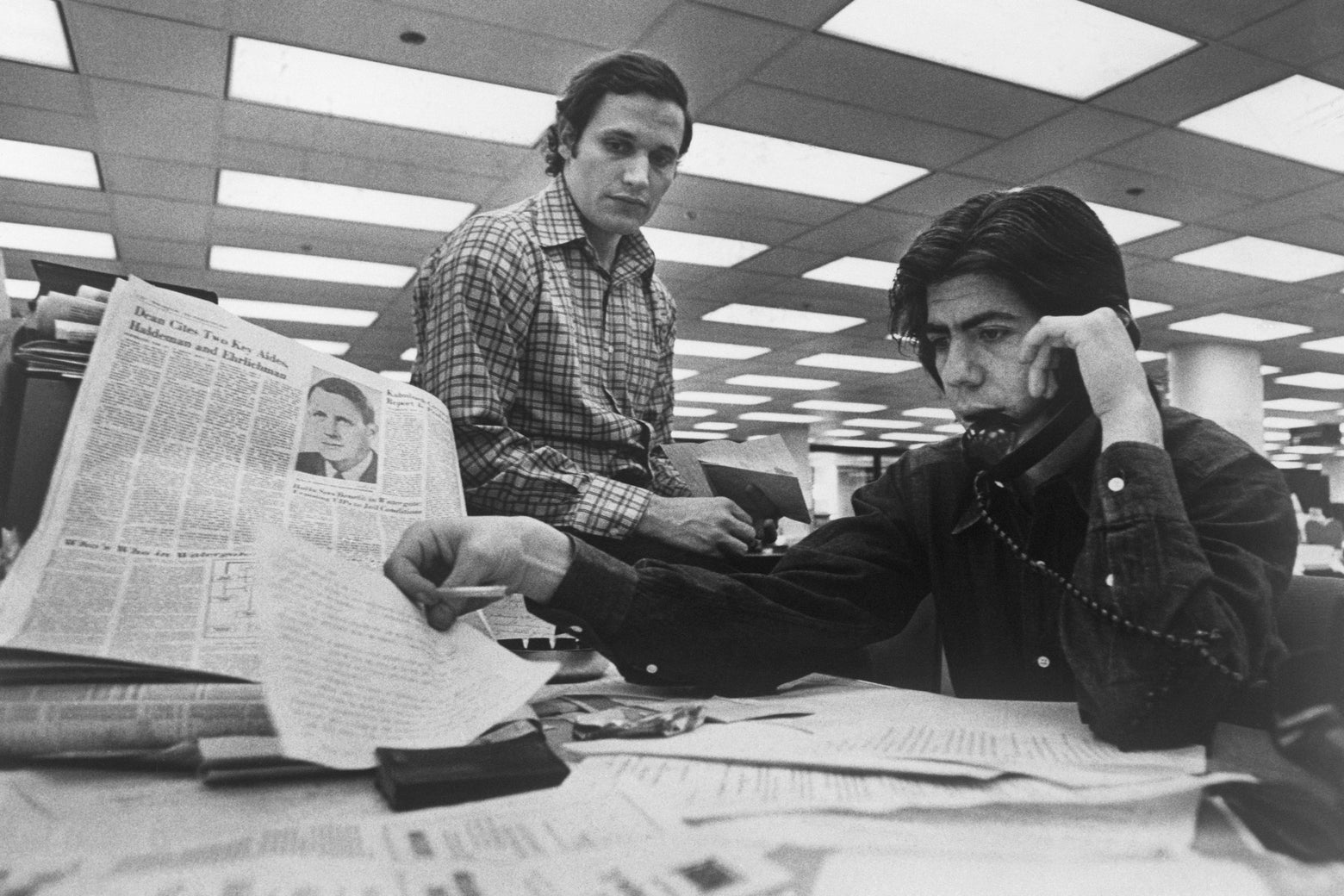
War Stories Bob Woodward Spills His Secrets The most famous investigative reporter of our time reveals how he got his stories—and what really drove him to be a snoop. By Enter your email to receive alerts for this author. Sign in or create an account to better manage your email preferences. Unsubscribe from email alerts Are you sure you want to unsubscribe from email alerts for Fred Kaplan? Nov 12, 20261:10 PM Bob Woodward (left) and Carl Bernstein at the Washington Post. Bettmann/Contributor/Getty Images Sign up for the Slatest to get the most insightful analysis, criticism, and advice out there, delivered to your inbox daily. Bob Woodward’s Secrets: A Reporter’s Memoir is a remarkable, sometimes stunning book, unlike anything he, or really any other journalist, has written. The big news story coming out of this book is that Woodward—the Washington Post veteran who brought down Richard Nixon half a century ago and has since written 23 books on the inner workings of the White House and other power centers—here identifies the sources of his many scoops (at least those sources who have since died or given him permission to name them). Catnip for newshounds and gossipmongers! But the book is much more than that. It’s Woodward’s deep dive into his own psyche—an exploration of his identity, the roots of his obsession with secrets and his need to expose them. The first page—a killer opener—gets right to the point. One afternoon, when he was 11, young Bob hurtled in through the back door of his house and saw his mother kissing his father’s best friend. “Not just a peck” but “a deep movie kiss between lovers,” he recalls. “My whole body went numb, my feet bolted to the floor by shock.” Without either of them noticing him, he backed slowly out of the room. He later confronted his father and then his mother about what he’d seen, but both were evasive. “What I was witnessing and what I was being told were two very different things. I learned to trust what I saw.” And so, he writes, “I became a snoop. I would pry into cabinets and bedside tables, nosing through the top drawer of my father’s dresser—a regular mission.” One day he discovered a letter from his mother, mentioning “our divorce.” “This,” the most famous investigative reporter of our time recalls, “was news to me.” In high school, he worked nights as a janitor in his father’s law office and, after cleaning up, he snooped through the case files. This was in the small conservative town of Wheaton, Illinois, yet the files teemed with “the hard ugly controversies in people’s lives”—assaults, sexual assaults, student–teacher pregnancies, secret business settlements. “Everybody has secrets,” he realized. “You must look everywhere things could be hidden, because they are being hidden.” In the book’s final sentence, he writes that he will remain a reporter for as long as he’s able, so he can keep asking, “What are the bastards hiding?” A common critique of Woodward’s reporting over the decades (I’ve leveled it in reviews of a few of his books) is its absence of analysis. In a 1989 Playboy interview, he acknowledged that analysis wasn’t his strong point: “I am just not capable—and this is a grave fault—of taking A, B, C, and D, and saying, ‘OK, now “E.” ’ ” In his new book, he recalls the editor of his CIA tome, Alice Mayhew, asking what he thought the CIA should and shouldn’t do. He replied, “I present all the facts, but I do not speculate about underlying or greater cosmic meaning.” Yet here he is, at age 83, analyzing, trying to connect the random dots of his life. It comes as a surprise even to him. “Over the course of my reporting career,” he writes, “I have pushed people to honesty—to uncomfortably dissect their own and others’ lives in moving and sometimes harrowing ways. Before writing this memoir, I have never pushed … myself that way.” Has he always grasped these causal links between his childhood trauma and his subsequent career? He doesn’t say, though he reveals himself to have a darker sensibility than his “straight Midwestern manner,” as he calls it, might suggest. Several times in the book, he mentions his fear of nuclear war, “which still keeps me up at nights.” He calls himself a “catastrophic thinker,” adding, “I wish I could be more hopeful, but it is not who I am.” Some of this may stem from another instance of childhood trauma, when a neighbor joked that Woodward’s house was on fire, leaving Bob so terrified that, even now, he loads his house with lots of fire extinguishers. Woodward at his peak may have been the hardest-working reporter in town, but he also realizes his life has been, in good part, the product of sheer luck. He was accepted by Harvard Law School and probably would have gone, except that his father couldn’t afford the tuition. He applied for a job at the Washington Post, despite an utter lack of experience. An editor, Harry Rosenfeld, gave him a two-week trial, on the basis of a recommendation from Woodward’s commanding officer from his time in the Navy. He washed out—“See, you don’t know how to do this,” Rosenfeld told him—but, again, out of respect for the commander, he sent Woodward to the editor of a weekly newspaper in Montgomery County, Maryland. There, Woodward learned the business, cultivated sources, uncovered scoops, and wrote them in stories, some of which were picked up in the Post, which hired him a year later—nine months before the Watergate break-in. How Woodward met Mark Felt, the FBI deputy director who became Deep Throat, his main source on the Watergate story that changed the nation (and Woodward’s life), is such a kaleidoscope of accidents that I’ll just direct you to his account pages 29–32. At one point in the ensuing scandal, Sam Dash, chief counsel of the Senate Watergate Committee, asked Woodward to leave the Post and come work for him. Woodward turned him down. (“I never wanted to be on the inside,” he writes in the book. “I preferred the outside. Where you could last and you rarely had to compromise.”) But he recommended the smartest person he knew, Scott Armstrong, a childhood friend and law-school dropout, who did join Dash’s staff and leaked inside information to Woodward. In return, Woodward urged him to interview a White House staffer named Alexander Butterfield, who he suspected was hiding something. It was Butterfield who, when asked about a memo filled with what seemed like verbatim dialogue, revealed that Nixon had a taping system in the White House. This led to the discovery and release of the tapes, which contained evidence of Nixon’s cover-up, without which he probably would not have been forced out of office. In print and behind the scenes, then, Woodward has been a consequential reporter—probably, along with Seymour Hersh, the most consequential American reporter of the last 60 years. He devotes much of the book to how he got his stories—not just the names of his sources, but how he persuaded them to be sources. (A few, like Mark Felt, he’d met before, but most, he hadn’t.) Diligence, persistence, and guile are part of the formula. But much of it is the fact that he’s Bob Woodward, the famous reporter who writes famous first (or second) drafts of history. Therefore, if they talk to him, they will be part of history, and to the extent they’re characters in the story, they’ll come off well. (It’s widely speculated that Woodward writes favorably of those who cooperate; little of this book’s source-naming rebuts that proposition.) Woodward doesn’t quite admit how much he uses his own fame to ensnare sources, but he comes close. He quotes at length the evocative account in George Stephanopoulos’ White House memoir of how Woodward coaxed information out of him over dinner at the reporter’s plush Georgetown home. Woodward objects over his “quite sinister” spin, protesting, “There is no trap. I believe my approach is straightforward and my manner forthright. I want your take on this information I have. What am I missing?” But the fact that he devotes a whole page to this account—as well as another page to Stephanopoulos’ dissection of the letter Woodward wrote requesting an interview with President Clinton—suggests that he detects some truth to it. Similarly, he quotes his friend Armstrong telling Robert Redford, who played Woodward in the movie All the President’s Men, “Bob thinks in Republican terms so when he approaches a Republican for an interview, he projects exactly that image. … He had the look of a guy who’d been in the Navy and at one time a Republican from the Midwest. He could always conjure up sincerity and effectively tell people he was not a partisan.” No rebuttal from Woodward on this point. Was this strictly an image? Was his semblance of sincerity merely conjured up? Was any of it real? What’s the truth, and, in telling us this, what does Woodward want us to believe is the truth? There may be more truth in this image than Woodward recognizes. Another common critique of his books—especially those about establishment Republicans like George H.W. Bush, Brent Scowcroft, Colin Powell, and Alan Greenspan—is that he serves as their mouthpiece. Woodward counters that he’s getting inside their heads, showing us how they think. The problem is that, in some cases, they’re feeding him a load of horseshit, and his aversion to analysis keeps him from seeing this. (He draws an exception for Donald Trump, whose horseshit was so toxic in their many lengthy conversations that Woodward ended one of his books about him by saying Trump is “unfit to lead the country.”) Too often for someone entrusted with such inside skinny, Woodward wants to find great men, heroes. I was surprised to read that he kept in touch with Mark Felt for years after the Deep Throat escapade, tapping his wisdom for advice, viewing him as “a guiding figure in my life, almost a father figure.” He regards Gen. Colin Powell, whom he phoned every Sunday while researching The Commanders, as “the only person I interviewed who I believed had the potential to be a great president.” He even admires Sen. Bob Dole for his “basic decency,” seeing “a kind of Faulknerian endurance in him.” This is preposterous. Dole, while funny and smart, was one of the most bitter and mean-streaked politicians of his time. In 1974, he pioneered the modern brand of right-wing electioneering, smearing his opponent, Bill Roy, a truly decent obstetrician and lawyer, with skull-and-crossbones letters for performing a few abortions. Woodward is old enough to remember Dole’s disgraceful debate in the 1976 presidential campaign, as Gerald Ford’s running mate, when he denounced World War II as a “Democrat war.” Woodward writes, “I had a drilled-in respect for authority,” which seems odd coming from a reporter who has demystified and even brought down so many figures of authority. Most of us contain myriad contradictions. Woodward hasn’t resolved all of his, though Secrets amounts to an intriguing first try. It’s also, despite its shortcomings, a compelling account of an insider-outsider chronicler’s journey through his—and our—turbulent times. Books History Journalism Richard Nixon
The Man Who Brought Down Nixon Spills His Secrets
Full Article
Original Source
Read the full article at Slate →KhanList aggregates and links to publicly available news content. We do not host full articles from third-party sources. Always verify important information with original sources.