
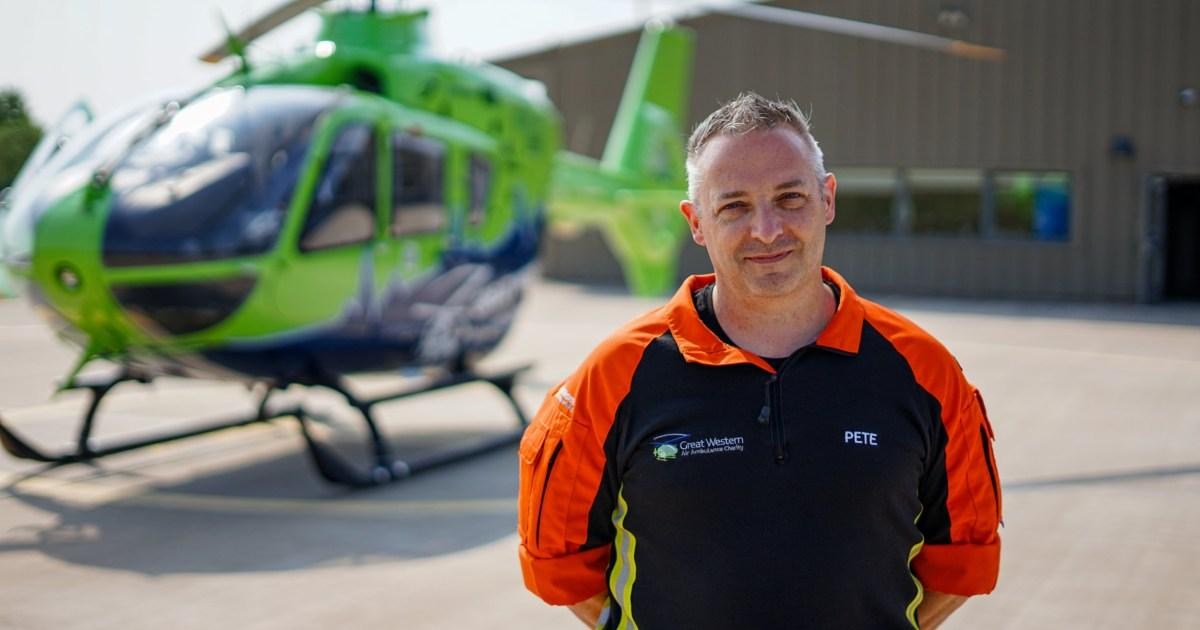
Pete has seen people with their intestines by their heart due to the impact of their accident (Picture: Supplied) ‘He was the most broken man I’ve ever seen survive’. Those are the words of Peter Reeve, specialist paramedic in critical care for Great Western Air Ambulance Charity. He flew to the scene of a devastating head-on crash that left car passenger Simon Clark, 44, catastrophically injured and his partner Lindy tragically dead. In this week’s Unsung Heroes series, we’re highlighting the efforts 50-year-old Pete goes through to save people in his line of work following Air Ambulance Week. ‘When our air ambulance responded to the call, we found Simon with a shattered pelvis, and spine and neck broken’, Pete recalls about the 2019 incident. ‘The impact was so severe his intestines were pressing up around his heart with his diaphragm ruptured.’ Simon was in a coma for over six months (Picture: Simon Clark) Air ambulance doctors anaesthetised him and gave blood on the scene. ‘Without those two treatments immediately administered, he would have likely died,’ says Pete. The medics also had to puncture a hole in his chest to release pressure from built-up air. Then, they flew him to hospital. Simon was in a coma for months only to wake up to find he was paralysed from the neck down – and the love of his life was gone. Ask Metro Use AI to go deeper into the stories you care about – powered by Metro and trusted publications. Initially, he was told he’d never walk or feed himself again. But through gruelling physical rehab, he walked out of hospital about six months later. Astonishingly, he has now trekked to Mount Everest Base Camp and is aiming to walk to the North Pole next. Now Simon is well, and still stops off to say hello to the team at Great Western Air Ambulance (Picture: BBC/ Simon Clark) ‘It was a remarkable recovery,’ says Pete. ‘And it feels great when Simon pops in to say “hello” to us – the air ambulance team who responded to his call.’ A charitable mission Simon’s story is just one inspiring example of the many lives saved by air ambulance teams nationwide. The helicopters fly in small teams of medical specialists who can rapidly deliver advanced emergency care to people with life-threatening injuries. The speed that medical aid is delivered is the difference between life or death for many seriously injured Brits. ‘We can lift off within three to four minutes and the helicopter flies at about 120 to 130 miles an hour, depending on weather. So we supply emergency medical care within minutes,’ explains Pete. Air Ambulance relies wholly on donations (Picture: Getty Images) The Great Western Air Ambulance Charity serves more than 2 million people in and around Sommerset. You might think that such a vital lifesaving service is government funded – but that’s not the case. Air Ambulances UK is a national charity supporting the lifesaving work of the UK’s 21 regional air ambulance charities in their role of bringing emergency hospital care directly to patients at the scene. Every year, air ambulance charities collectively respond to more than 50,000 emergency missions across the UK, making them a critical frontline emergency response, yet they receive no day-to-day government funding. In fact, air ambulances rely on donations from people like you. Peter saved Simon’s life (Picture: TAMARA LYNN KWAN) ‘Most people don’t know Great Western Air Ambulance is a charity which needs at least £4 million per year to keep operating. Each rescue costs about £2,200. We don’t get government funding. It’s only because of the generosity of the communities we serve that we can continue to function,’ says Pete. Not only can the air ambulance swoop into remote destinations much more quickly than a road ambulance, but it also carries more advanced medical supplies. It has blood products to transfuse trauma patients on scene. Plus, anaesthetic to put patients to sleep and advanced pain relief crucial for being able to moving critically injured patients and for getting their blood pressure and heart rate under control. The paramedic says he enters a ‘flow state’ when saving a life (Picture: Getty Images) Each air ambulance team is small – usually up to four people – but it is brimming with advanced medical knowhow, which can include intensive care medics, emergency department doctors, cardiologists, neonatologists and paramedics. Air ambulance rescues are, of course, high stress, hyper-focused environments for the dedicated men and women who provide life-preserving medical care to our communities. What’s the motivator? ‘You enter a kind of flow state where time flies by. I do enjoy the chaos. I think you have to. Most of us have a dark sense of humour. The patient is trying to die on you but you’ve got to do your best to stop that happening,’ says Pete. In that moment, the best bit of equipment the crew has is often not the fancy medical gadgets but their own brains. As Pete explains, the job is about decision-making. So sometimes the smarter move is knowing when and when not to use high-tech equipment on scene, or when to just rush the patient to hospital. Despite the ultra-high-pressure working environment, helicopter crew do occasionally get chance to enjoy the view. The charity save countless lives every year (Picture: Getty Images/Westend61) ‘I love being on the helicopter,’ says Pete. ‘We have to keep watch for air traffic, such as gliders, which are ridiculously difficult to spot. So, we do get to admire the countryside then, too. I think most of us have one or two aerial photos of the landscapes.’ As to what drew Pete into becoming an air ambulance specialist paramedic, well, he’s no stranger to pressure at work. ‘I used to be a conflict resolution instructor for the police. So, basically, I got paid to have fights with the police! Next, I spent six years on the Hazardous Area Response Team, dealing with large scale incidents or terrorism. My unit spent a lot of time in Salisbury after the Novichok nerve agent attacks on UK soil by Russia.’ Pete has even transferred his emergency medical skills outside the UK, teaching first aid to officials and civilians under attack by Russian in Ukraine, in 2022. Later, he did medical evacuations from the frontline near Dnipro. ‘One older lady who I taught in Ukraine sticks in my mind, as she said: “I want to know what to do if my grandchildren get hurt.” ‘ says Pete. Now, Pete teaches others how to administer first aid (Picture: Getty Images) He also ventured into Syria, just days after the regime fell, to teach a medical skills update course to local medics, where he found himself chatting to the volunteer first responders, called the White Helmets. Great Western Air Ambulance Charity, where Pete is based, uses volunteers for projects such as Heartstarters, who teach cardio pulmonary resuscitation and defibrillation to people, including thousands of school children. ‘Teaching the public CPR will save many lives as early intervention is critical to survival. It’s one of many amazing life-saving campaigns supported by Air Ambulances UK,’ says Pete. Donate to the UK’s air ambulance charities at airambulancesuk.org Arrow MORE: ‘AI chatbots sexually exploited my 13-year-old daughter until she didn’t want to live’ Arrow MORE: I’m a fat-positive writer taking Mounjaro — that doesn’t make me a hypocrite Arrow MORE: I’ve explored different careers – but I keep working at a sex shop
The man paralysed waist down but climbed Everest – and the hero who saved him
Full Article
Original Source
Read the full article at Metro →KhanList aggregates and links to publicly available news content. We do not host full articles from third-party sources. Always verify important information with original sources.