
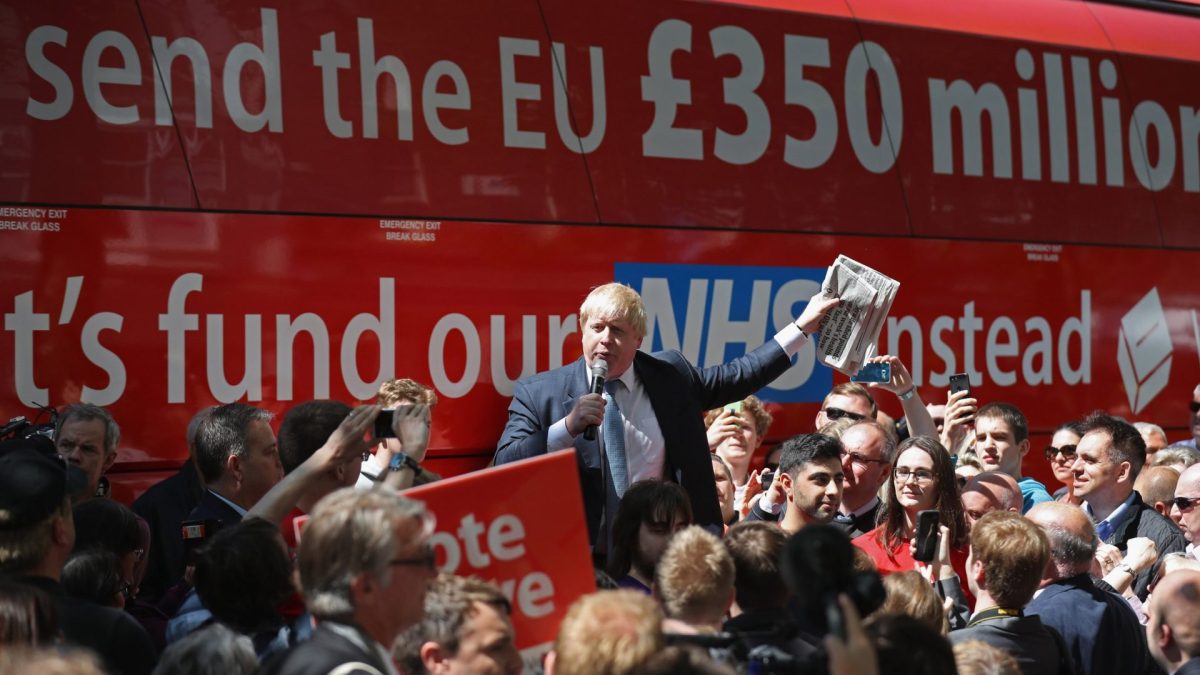
is a freelance journalist, former Times leader writer and columnist, a linguist and an author The emblematic feature of the Brexit referendum campaign in 2016 was emblazoned on the side of a bus. Vote Leave’s campaign slogan ran: “We send the EU 350 million. Let’s fund our NHS instead.” It proved politically potent. And the man who came up that figure is back in the fray. A new pressure group called Stay Out is chaired by Oliver Lewis, who was prominent in the Leave campaign. Its initial contribution to public debate has a familiar ring. It claims that rejoining the EU would cost Britain £39.3bn a year in contributions, equivalent to about £750m a week. Lewis avers: “The country has had enough of arguing about Europe, and it is time to move on and spend our money on our own priorities.” The irony is presumably unintended, for if the country has genuinely had its fill of this debate, then it shouldn’t be necessary for Brexiters to make patently false assertions. Their 2016 slogan was innumerate and unscrupulous. You needn’t take my word for this. Sir Andrew Dilnot, then chair of the UK Statistics Authority, said of the £350 million statistic: ‘The continued use of a gross figure in contexts that imply it is a net figure is misleading and undermines trust in official statistics.” Stay Out’s “£750 million a week” comes from the same playbook. It’s a spurious gross figure, misleadingly presented as a net one, based on an unknown EU budget that’s currently being negotiated and on totally hypothetical accession terms. For Brexiters like Lewis – or my old friend Michael Gove, who has given his support to Stay Out – these claims are in any event beside the point. Though a Remainer, I never doubted it was possible to advance a rational case for Brexit based on benefits and costs. But for hardcore Brexiters, all that mattered – as it did in the 1975 referendum for anti-EEC campaigners like Michael Foot and Enoch Powell – was regulatory sovereignty. Anything that abridged this was judged an assault on our liberties.That sort of dogmatism no longer commands credibility among voters. There’s been a clear shift in polling towards the proposition that Brexit was a mistake. Many Leave voters in 2016 have since died. Members of Generation Z, born from 1997 to 2012, are overwhelmingly pro-European. And more Leave voters than Remain voters have changed their minds since 2016. It’s hence good politics, regardless of anything else, for Andy Burnham to raise the issue of Britain’s relations with the EU. It’s also impeccably democratic. Just as no parliament can bind its successor, a referendum result can’t constrain future generations if they make a different assessment of the national interest. Let’s be clear. Some arguments made by the Remain campaign in 2016 were desperate and misconceived. I took particular exception to the claim (and wrote a column about it) that Brexit would cost jobs owing to a diminution in trade volumes. And I’m concerned that many who favour rejoining apparently believe that the status quo ante is available. It isn’t. If Britain were to eventually rejoin the EU, it wouldn’t even be a negotiation. It would require us to meet certain tests, which we can’t at the moment know. These would certainly include compliance with the legal framework for the EU and substantial budgetary contributions. Other elements, such as membership of the euro and of the Schengen area, might apply but are by no means certain. These criteria would be a difficult sell for pro-European parties in Britain. It is highly improbable that the member-states of the EU would offer the previous concessions that we enjoyed or cut us a special deal. It is vanishingly unlikely that they would even entertain the prospect of Britain rejoining until such time as it’s a matter of political consensus among mainstream UK parties. But I still consider it’s a goal worth striving for, on which the electoral arithmetic will eventually converge. The Prime Minister is right to raise it, as his predecessor sadly did not.
The man behind Brexit’s most notorious number is back
Full Article
Original Source
Read the full article at Inews →KhanList aggregates and links to publicly available news content. We do not host full articles from third-party sources. Always verify important information with original sources.