
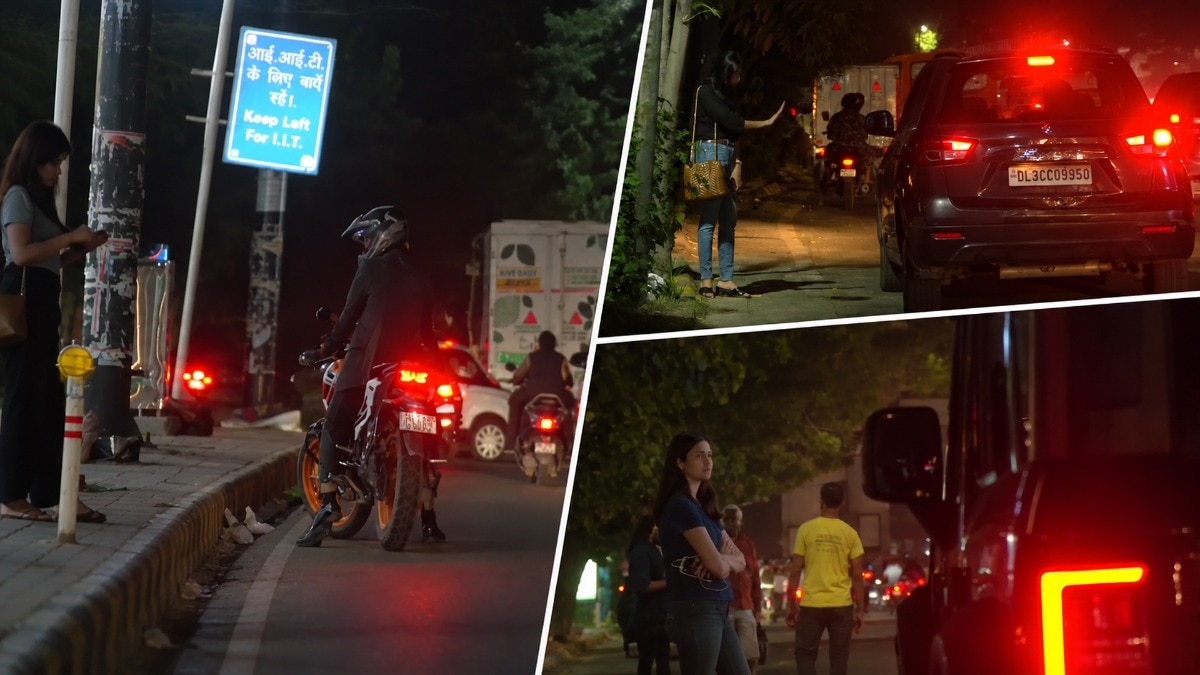
Four women reporters. Multiple parts of Delhi. Hours of observation. What they encountered was not always a crime that could be reported, but a pattern of staring, following, stopping, propositioning and persistent approaches that made ordinary public spaces feel unsafe.What if we stopped waiting for a woman to become a victim before asking whether she was safe?What if, instead of beginning the conversation at the crime scene, we looked at what happens in the moments before the crime?The staring. The following. The repeated stopping. The unwanted approach. The casual proposition. The gaze that lingers. For women, these moments are often dismissed because they do not always end in physical assault. There may be no police siren, no dramatic confrontation, no FIR.But that does not mean nothing happened. For this investigation, four women reporters went across Delhi, Central, South, East and West, and spent time in places where women ordinarily live their everyday lives: markets, hospitals, colleges, temples, office districts and public spaces.They did not go looking for deserted alleys or abandoned buildings. They went where Delhi lives. And what they encountered was not one isolated incident.It was a pattern.AT MOOLCHAND, A 'NO' DID NOT END THE CONVERSATIONIt was around 7:30 pm near Moolchand Hospital. Office hours were ending. There were cars, pedestrians and traffic everywhere.Yet within minutes, a simple act of standing on a public road became an opportunity for a stranger to test how many times a woman would say no.Aishwarya Palliwal was approached by a man in a car."Drop kar doon?"She refused.He did not stop."Company chahiye?"Another no.The man told her he was a "nice guy".After a firm no for the third time, he moved his car.Barely 50 metres later, he reversed."Sure ho?"Three approaches. One woman. One very simple answer.No.But the conversation continued until the man was satisfied that the answer really meant no.ONE WOMAN. ONE CAR. MULTIPLE APPROACHES. THREE REJECTIONSThat interaction captures one of the most difficult aspects of street harassment: the behaviour often exists in the space between what feels threatening to a woman and what can easily be classified as a crime.WEST DELHI: WHEN 'NOTHING HAPPENED' IS THE POINTMoving west, Jessica Goel reported from Patel Nagar, Kirti Nagar, Rajouri Garden, Janakpuri and Tilak Nagar.What she found looked deceptively ordinary.Men stopping.Watching.Following.Waiting.At Patel Nagar and Kirti Nagar, bikes and cars repeatedly stopped simply to stare.At a Rajouri Garden bus stop, bikes stopped for no apparent reason.In Janakpuri, near Happy Model School, a car appeared to follow Jessica for some distance.The man did not approach.Instead, he got out.He lit a cigarette.And repeatedly looked towards her.Nothing happened.And that is precisely the point.Because for a woman on the street, "nothing happened" does not always mean nothing happened.Being followed is something.Being watched is something.Being approached is something.Being made uncomfortable is something.Near Bharti College, there were dark stretches and poor lighting. In Tilak Nagar, a man walked extremely close to Jessica, appearing to try to touch her while passing.There was no dramatic soundtrack.No screaming.No police siren.Just another day on a Delhi road.As Jessica put it: a bike slows down, a man stares, a car follows you, someone comes too close — and you are expected to simply keep walking.Because if nothing "serious" happens, women are often made to feel there is nothing to complain about.But as a woman, you know the difference.THE PART WE NORMALISEPerhaps that is where the normalisation becomes even more disturbing.A car follows you.A stranger keeps approaching you.A man stops you and asks you something you never invited him to ask.Over time, these moments can become so normalised that women may not even expect the police to treat them as a crime.They may go to the police and say:"This happened to me"."I was followed"."I was harassed"."A car chased me".But how many of these moments actually become a complaint?How many become an FIR?When women themselves begin to believe that nothing will happen, the incident can disappear before it ever becomes a case.That is how normalisation works.Not simply by making bad behaviour common, but by making women believe it is not serious enough to report.AIIMS: ONE HOUR, SEVERAL VEHICLES, AND A 'MILENGI?'Then we went south.Lajpat Nagar.AIIMS.Kartiki Arora stood at one spot near the AIIMS area for roughly an hour.In that time, seven to eight vehicles stopped.Most offered to drop her somewhere.Some hesitated.Several came back even after being rejected.And then came the line caught on camera:"Milengi?"The numbers from the observation were stark:1 hour7–8 vehicles stopped2–3 vehicles returned after rejection2–3 asked: "Milengi?"These figures are based on the reporter’s observation and recorded footage at the location.Kartiki was not walking towards anyone. She was not asking for a lift. She was simply standing there.Yet within about an hour, several vehicles stopped.Some offered her a drop.Some came back after she had already refused.And some men simply asked, "Milengi?"For a woman, these may look like small moments.But when they keep happening, you begin calculating every vehicle, every man, every turn, every person who is looking at you.That calculation is what safety feels like for many women.SOMETIMES, THE THREAT DOESN’T SPEAKBut not every threat speaks.Some simply watch.And sometimes, the watching is the story.At the entrance of Hauz Khas Village, a man sat watching women passing by.He did not move.He did not speak.He simply waited for the next woman to enter his field of vision.A bike passed.Two women walked by.The rider turned his head almost 180 degrees.There was no attempt to hide it.No apparent fear of being seen.Because perhaps the behaviour has become so normal that even being caught watching no longer feels embarrassing.WHEN STARING BECOMES A GROUP ACTIVITYAt a Hanuman temple, four or five men sat near the entrance.A middle-aged woman walked in.She prayed.She bent down before leaving.One man’s gaze followed her.Not her face.Her body.Faith asks a woman to bow.Why should that become an opportunity for someone else to stare?Elsewhere in Hauz Khas, two foreign women walked past a group of men.It was not one man looking at one woman.Sometimes, it becomes a group activity.One notices.Another alerts the other.And suddenly, a woman becomes a subject of collective entertainment.One sees.Another notices.The group looks.For women, the most uncomfortable part may not always be one particular stare.It is how routine it looks.Men sitting around.Women passing.A look.A nudge.Another man turning around.Nobody appears to think they are doing anything wrong.And that raises a more uncomfortable question: when did making a woman uncomfortable become so normal that nobody even notices it anymore?THE CITY’S 'SAFE' SPACESThen came Connaught Place.The heart of the capital.Bright.Crowded.Public.Safe — at least on paper.But watch closely.A look.Another.A prolonged stare.A woman notices.Her body language changes.There is often no single moment that can easily be pointed to and labelled: "This is the crime".It is the accumulation.LOOK. STOP. FOLLOW. APPROACH. REFUSE. RETURN. ASK AGAINFour reporters, different locations, different men, different moments — but the same underlying behaviour.'MALE GAZING IS JUST SO NORMAL'For Priyanshi, the experience has become routine."Male gazing is just so normal," she said.She recalled sitting in an auto when two men who had been drinking repeatedly told her, "Ma'am, come with us"."This happens so often that it has become normal".She said she is fully covered "head to toe" and still experiences such behaviour."So what are women supposed to do? Carry guns?"Her question went further.Why are women supposed to stay at home? Why don't we put a curfew on men?"All the restrictions are on us — not on men," she said."Men need to do better. Men need to be raised better".WHEN WOMEN LEARN TO LIVE WITH ITZara was waiting for a rickshaw when a man sitting in front of her continuously gazed at her.- Ends
The male gaze: How Delhi makes women calculate every man, every vehicle, every turn
Full Article
Original Source
Read the full article at Indiatoday →KhanList aggregates and links to publicly available news content. We do not host full articles from third-party sources. Always verify important information with original sources.