
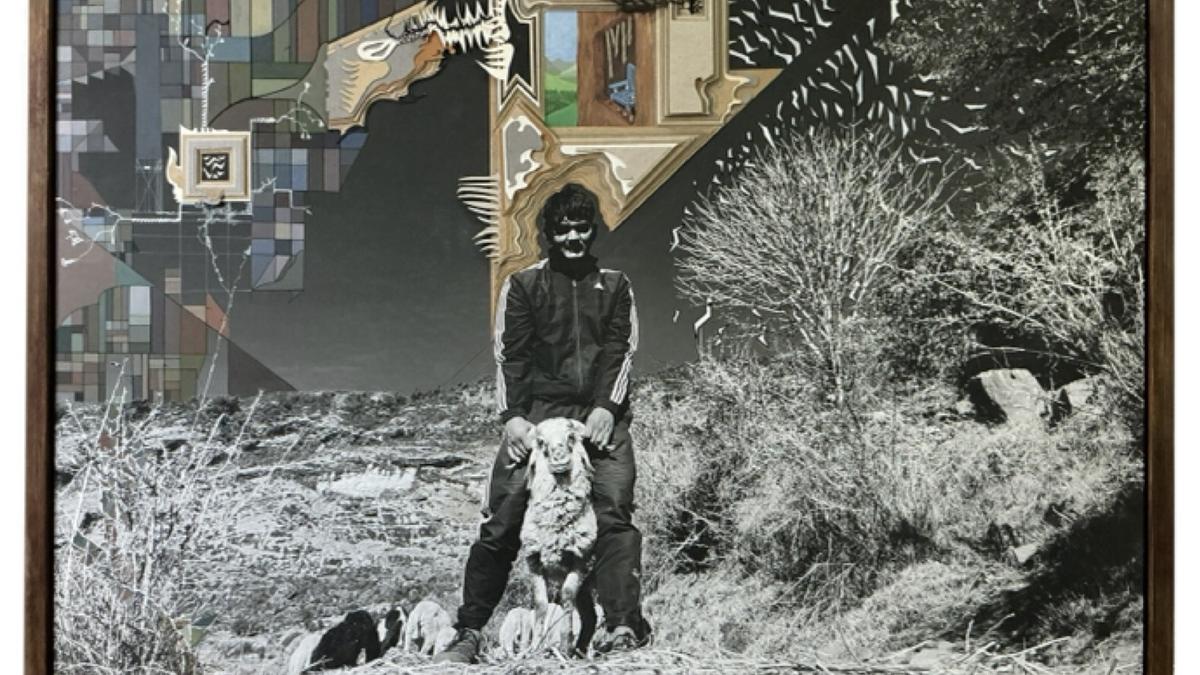
Like threads woven together to create a fabric, 16 contemporary artists come together in The Madras Warp, an upcoming exhibition at Lalit Kala Akademi that explores the many ways art engages with culture, identity, memory and place. Opening on November 1, the exhibition brings together artists from Chennai, Bengaluru, Hyderabad and Kerala. Spanning painting, photography, printmaking, mixed media and installation art, it offers a glimpse into the diverse perspectives shaping contemporary art today.Tangible formsTake, for instance, artist Rishi Sasi’s work, which uses collage as his visual language; his artworks begin with a question, conflict, or circumstance and gradually transform into a visual dialogue. “My work explores the subtle interplay between memory, thought and time. It is essentially a desire to translate intangible things into tangible forms, such as dreams, memories and impressions,” says Rishi. Two of his works are inspired by photographs from his trip to Lwani village in Uttarakhand, made using photographs, overlapping papers, paper boards, and found objects to create collage-like visuals; the works create dreamlike visuals that call for careful observation. “Through this exploration, I aim to evoke a sense of timelessness and complexity, where personal experiences and shared memories interact,” he adds. Artwork by artist Hemant Kumar | Photo Credit: SPECIAL ARRANGEMENT In another work, artist and photographer Hemant Kumar uses printmaking to create awareness about the endangered species around us. Each print, he says, “is carved from wood layer by layer, capturing the beauty of the wildlife we can no longer take for granted.” The three artworks made from woodcut prints showcase species like the vanishing green slender loris, the Malabar large-spotted civet, and the green Nilgiri marten. His works also remind us of how rapid urbanisation and canopy loss have driven some of these species to extinction. Artwork by artist Manimaran Rajapandian | Photo Credit: SPECIAL ARRANGEMENT Artist Manimaran Rajapandian connects his work to a childhood habit of finding faces in everyday things. “There are mountains, plains and rivers, each with its own form and flow. It reminds me of how our emotions and moods keep changing, taking different forms and flowing differently at different times,” says Manimaran. Two of his artworks relate cartographic features on maps to human emotions. Landscapes of belonging Artwork by artist Nivetha Mailasini | Photo Credit: SPECIAL ARRANGEMENT “An artwork begins with the artist, but its story continues with everyone who encounters it,” says curator and participating artist Nivetha Mailasini. For the exhibition, her works explore landscapes as “collective drawings made by people over time”. From afar, the artworks look like a block of colours red, crimson, and green but look closer and reveal more. “The roads, settlements, and agricultural fields become visible traces of culture, memory, labour, and belonging. I explore how the land holds the presence of human life, even when individual stories remain unseen,” says Nivetha. Stories of resilience and grief also find expression in the exhibition. Artist Selin Sabashini takes a multidisciplinary approach, working with acrylics, paper-mâché, wood and interactive installations to explore patriarchal structures, the stages of grief following her mother’s death, and the challenges of living with chronic, invisible pain. Watercolour work by artist Vidya Lalgudi Jaishankar | Photo Credit: SPECIAL ARRANGEMENT Artist Vidya Lalgudi Jaishankar’s Artwork titled Recovering -1, made with watercolour, ink and gouache on watercolour paper, was painted during a period of physical recovery following ear surgery. “It emerged from a time of vulnerability, when my usual rhythms had been interrupted,” says Vidya. Her practice began with an exploration of the spaces between verbal and non-verbal communication, gradually expanding into a broader inquiry into how information and experiences shift as they move between forms. “My work engages with the relationships between perception, memory, the body and time, investigating how experiences take on new meanings when encountered through different mediums,” says Vidya. Symbolic Expressionism Artwork titled The Eye of Perception by artist Helen Jenifer. | Photo Credit: SPECIAL ARRANGEMENT “I have always been drawn to old walls, abandoned places, eroded surfaces, and the unusual patterns that emerge through wear and tear. To me, these surfaces are not merely damaged or forgotten; they hold traces of time, memory, and human presence,” says artist Helen Jenifer. Her works belong to the genre of Symbolic Expressionism, a fusion of abstract figuration, emotional expression, and philosophical storytelling. One of her artworks The Eye of Perception, made with mixed media on canvas, brings forth a divine messenger, the goddess of empathy, who offers humanity the ability to truly see one another. “Her outstretched hand presents the symbolic eye of perception, inviting us to perceive not with judgment, but with compassion. Through this act, she grants viewers the power to understand the emotions and struggles of others, a gift that leads to harmony and kindness,” says Helen. The Madras Warp will be on at Lalit Kala Akademi, Greams Road from November 1 to 7. Entry is free and open to all.
The Madras Warp explores culture and memory through 16 artists at Lalit Kala Akademi
Full Article
Original Source
Read the full article at Thehindu →KhanList aggregates and links to publicly available news content. We do not host full articles from third-party sources. Always verify important information with original sources.