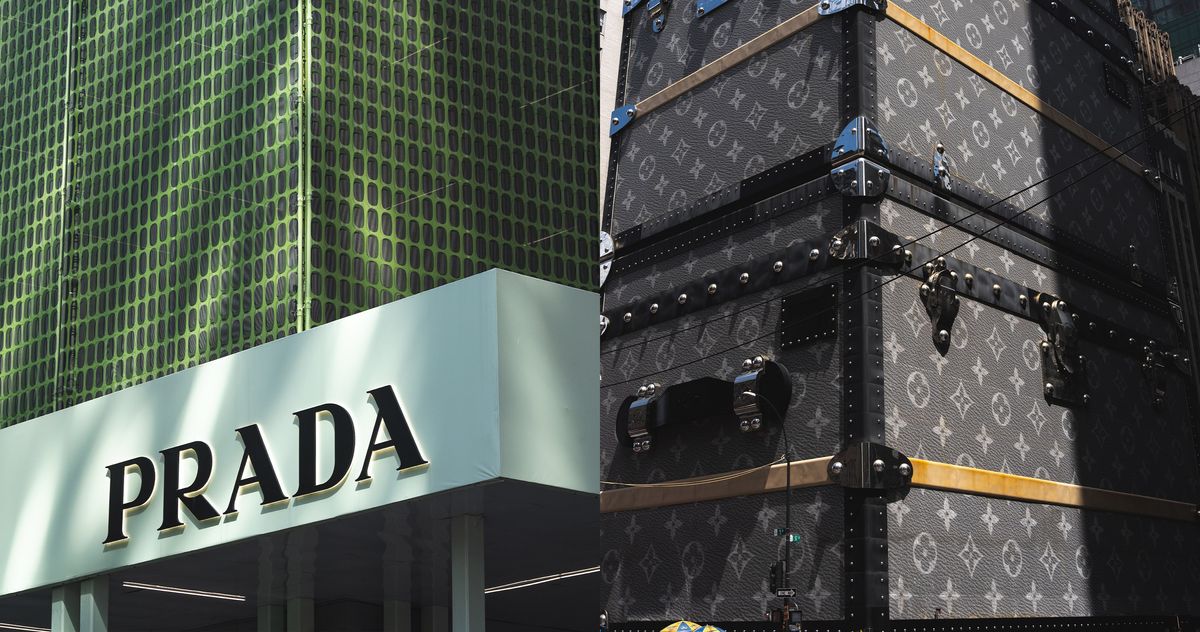
Louis Vuitton’s trunk pile and Prada’s shape-shifting green shell present very different approaches. Photo: Trey Thomas On one of the most competitive retail blocks in the world, the brands making the biggest architectural statements right now are doing it with temporary structures. At 57th and Fifth, Louis Vuitton’s in-house team has erected a 240-foot-tall construction shed that resembles a stack of six luggage trunks covered in its signature logo. The structure covers the ongoing construction of its new flagship with what is essentially a billboard for the brand. Architects Robert Venturi and Denise Scott Brown had a term for a building like the trunk pile: “a duck,” a building that conveys its function through its shape and form. They were talking, for the most part, about the Las Vegas resorts that made it obvious, from their appearance, what they were — like the massive pyramid standing in for the Luxor hotel, named after a city in Egypt. Louis Vuitton leveraged its site as an opportunity to construct a meme-able sculpture of logomania. This is no cheap, surface approximation either — the company has emphasized how close it is to the real thing, since 3-D scans provided the basis for all the locks and latches on the trunks and the corners are hand-welded steel. It’s an instant landmark and instantly recognizable. The choice to magnify its luggage trunk to this scale is not surprising, considering that it’s a stand-in for the brand that Louis Vuitton is also doubling down on in its temporary 57th Street store. Hundreds of them have been used as the language of the brand’s environmental design, with sculptures of towering trunks zigzagging up their five-story atrium. From left: Photo: Trey ThomasPhoto: Trey Thomas From top: Photo: Trey ThomasPhoto: Trey Thomas The counterpart to Venturi and Scott Brown’s “duck” is the “decorated shed,” where systems of space and structure are directly derived from the program of a building or site, i.e., what happens within it. This is what Prada, in collaboration with 2x4, an environments and branding firm, has constructed around its flagship Fifth Avenue building this spring. Here, the scaffolding indicates that the building is undergoing a renovation (while the company also builds a skyscraper next door). Most scaffolding is not really “designed,” instead shaped by the demands of efficiency and compliance. But it’s clear that for luxury brands on Billionaires’ Row, losing visibility on Fifth Avenue for an indefinite amount of time is simply not an option. Prada’s intervention looks straightforward enough, but it does much more than it has to without much customization or fanfare. No components of the structure were invented just for this project. It’s made of standard commercial-pipe scaffolding by Spring Scaffolding, a local contractor, painted a uniform Prada green. The only invention was a double-layered scrim system printed with two offset mesh layers with a more porous front layer and a denser one in the back separated by a one-foot air gap. The two layers overlap to generate a moiré effect, a pattern that shifts with the movement of the viewer. From a distance, the scaffolding reads like a minimalist green volume, almost a building onto itself at urban scale. As you approach the building, the layers register as semi-transparent and thousands of intricate components reveal themselves. At night, another face appears: a uniform lighting grid that aligns with the scaffolding structure and visually dissolves the outer scrim, exposing the depth of the structural framework. Here, visual interest comes not from a ten-story logo or a building shaped like a symbol but from depth, pattern, and systematic layering that invite a second glance rather than screaming for a first look Brands have been making urban-scale spatial decisions like these for decades, but the architecture profession has largely treated spatial work that doesn’t result in a permanent building as beneath serious practice. As these luxury sheds show us, ignoring the design potential of construction infrastructure is a missed opportunity. Firms like 2x4 have filled the gap. It’s a branding agency, yes, but a large portion of its staff are architects who have left the field of traditional architecture. What they’ve built applies architecture methodology to a different set of priorities; rather than abide by the demands of commercial architecture practice, which offers the developer a maximum return on investment (and therefore a form that offers maximum leasable square footage), they have followed the logic of luxury brands, whose metric of success is based on cultural positioning. Formally interesting design (and novelty) is rewarded. From left: Photo: Trey ThomasPhoto: Trey Thomas From top: Photo: Trey ThomasPhoto: Trey Thomas The Prada scaffolding is sophisticated architectural thinking; it just didn’t come from a traditional architecture firm. Architecture is morphing into a pan-disciplinary practice, where architects leave conventional practice to apply their thinking at the intersection of strategy, branding, graphic design, and spatial environments. 2x4 isn’t the exception; it’s an indicator of where architectural thinking is migrating toward and what it’s capable of when it gets there. The Luxury-Scaffolding Face-off on Fifth Avenue Your product is saved! You’ll receive emails when your saved products go on sale. Manage preferences.
The Luxury-Scaffolding Face-off on Fifth Avenue
Full Article
Original Source
Read the full article at Curbed →KhanList aggregates and links to publicly available news content. We do not host full articles from third-party sources. Always verify important information with original sources.