
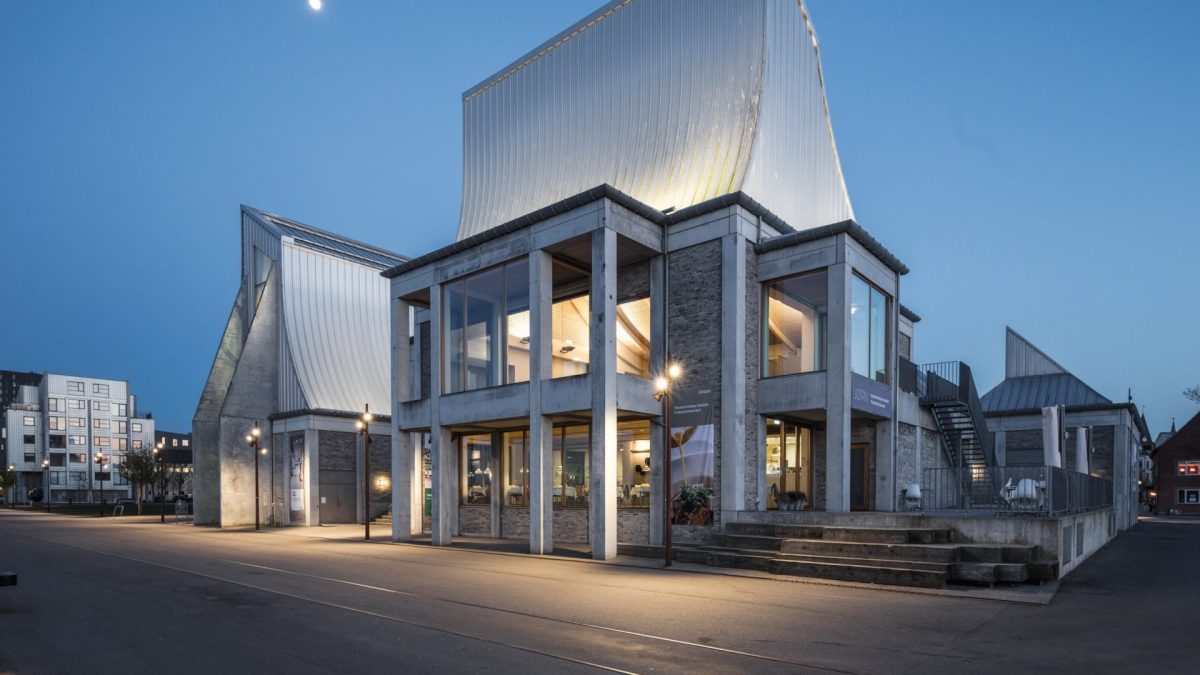
When the young Danish architect Jørn Utzon submitted his sketches to an international competition in 1956, he never expected to win. Yet his bold vision for Sydney’s new opera house went on to define the Australian harbour and become one of the most significant buildings of the 20th century. His final project, inaugurated more than 50 years later, can be found in his hometown of Aalborg in northern Denmark. Inspired by the city’s gritty industrial past and the shipyards where his father worked as director, the Utzon Centre sits on the banks of the Limfjord. With an unusual, curved roof, reminiscent of boat sails, it is one of several striking structures that have redefined the waterfront in recent years. Denmark’s fourth largest city, Aalborg was once known as “the city of smoking chimneys”, its economy driven by cement production, distilleries and a tobacco factory. Shorts “The air was so full of coal dust that you couldn’t even hang your washing out,” guide Søren Smidt explains as we arrive at the promenade. Aalborg is significantly smaller than Copenhagen, with visitor numbers reflecting differences in size and tourist stature. Between January and August this year, for example, the Aalborg region recorded slightly more than three quarters of a million overnight stays, while Copenhagen had 8.1 million. However, this small city has cultural clout. We continue past the Musikkens Hus, a futuristic steel concert hall, and the university’s Department of Architecture, Design and Media Technology, with its glass-fronted auditorium looking straight out onto the water. The old power plant, just one street back, is now a cultural centre, including a cinema and theatre, where the coal funnels remain suspended in the vast boiler room. The Limfjord waterfront on the outskirts of the city (Photo: Nicolas Cho Meier) “People from North Jutland have a very strong connection to the fjord,” Søren says. Speedboats rip through the water and sailing boats wait for the low bascule bridge to open. Others moor up outside the restaurants and bars. On the banks there are people running and cycling, eating and drinking, setting up board games or simply watching the world go by. Ostre Havn, the former industrial Eastern Port now harbours saunas and hot tubs. The Limfjord winds over 100 miles from the North Sea in the west to the Kattegat Sea in the east, essentially separating the northernmost part of Jutland from the rest of the peninsula. Aalborg sits at its narrowest point. In Viking times the fjord served as a strategic inland corridor, with a series of rivers cutting into the hinterland. Just outside the city, and easy to reach by bus, is Lindholm Høje, one of the country’s most significant Viking sites. Here, stone circle graves from the late Iron and Viking ages cover a grassy hill now occupied by sheep. The adjoining museum documents the region’s history. The Kunsten Museum of Modern Art was designed by Alvar Aalto (Photo: Visit Denmark/Destination Nord) I explore Aalborg’s centre on foot, from the marble fronted Kunsten Museum of Modern Art – designed by legendary Finnish architect Alvar Aalto – to the street food market inside a former furniture factory. The old town is centred around Østerågade, with notable landmarks including a brick gothic monastery established in 1431, the white Budolfi Cathedral and a gabled merchant house built by Jens Bangs in 1624, now with a wine bar in the cellar. Like Copenhagen, Aalborg has several standout restaurants. At Textur, the seasonal set menu – which starts at a very reasonable £40 for three courses – is paired with European wines or juices reduced or pressed in the kitchen. Alimentum was awarded Aalborg’s first Michelin star in 2025, followed by Bach & Nurup earlier this year. Headed by chef Søren Birch, Alimentum works closely with local producers to produce dishes such as Limfjord lobster with carrot and fennel ragout. Smorrebrod open sandwiches make a fulfilling lunch (Photo: Maridav/Getty) However, I can’t leave the city without trying some smørrebrød. At Mortens Kro I work my way through the more unusual toppings of these open sandwich classics, such as lobster tail with fennel and dried strawberries, while at Hos Isidor Henius, an institution with red gingham tablecloths and green pendant lamps, I order what everyone on the neighbouring table is eating. The heap of heavy butter-fried plaice and hand-shelled shrimp benefits from a squeeze of lemon and a glass of Henius Ale from the Thisted Bryghus brewery. This laid-back little city, which revolves around the water, is easy to navigate. After just two days, I feel I know my way around, but still leave feeling there is more to discover. Time for one more drink by the fjord wouldn’t hurt. How to get there Norwegian flies nonstop from Gatwick to Aalborg, or indirectly with a stop in Copenhagen. KLM flies from various UK airports via Amsterdam. Where to stay Kompas Hotel Aalborg has doubles from 799 DKK (£90) excluding breakfast. More info The writer was a guest of VisitDenmark and DestinationNord.
The low-key alternative to Copenhagen with great restaurants and a lively waterfront
Full Article
Original Source
Read the full article at Inews →KhanList aggregates and links to publicly available news content. We do not host full articles from third-party sources. Always verify important information with original sources.