
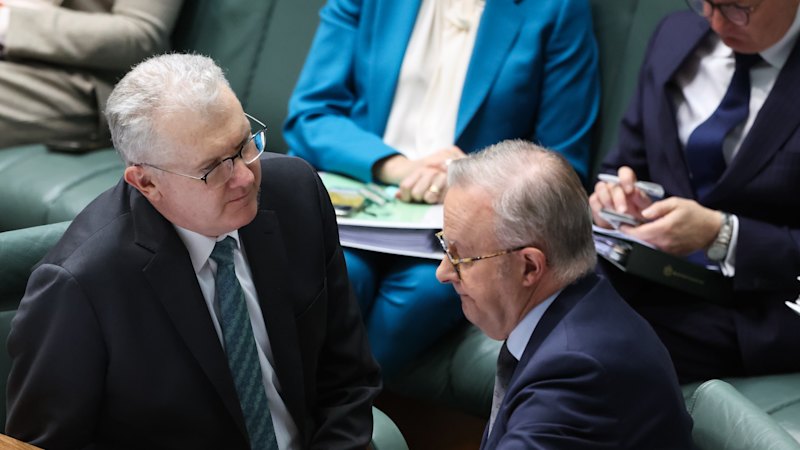
Updated August 25, 2026 — 6:17pm,first published 5:53pmThe federal government’s sweeping changes to Australia’s migration system could be pushed back up to a month, with industry groups seizing on the delay to lobby Labor against reducing the number of temporary workers in Australia.The National Farmers Federation and the Australian Construction Association, peak bodies that represent industries that rely on imported labour, said the plan to scale back immigration appeared to be driven by politics rather than practicalities and could have damaging effects on their industries.Home Affairs Minister Tony Burke and Prime Minister Anthony Albanese are trying to steer a contentious policy package on migration.Alex EllinghausenThe intensity of their lobbying is a sign of the economic and business sensitivities that Labor is dealing with in its plan to change the migration system without jeopardising key industries.Labor will attempt to restore public confidence in the migration system as One Nation’s public support surges, although the minor party again appeared confused over its policy on Tuesday, with Senator Malcolm Roberts referring to “negative” migration rather than Pauline Hanson’s recent clarification of a 130,000 net intake.Home Affairs Minister Tony Burke’s proposal for reducing migration levels has not returned to cabinet for debate since a discussion in the expenditure review committee, led by deputy prime minister Richard Marles, put the changes on ice earlier this month. In that meeting, ministers expressed concern the proposal was not watertight and had not worked through all the economic and budget consequences.Labor ministers have played down the dispute and the delay, but Opposition Leader Angus Taylor this week accused the government of “brawling within their team” over the issue.“They can’t agree, and that’s why the numbers have consistently come in above target,” Taylor said.Asked if the changes to migration policy were sorted during a cabinet meeting on Tuesday, Prime Minister Anthony Albanese said: “No, we won’t be finalising that today.”“Migration policy though, we’ve finalised our numbers. We’re headed to [net overseas migration of] 225,000 in two years’ time,” Albanese said. “We have a series of plans in place. There’s more work to do and we’ll work on that and make announcements at [the] appropriate time.”This masthead reported that Burke wanted to boost compliance by sending out more immigration officers to track down and deport overstayers, while other reports from the ABC said Burke was considering restricting family visas, as well as the work and appeal rights of asylum seekers.But a keynote speech announcing those changes was cancelled just days before the scheduled address at the National Press Club on August 6.Three Labor MPs, speaking on condition of anonymity as they were not authorised to speak publicly, said the delay in the announcement was likely to stretch until mid-September.“Industry has gotten hold of it and said how badly this will hurt them. They are going bananas,” one MP said.“Everyone has used the extra time to prosecute the case for why they should not be impacted. The longer this goes, the harder it gets.”A second MP said: “If you were moving quickly you could do it next week, but I’m not sure they are, as this affects so many stakeholders.”The government has since quietly paused working holidaymaker visa applications from 24 countries. Migration and travel agents have told the tourism industry they have been detecting delays in processing times, and the pause on applications was introduced without notice.National Farmers Federation president Hamish McIntyre said the agriculture sector desperately needed both working holidaymakers, who comprise up to 80 per cent of the labour that harvests fresh produce in peak times, and Pacific Island workers.Changes that scaled back either cohort would mean “we wouldn’t be able to harvest our crops … and it would drive up costs and increase the cost of living,” McIntyre said.“Some crops only give you a week to harvest, some crops give you a couple of weeks. We are horrified at them cutting off the labour we need because of politics.”Australian Constructors Association chief executive Peter Colacino said the sector needed highly skilled labour to complete some of the most sophisticated projects in the world, ranging from tunnelling to the Snowy Hydro project through to a nascent nuclear industry.“It’s a conflicting message from government wanting the best in the world in terms of people with the right skills, but on the other hand they are looking to constrain migration,” he said.Coalition home affairs spokesman Jonno Duniam said Labor had “finally realised that the immigration system is a mess of their own making”.“They’ve been dragged to this point kicking and screaming … but clearly can’t agree internally on what to do.”Burke was contacted for comment.Migration’s magic number?As recently as last October, Burke was saying there was “not a magic number” in the immigration debate, and that net overseas migration was difficult to predict because it involved levers the government did not control – such as Australian citizens’ movements – as well as those it did.But since the May budget, Labor has framed the 225,000 budget forecast for NOM as a target it intends to hit, as One Nation’s surging popularity pushes the Albanese government to offer credible policies that maintain public confidence in the migration system.Net migration was about 300,000 last year and shows signs of remaining at that level. It means Burke has been considering a suite of policy changes that will drive that number down by a further 75,000 people.In a statement provided to this masthead, Hanson said: “You cannot bring migration back under control without dealing with the flood of temporary visas driving these numbers. Now Tony Burke is resorting to accounting tricks to make the net migration number look better without dealing with the real problem. Changing someone’s visa status is not cutting migration. And even his own Cabinet won’t accept his plan because Labor remains addicted to mass migration.”One Nation’s policy was drawn into the spotlight this week as conflicting statements were aired over whether Pacific islanders and aged care workers should be exempt from cuts, leading to a net intake of up to 230,000 people.The argument from MP David Farley, whose background is in agribusiness, prompted Hanson to clarify the party’s policy was a net intake of 130,000. It was a change from One Nation’s policy to cap visas at that number, which would have led to negative migration, given more than 200,000 people have been leaving the country each year.Hanson’s statement, in turn, angered parts of One Nation’s voter base who had expected the party to pursue zero or negative migration. One Nation would not comment on when or why it had changed its policy.Senator Malcolm Roberts appeared to refer to the original 130,000 cap policy – which is still on One Nation’s website – in an interview published on X on Tuesday afternoon.“I’ve been talking about net negative migration,” he said. “So if 220,000 people leave... you have 130,000 people coming in, that’s a net migration of minus 90,000.”Cut through the noise of federal politics with news, views and expert analysis. Subscribers can sign up to our weekly Inside Politics newsletter.From our partners
‘The longer this goes, the harder it gets’: Industry scrambles as Labor agonises over immigration
Full Article
Original Source
Read the full article at Smh →KhanList aggregates and links to publicly available news content. We do not host full articles from third-party sources. Always verify important information with original sources.