
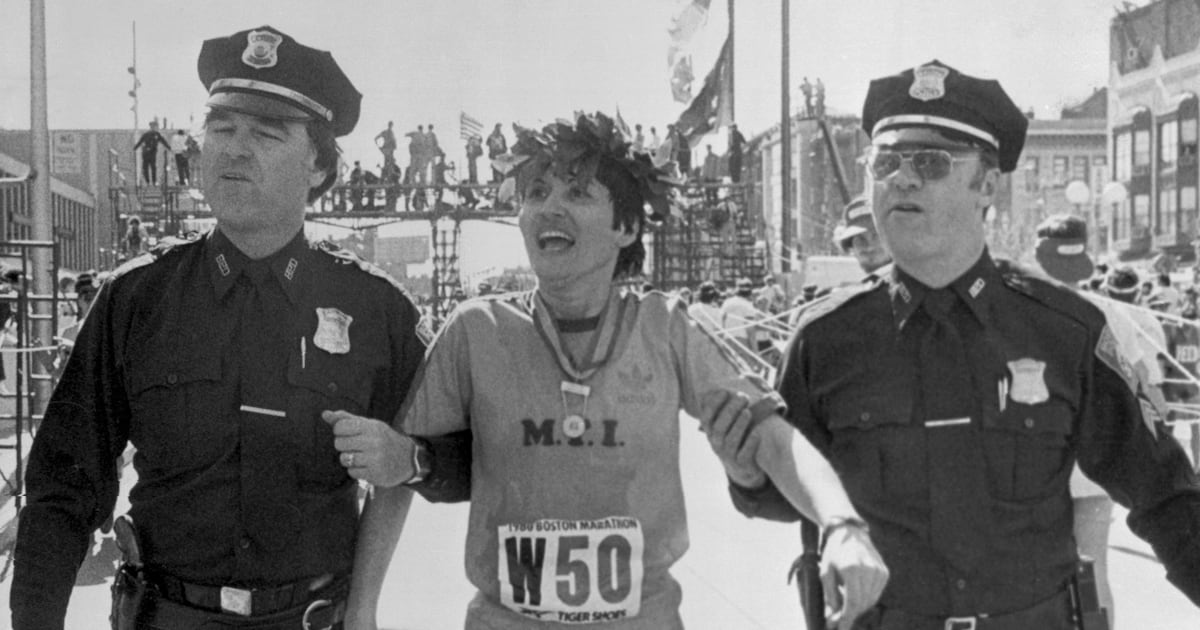
Of all the guarantees that come with running any big city marathon – tortuous muscle cramps, vicious blistering, hitting the wall, etc – there is no escaping the sense of deep satisfaction when crossing the finish line.Assuming it’s all been achieved by entirely scrupulous and unassisted means. It may or may not yet have even entered the minds of the 22,500 runners who have signed up for this Sunday’s Irish Life Dublin Marathon, but there is a long history of men and women somehow cheating their way to the finish line, and most commonly by way of a simple short cut.One of the last examples of someone caught cheating in the Dublin marathon was four years ago, when the organisers announced that a male runner – an off-duty member of the Garda anti-corruption unit – had been disqualified and his finisher’s medal returned when it emerged that he’d likely travelled a latter portion of the 26.2-mile course on the Luas.The runner himself claimed this was largely unintended, as he’d willingly dropped out around the halfway mark, and only returned through the finish line to collect his gear. At which point he was awarded his finisher’s medal anyway. He might have got away with it too, had someone not pointed out that the second half of his marathon was run almost impossibly faster than the first half.READ MOREDublin Marathon Group, the organisers of Sunday’s marathon and countdown race series, declined to comment on whether cases such as this remain a running concern. In the meantime, there are now several running watchdog groups set up for the purpose of the protecting the integrity of the marathon. These include the Marathon Investigation website, started in 2017 by former US marathon runner Derek Murphy, and more recently the Official Marathon Time Integrity Unit (OMTIU), set up in Australia last year, who identify suspected unscrupulous runners on Instagram.Trace the trail of marathon history, and the first recorded example of a cheating runner came at the 1904 Olympics in St Louis. Eight years after the classic distance was first revived for the 1896 Olympics in Athens, Fred Lorz from New York reached the finish line in three hours and 13 minutes and was immediately hailed as the winner.A view over Tower Bridge as runners take part in the 2026 London marathon. Photograph: Photo by Alex Broadway/Getty Images With that, Lorz was photographed with Alice Roosevelt, daughter of US president Theodore, and was about to be awarded his Olympic gold medal when it was discovered he’d actually stopped running after nine miles, hitched a ride in a car for 11 miles, then started running again (after the car broke down). Lorz claimed it was all just a practical joke, and although initially banned for life, he was back running in time for the 1905 Boston edition. This time he did win, presumably by entirely unassisted means.More than seven decades later, Rosie Ruiz was also greeted as the winner at the finish line of the 1980 Boston marathon, in an excellent time of 2:31:56. Suspicions about her victory arose immediately after claims that no one had seen her at checkpoints along the 26-mile course, and at least one witness reported seeing Ruiz enter the course at Kenmore Square, about a mile from the finish line.[ Dublin Marathon countdown: Essential dos and don’ts before Sunday’s classic endurance testOpens in new window ]Not so easy in the days of modern chip timing and Strava. Still, in last month’s Berlin marathon, the OMTIU reported the case of Yuanyuan Sun, a 30-year-old Chinese fitness influencer with more than half a million social media followers, who had been photographed sitting on the back of a bike during the final 5km. Only then did she admit to her illegal assistance and was later disqualified.The Marathon Investigation website, which continually exposes runners cutting short or skipping entire sections of several major road running events, is also in the business of verifying some marathon results. One interesting example of that was in last year’s Berlin marathon, when Harry Styles finished in a highly impressive 2:59:13.Although the former One Direction star was running under the pseudonym Sted Sarandos, Marathon Investigation confirmed his timing chip registered across all official mats, thus perfectly legit.As for Sunday’s Dublin marathon, Gary O’Hanlon, the top Irish men’s finisher in 2017, who coaches groups of marathon runners every year, says he’s never come across anyone who was tempted to cheat at the distance. The 2026 Dublin marathon takes place this Sunday. Photograph: Bryan Keane/Inpho “No, not in my experience,” he says. “There’s an honesty thing about marathon running, and most of that is just being honest with yourself.“I can understand why some people might cheat on an exam, just to pass it, because they need it for a job. Or something like that. So they might think to themselves ‘if I could just get through this exam’.[ Definitely a runner: Alan Milton on preparing for Sunday’s Dublin MarathonOpens in new window ]“But to me, it just doesn’t make sense for someone running a marathon, who maybe wants to break four hours. It’s only you that’s being cheated on. They also think other people might be impressed, but they just want you to be happy. So if anyone is going out there to cheat, just ask yourself, ‘for what?’ Because no one else really cares.”
The long history of runners taking shortcuts in the marathon
Full Article
Original Source
Read the full article at Irishtimes →KhanList aggregates and links to publicly available news content. We do not host full articles from third-party sources. Always verify important information with original sources.