
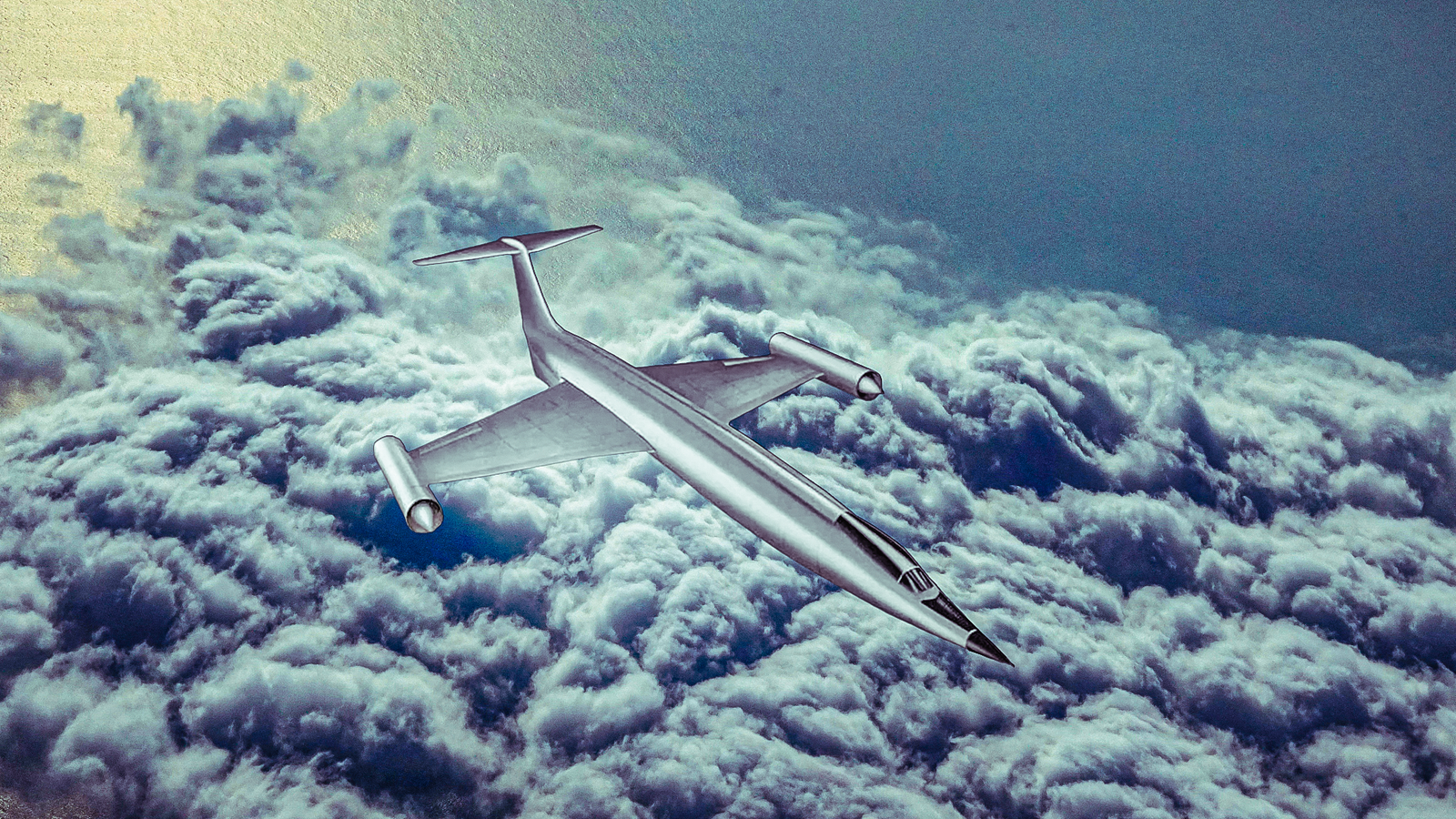
Published Sep 28, 2026, 12:00 AM EDT Aaron is an aviation enthusiast and world traveler with a deep interest in aerospace history and technology. He has traveled around the world numerous times, often incorporating visits to aviation museums and historic aircraft collections into his journeys. A native of New Zealand, he is an expert in aviation and maintains a broad interest in a variety of other subjects. Engineers have long seen hydrogen as offering a range of attractive benefits over traditional kerosene jet fuel for aircraft. However, hydrogen has very low energy density by volume, meaning that storing enough of it requires significantly more space than conventional aviation fuel. One of the most remarkable aircraft that never flew was Lockheed's effort in the 1950s to develop a hydrogen-fueled successor to the Lockheed U-2 spy plane. To accommodate the hydrogen, however, the aircraft was to be enormous. The Lockheed CL-400 Suntan appears almost sci-fi by today's standards, even if it does resemble a massively upscaled F-104 Starfighter. Yet it was also somewhat typical of its time. The 1950s and 1960s were a period of enormous change and experimentation in aviation, with engineers exploring numerous technologies and development pathways, many of which ultimately proved impractical or were overtaken by competing approaches. Here is what to know about Lockheed's remarkable CL-400 Suntan spy plane that never flew. The Need For A U-2 Replacement Credit: US Air Force The succession of ultra-high-flying early US Cold War spy planes is often presented as the Lockheed U-2 Dragon Lady and then the SR-71 Blackbird. The SR-71 was then replaced by an assortment of drones, signals intelligence, remaining upgraded U-2s, and satellites. But there were other programs, including some that didn't get out of the prototype stage. The Lockheed CL-400 Suntan was a prototype reconnaissance aircraft project that would have created a much faster and higher-altitude successor to the U-2 Dragon Lady. The Lockheed U-2 was developed in a time before satellites existed and when the US had no ability to see what was happening in the interior of the Soviet Union. The aircraft was designed by the CIA to fly at an altitude above 70,000 feet (21,300 meters), out of range of enemy air defenses of the early and mid 1950s. Lockheed first proposed the aircraft in 1953, with the first test flight in 1955, and it entered service in 1956. But almost immediately, US planners knew that the fast-developing Soviet surface-to-air missile defense would make it vulnerable. By the mid and late 1950s, work was already underway to develop a replacement. The first U-2 (piloted by Gary Powers) was intercepted and downed by the Soviets in 1960. This breathed renewed energy into fielding a replacement, which would be the SR-71. Credit: US Air Force But one of the aircraft Lockheed conceived to replace the Dragon Lady was the Lockheed CL-400 Suntan. It is regarded as one of the most extraordinary aircraft never built. According to its intended designs, drawn up in complete secrecy by Kelly Johnson's Skunk Works, it would have flown at Mach 2.5 and reached an altitude of around 100,000 feet (30,500 meters). This was almost twice the speed of the U-2 that it was intended to replace, and even higher than the SR-71 that would come later. Development work was done on the CL-400 Suntan between 1956 and 1958. NASA writes, "CIA and Air Force analysts concluded the U-2 would have a relatively short operational lifespan before hostile antiaircraft technology rendered it obsolete. As early as 1956, just as the U-2 was becoming operational, Johnson American Institute of Aeronautics and Astronautics 4 proposed a Mach 2.5 hydrogen-fueled airplane capable of cruising above 99,000 feet. Only 25 people were cleared into this special access program, code-named SUNTAN." Lockheed initially received a contract for two prototype CL-400 reconnaissance aircraft, with the first expected to fly in 18 months. Soon after, it received a contract for six aircraft. The first time that the CL-400 program was publicly discussed was in 1973 by Ben Rich at a symposium on hydrogen-fueled aircraft at the NASA Langley Research Center. The original design had the fuselage measuring 160 feet (49 meters). Runaway Engineering Issues Credit: NASA It would have carried 21,500 lb (9,740 kg) of liquid hydrogen. A retractable ventral fin helped to improve directional stability at supersonic speeds. The engines were to be designed by Pratt & Whitney. It was envisioned to have a range of 2,200 nautical miles (4,074 km), although this could only be extended by a considerable increase in the size of the aircraft. The aircraft's anticipated operational radius of only around 1,000 nautical miles (1,852 km) became a matter of great concern. But the designs soon ran wild. Lockheed's initial Suntan studies soon called for an aircraft almost 300 feet (91 meters) long with a gross takeoff weight of 358,500 pounds. This was almost double the length of a Boeing 747. The design came with numerous technical challenges, including materials, manufacturing, the integration of the airframe and the powerplant, storage and handling, and fuel production. Planned specifications for Lockheed CL-400 Suntan (per NASA) Crew 2 Length (initially) 160 feet (49 meters) Wingspan 83 feet, 9 inches (25.5 meters) Cruise speed Mach 2.5 Operating altitude 100,000 feet (30,500 meters) Fuel Liquid hydrogen Engines 2x Pratt & Whitney Model 304-2 Soon, technological problems overwhelmed the project. More studies found that the aircraft's design and mission requirements gave the CL-400 severe range limitations that existing technology could not overcome. In 1957, Johnson recommended to the Air Force that it cancel the program in favor of an aircraft with a more conventional propulsion system. He also advocated a smaller and lighter airframe that could be powered by a pair of Pratt & Whitney J58 engines. The CL-400's Hydrogen Fuel Credit: NASA One of the more notable aspects of the CL-400 was that it was to run on hydrogen. Today, hydrogen is seen as the zero-carbon aviation fuel of the future and is one of the main candidates to decarbonize the wider transport industry. It is remembered as the fuel that doomed the Hindenburg airship in the 1930s. But it was also seen as necessary for the CL-400 if it was ever to succeed. Hydrogen contains around three times more energy per unit of weight than kerosene. It is also a lighter fuel that helps to reduce the overall weight of the aircraft. Another attraction was that it burned cleanly and predictably at high altitude. But one of hydrogen's long-running engineering hurdles has been its low density (high combustibility was the problem for the Hindenburg). While liquid hydrogen has the benefit of extremely low density, making it light, it also occupies around four times the volume of jet fuel. The bulky nature of hydrogen fuel makes it difficult to transport today and is one of the key limitations in its mass adoption with trucks and aircraft. For the CL-400, this meant the aircraft needed to have an enormous 10-foot (3-meter) fuselage, almost entirely devoted to accommodating insulated cryogenic tanks. Engineering Challenges Of Using Hydrogen Fuel Credit: H2 Clipper NASA notes that the hydrogen tanks and systems for the hydrogen-fueled aircraft, along with the few lower temperature and density of the fuel "posed special design problems" for its tanks, pumps, lines, instrumentation, and other fuel system components. The CL-400 design divided the hydrogen tankage into three sections. These were: the forward tank had a capacity of 17,700 gallons (67,000 liters); aft, 15,250 gallons (54,000 liters); and the center (sump), 4,000 gallons (15,000 liters). As the engines were mounted at the wing tips, the liquid hydrogen had to pass through the hot wing, where temperatures could reach up to 436 Kelvin. While Lockheed worked to engineer its way around the various challenges, there were still many unknowns in the design of hydrogen tanks, and it carried out a range of tests to learn more. This led to the team developing an unprecedented liquid hydrogen production infrastructure at Burbank and West Palm Beach. At one point, United Aircraft Corporation (later United Technologies and now merged with Raytheon, part of RTX) became involved in liquid hydrogen as a propulsion fuel in 1955 on the initiative of the power plant laboratory at Wright Field. NASA writes, "Acting on a directive from its headquarters, the laboratory initiated a procurement request in January 1955 to investigate hydrogen as a fuel in turbojet engines." The Space Flight CL-400 Legacy Credit: NASA Suntan was canceled in February 1959 at Johnson's request. According to NASA, Johnson's final design, the hydrocarbon-fueled CL-400-15JP, went on to serve as a stepping stone for the Archangel project that would eventually produce the A-12. The A-12 was the forerunner of the SR-71. But in a way, the greatest impact of the CL-400 and its experimentation with hydrogen fuel was in space flight. While the aircraft never flew, the LH2 pumps, liquefaction plants, and cryogenic know-how directly fed into NASA programs. In the end, it was range that brought the CL-400 program to an end, not the fear of hydrogen being dangerous. As the design matured, its range became much shorter than originally intended, as the bulky hydrogen tanks created too much drag. One insight from Suntan was that Mach 3 with conventional fuel was more practical than Mach 2.5 with hydrogen. But one of its primary forgotten legacies was NASA's Apollo. The canceled CL-400 taught US engineers how to produce liquid hydrogen in industrial quantities, how to transport it safely, how to store it, and how to rapidly transfer it between vehicles. These were the same cryogenic handling techniques that would be needed as the foundation of the Saturn V program (which launched the Apollo missions) and later the Space Shuttle. These used liquid hydrogen as rocket fuel.
The Lockheed Spyplane That Briefly Made More Liquid Hydrogen Than Anywhere Else In America
Full Article
Original Source
Read the full article at Simpleflying →KhanList aggregates and links to publicly available news content. We do not host full articles from third-party sources. Always verify important information with original sources.