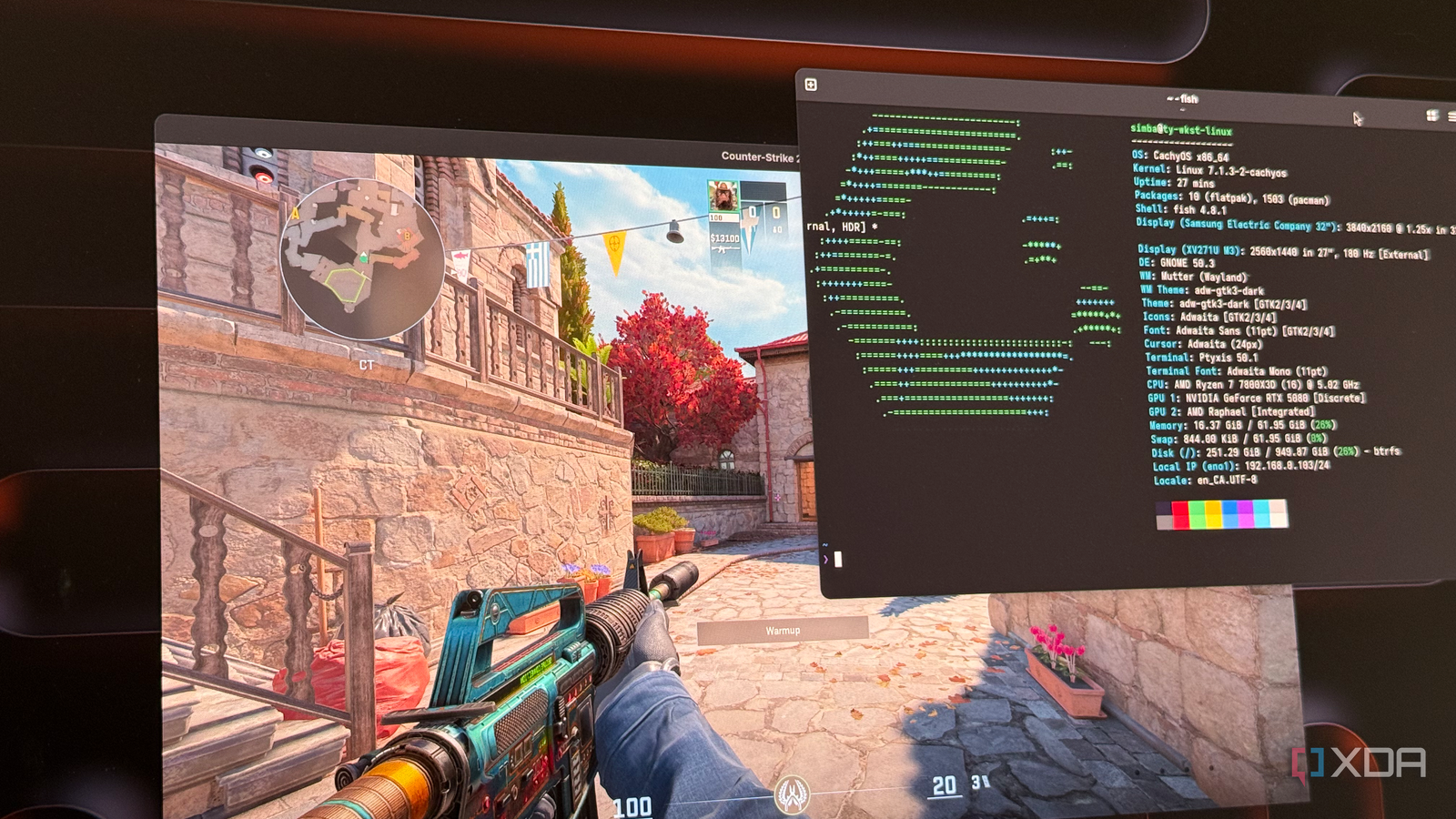
Published Aug 10, 2026, 12:30 PM EDT His love of PCs and their components was born out of trying to squeeze every ounce of performance out of the family computer. Tinkering with his own build at age 10 turned into building PCs for friends and family, fostering a passion that would ultimately take shape as a career path. Besides being the first call for tech support for those close to him, Ty is a computer science student, with his focus being cloud computing and networking. He also competed in semi-pro Counter-Strike for 8 years, making him intimately familiar with everything to do with peripherals. When the Open Gaming Collective was announced on January 29, the founding member list read like a roll call of the usual suspects involved in Linux gaming outside of Valve. Universal Blue was present with Bazzite, Nobara, ChimeraOS, ASUS Linux, PikaOS, and the list goes on. There was one curious omission from that list, and it wasn't an accident. CachyOS wasn't on the list, despite having one of the most engaged user bases in the Linux gaming category. This wasn't an accident, and its founder was clear as to why. More than six months on from the OGC announcement, nothing has changed with the trajectory of CachyOS, and if anything, it has only picked up more steam. CachyOS's objection was never a technical one None of the reasons had to do with code Peter Jung, who founded CachyOS and drives most of its kernel work, pretty clearly laid out his reasoning in a Reddit thread the day after the announcement. The team had considered joining, but opted out because they didn't see much of a benefit on their side. The headline handheld support isn't CachyOS's main focus, and he mentioned his concern about the whole arrangement turning into a "bureaucratic loophole." He went on to add that the team didn't want to be associated with Playtron, the company behind GameOS and the Web3-linked SuiPlay0x1 handheld, which sits among the OGC's founding members. The timing of the OGC's creation and Bazzite's involvement supplied CachyOS with another reason to stay away, and it had to do with Bazzite's removal of Antheas Kapenekakis, the developer who created Handheld Daemon and much of what made Bazzite work well on non-Valve handhelds. Bazzite then dropped Handheld Daemon in favor of InputPlummer as part of its OGC alignment. Jung's read on the situation was that the initiative looked rushed and seemed like an effort to find new kernel maintainers. They haven't missed anything by not joining Upstream-first cuts membership out of the delivery path The OGC's stated policy is that any code it produces or improves should live in the original project rather than surviving as a permanent fork or patch, and this "upstream-first" attitude is more of a rigorous technical policy than a simple preference within the group. If you take it at its word, this means that something like a controller bug fixed in the stable branch gets pushed upstream, and that reaches you on CachyOS eventually, and even something like Mesa works the same way. If the improvement is made via the OGC, it doesn't exclusively get pushed to OGC distros. They still maintain their own kernel builds, downstream gamescope forks, and tooling like ScopeBuddy, and those reach the member distros first, but CachyOS recieves all of the core things that make a distro feel better to game on, and that's what's most important anyway. In the same aforementioned Reddit thread, Jung also made it clear that they have already been working with members of the OGC for more than a year at the time of its founding, and felt that joining a collective would be unnecessary as a result. Months later, nothing has changed with CachyOS's adoption It's grown significantly The decision to opt-out of the OGC doesn't seem to have affected CachyOS's adoption rate among gamers, and its only seemingly gone from strength to strength in the last few months. According to Valve's Steam Hardware Survey, CachyOS ranks second at 14.31% of users with only SteamOS above it at 22.24%. The only OGC distros reported on this list are Bazzite at 7.73% of users and Nobara coming in at 1.65%. SteamOS Holo holding at number one isn't a surprise, as it's what arrives preinstalled on the Steam Deck and the Steam Machine. Set aside the hardware Valve sells with an operating system already on it, and CachyOS leads every distro that users go out of their way to install for gaming specifically. The survey is opt-in, which definitely muddles things a bit, but it's also worth noting that CachyOS isn't primarily marketed as a gaming distro, either. It isn't mentioned anywhere on their home page, and while it does have a wiki page dedicated to gaming, it's more than halfway down the sidebar. Its primary mission is to offer high performance while maintaining the consistent rolling release schedule that Arch users expect, and that isn't specific to gaming. The OGC can be a positive for you, the user, but your distro doesn't have to be a part of it CachyOS's growth isn't due to opting out of the OGC, but it's also not an accident. What the last few months have illustrated is that growth is dictated by quality, and users will by-and-large install the OS that fits their use case the best. The OGC enables developers to more easily work together, which can be a positive for everyone downstream of that development work, including developers that have opted out. CachyOS
The Linux gaming distro that refused to join the Open Gaming Collective is now dominating the Steam charts
Full Article
Original Source
Read the full article at Xda-developers →KhanList aggregates and links to publicly available news content. We do not host full articles from third-party sources. Always verify important information with original sources.