
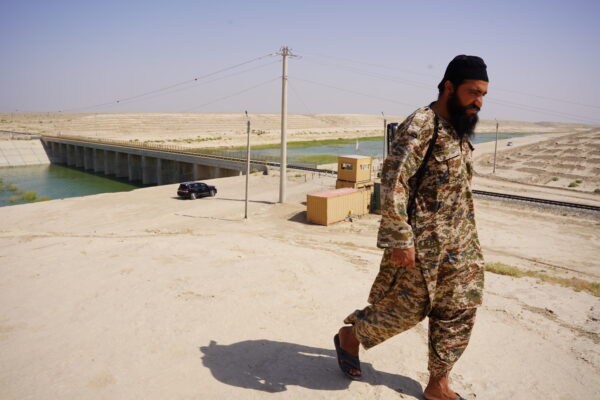
In the female section of an upscale restaurant in Kabul’s Shar-e Naw, a waiter brings me a menu and a form. Only two lines are filled in: one bears an Italian name, the other a local one. The waiter explains that guests are required to fill it in at the request of the Ministry of Interior. It is for the guests’ own safety, he emphasizes, slightly uneasy. It is hard to tell if he believes it. I look at the form. It asks for the guest’s name, date of birth, passport number, address in Kabul, as well as when they visited the restaurant. “It is for your security,” the waiter repeats. I give him the blank form back. “I feel secure without it,” I say. He doesn’t insist. He takes my order and disappears. Five years after the withdrawal of NATO troops from Afghanistan, and into the rule of the Taliban, the group’s control over the country is stable. While the Taliban might not have access to the newest surveillance technologies, their infiltration of local communities is high. They had learned their lesson from their first period of rule, the emirate that ended in 2001 with the U.S. invasion, a United Nations official tells me. “You can say that fundamentally, ideologically, they haven’t really changed. But in terms of control, consolidation, management, messaging, they are far more sophisticated now,” he says. “The first emirate was a brand new experiment. The second emirate is still an experiment, but they have learned a lot of lessons. They are smart.” Kabul still reminds me of its former self, as if time had stopped. The streets are bustling with life; street vendors cover the pavements, selling products ranging from food and cigarettes to clothes and electronics. The new regime is seen in the details: fewer women walk the streets, less rubbish lies scattered across the city center – a lasting feature of the corrupt rule back in the Republic days – and the streets seem less chaotic. But at first glance, the changes are small, sometimes imperceptible. A Taliban checkpoint in Balkh province, Afghanistan. Photo by Agnieszka Pikulicka. Everyone I speak with says that the country has become safer. Twenty years of war and decades of fighting have taken their toll on people. The Taliban, while brutal and devoted to anti-modern ideas, has nevertheless brought peace. The paradox is that the Taliban were the main perpetrators of violence during the Republic days. It was due to their attacks on cars that traveling between provinces used to be dangerous and caution was advised. Since they took power, traveling between different regions of Afghanistan has suddenly become possible. Now, Taliban checkpoints cover the whole country. Some of them are stricter, with soldiers standing under the white flag bearing the Shahada, the Islamic declaration of faith, and the Taliban symbol, checking travel permits meticulously. Other checkpoints are more relaxed, and it is enough to slow down and let the Taliban gaze into the car. There are few roads that the group does not control. To leave their place of residence, drivers need special permits, and so do tourists. A letter from “Afghan Tour,” a unit responsible for travelers, is required to travel and stay in another province. It is unclear what its purpose is, other than surveillance. In Kabul, the “Afghan Tour” official says that getting a travel letter requires paying for an expensive tour. But it is possible to get it in Bamyan, another province, for a small fee. Most other regions also issue such letters in exchange for booking an inexpensive “tour” with an official guide. It is unclear if its price is official or simply a bribe paid for obtaining the letter. It is also hard to call it a tour. As part of the “tour” I book to stay in Mazar-i-Sharif, the local guide shows me into the Blue Mosque, the shrine of Imam Ali, first built in the 12th century before Genghis Khan leveled the original building to the ground. But the tour included little in terms of a history lesson. The guide complained about his low earnings, suggesting I pay extra for his time. Then he demanded that I share my local contacts with him. For my own safety, of course. Today the new Taliban administration is stable. Ministries work, and courts solve disputes without the need to pay bribes, I am told. 96 percent of the poppy fields have been eradicated and hundreds of addicts who formerly squatted on Kabul’s streets and under bridges have been forced into rehabs. This is the kind of “stability” I know all too well from Central Asia’s autocracies, Afghanistan’s neighbors: they are brutal and relentless, but the pavements are clean. According to a recent report from Human Rights Watch, censorship of local media outlets and restrictions on freedom of expression have intensified, while journalists, activists, academics and other regime critics have faced repression, torture, and arbitrary arrests. “The Taliban always accuse us of being spies, it’s hard to work these days,” one local photojournalist told me. The Blue Mosque, the shrine of Imam Ali, in Mazar-i-Sharif. Photo by Agnieszka Pikulicka. Women have been denied basic rights, such as the right to education beyond sixth grade. A woman visiting her parental home who does not return to her husband can be deemed a criminal. That includes survivors of domestic violence. A woman accused of touching, shaking hands with, or hugging a man who is not her mahram, a close male relative with whom marriage is prohibited, can spend a year in prison. Two months if a girl or a boy is seen dancing. A new “Preachers’ law” defines Muslims as followers of the Hanafi school of Islam. Local Hazaras, or Ismaili minority groups, are now officially deemed heretics. “Many Ismailis now hide their faith,” one man from the community tells me. He lost his job in a school in Badakhshan due to his faith. All that in the name of the “peaceful and clear sky above us,” as Uzbekistan’s late President Islam Karimov used to say in justifying his own repressive rule. Except that this is not the reality for most Afghans. While the war might be over – except for skirmishes in Badakhshan province and regular attacks from Pakistan – Afghanistan is hardly facing a post-war recovery. The withdrawal of U.S. and NATO troops and the coming to power of the Taliban, a government recognized only by Russia, meant that the United Nations mandate became much more restricted in scope. Cooperation with the de facto Taliban authorities has focused mostly on securing people’s very basic needs. Most international non-governmental and governmental organizations, and media, have left, and with them hundreds of local jobs disappeared. The biggest difference is noticeable in large cities: Kabul, Herat, or Mazar-i-Sharif, where previously educated, English-speaking men and women could find employment and develop careers. As another local journalist told me, during the Republic days he could support his family working as a photographer and videographer. Now, work is scarce. He has not had any projects for several months. “The situation seems to get worse every day and every year. Unemployment has reached a very high level, especially for people like me who work in the arts and creative fields,” he says. “People of Afghanistan are facing many other serious problems, including unemployment, untreated illnesses, hunger, poverty, and lack of adequate shelter. I do not see a clear government plan to address unemployment at its roots.” According to the United Nations, more than 17 million people, or 40 percent of Afghanistan’s population, are projected to face acute food insecurity. And the situation is worsening. While following the U.S. withdrawal, thousands of Afghans left the country in search of a better life, this trend is now reversing – though not voluntarily. Over the last few years, Iran and Pakistan have forced millions of Afghans to return home. Even the European Union, including Germany, a country with the largest Afghan population in the region, began to deport people back despite fears of torture and imprisonment upon arrival. This has put a massive strain on the already impoverished nation with very limited resources. As the U.N. official told me, at the time of 9/11, in 2001, Afghanistan’s population was around 20 million. By the time of the return of the Taliban, twenty years later, it had doubled. Over the last five years of the second emirate, the population has grown by 5 million, and currently totals around 45 million. “There has been almost triple pressure on resources, on communities, on infrastructure and humanitarian needs. And development hasn’t kept up. People are coming back to a country and to communities that are not equipped to sustain them,” the U.N. contact told me. “Even though we see economic growth, it’s not keeping up with population growth. And then on top of that a lot of people are coming back to urban areas, which is putting even more pressure on urban systems.” In other words, over the past five years the population grew by 12.6 percent, while at the same time, the amount of skilled work opportunities fell amid the withdrawal of the West. Women have been banned from a number of professions, which pushed many families into even deeper poverty. While traditionally conservative and impoverished rural areas have not seen much change, cities, where women were more emancipated under the Republic, have experienced the greater shifts. In Kabul, I meet with several young women, the friends and family members of my girlfriends who have long left the country. They are a lost generation. Unable to study beyond sixth grade, unable to follow their passions and have careers, they often live online. Some learn English, others open small businesses selling handmade accessories on Instagram, one of the few avenues left for Afghan women to make a living. But pressure is high. A friend hosted a get-together for women in a female section of a Kabul restaurant. She was summoned by the Taliban. The meeting was deemed suspicious. She still hasn’t told her parents and brothers about the interrogation. That would mean she would not be allowed to leave the house on her own. For her own safety. My friend is a brave, educated woman with good English. She wants to work and develop new skills, something that the local government sees as sinful. Her very existence is a threat to the system. Five years since the coming to power of the Taliban, tourism has appeared. Some travelers, hoping for an extreme experience, walk the streets of Kabul and other cities, talking to the Taliban and taking selfies. For someone like me, who had worked in Afghanistan for years under the Republic, this is an ominous view. People who only a few years back would want to kidnap a white traveler are now being depicted as dream hosts, embracing Western backpacking culture and adding an Oriental feel to flashy Instagram posts. The spectators will continue watching the events taking place in Afghanistan like a sneak peek into the life of another planet. The Republic times were not perfect: corruption was rampant, violence omnipresent, and the Taliban, the Islamic State, al-Qaida, and other groups continued to operate. The U.S. occupation, which cost roughly $2.3 trillion, failed to build lasting institutions or even basic infrastructure. As one of my friends snarkily remarked: “We still use roads built by the Soviet Union. All the Americans did was bring the Taliban back.” He is right. And following the American fiasco, no outside power is eager to get involved in Afghanistan again, no matter their horrific human rights record. Any militant challenge to the Taliban from within Afghan communities is limited and so far short-lived. The Taliban have learned their lessons and they know how to control their territory. This is something that China, Russia, and Central Asian states have already come to understand. They engage with the Taliban government in regional projects, China even makes investments. For the region, this is the new normal. The Taliban are here to stay.
The Lessons the Taliban Have Learned
Full Article
Original Source
Read the full article at Thediplomat →KhanList aggregates and links to publicly available news content. We do not host full articles from third-party sources. Always verify important information with original sources.