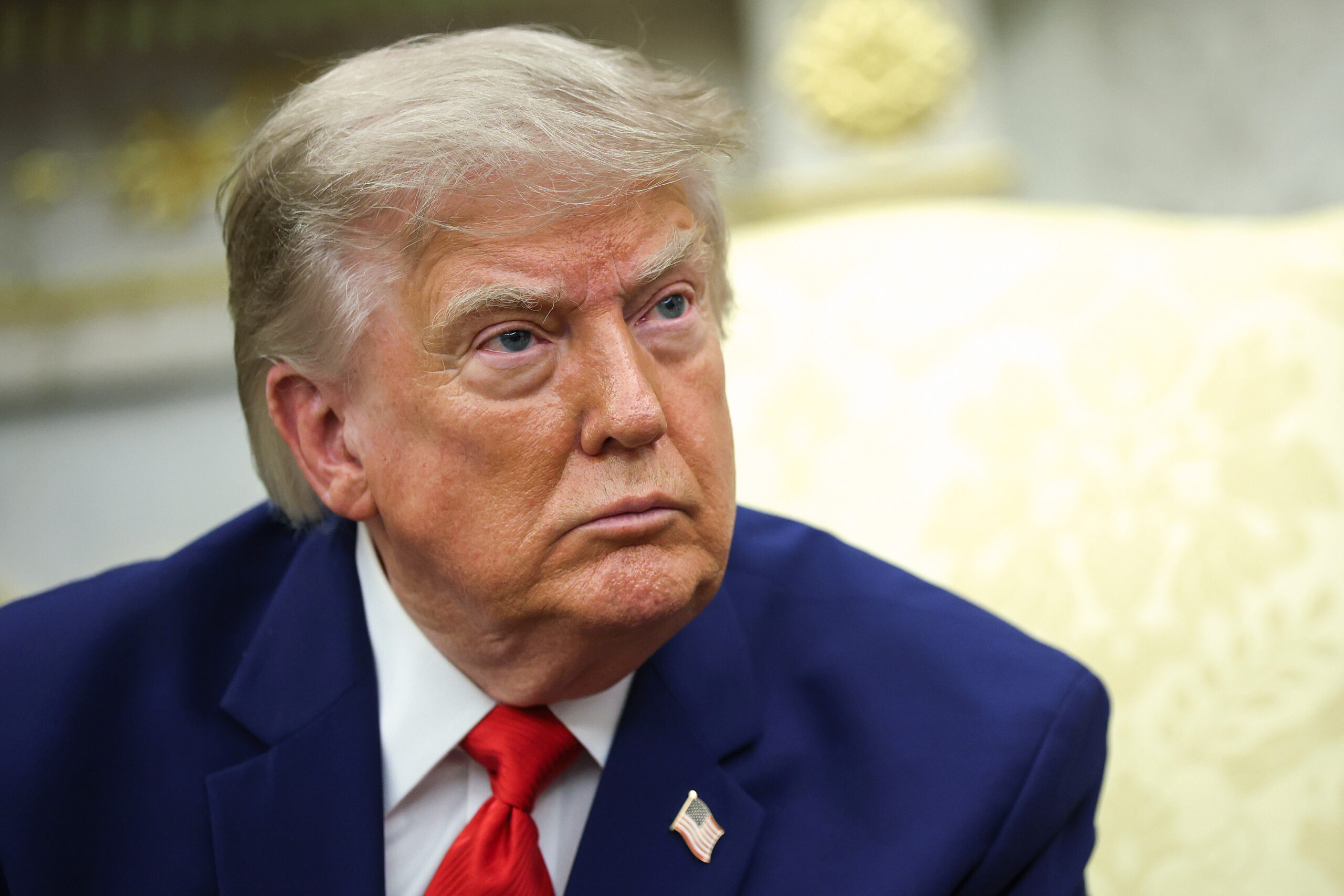
Foreign Affairs Strength is best manifested in cooption, not force. Photo by Kevin Dietsch/Getty Images “If you cross the Halys River and attack the Persians, you will destroy a great empire.” According to Herodotus, when Lydia’s King Croesus asked the Oracle at Delphi whether to make war on Cyrus the Great, he heard only what he wanted to hear, crossed the river and lost. The empire he destroyed was his own. Today’s oracles are far less discerning. When pastors gathered in the Oval Office this past March to lay hands on the president and pray for war, not one paused to warn him of the cost. Yet this modern hubris was not born in a vacuum. The crisis was a decade in the making. The first Trump Administration’s 2018 withdrawal from the Iran nuclear agreement all but guaranteed that Tehran would accelerate the stockpiling of highly enriched uranium. The military strikes in 2025 ended what little on-the-ground monitoring remained, and the war launched this year has given the Iranian regime every reason to finish the bomb. The Six-Day War of 1967 offers a lesson worth remembering. It is nearly impossible to know exactly when a covert nuclear program produces a usable weapon, especially when a state perceives an existential threat and political pressure distorts the intelligence. Robert McNamara called the 1962 Cuban Missile Crisis the most dangerous moment of his seven years as secretary of defense, and unprecedented in human history. It is not widely known that he explicitly coupled Cuba with two other historical events that also brought the world within a “hairsbreadth,” as he put it, of nuclear war: the 1961 Berlin Crisis and the 1967 War. During that latter conflict, Washington and Moscow both came close to a nuclear confrontation. Egypt, having previously deployed chemical weapons in Yemen, possessed a rocket program aided by scientists from Nazi Germany. Additionally, prominent Nazis had relocated to Egypt and Syria through networks the CIA-backed Gehlen group quietly facilitated. Meanwhile, entirely outside the awareness of much of the American security establishment, Israel had secretly crossed the nuclear threshold and stood ready to detonate a device in the Sinai. The proposed delivery system was by helicopter. This historical context helps us to understand the possible hidden dangers lurking below the surface. In addition to its highly enriched uranium stockpile and deeply fortified centrifuges, Iran controls a geopolitical lever of almost equal consequence in the Strait of Hormuz, a kill switch for the global economy. Now that there is an active war again, Iranian leadership is making it clear that any further strikes will provoke eye-for-an-eye attacks on American military installations and their host nations. If the crucial oil terminal at Kharg Island is destroyed, Tehran will simply go after Gulf petroleum infrastructure in kind, triggering an exchange that would send the global economy into a tailspin. If the U.S. goes after critical civilian infrastructure, Iran will do the same, as was demonstrated last week by the attack on a Kuwaiti desalination plant. While the Houthis have fired ballistic missiles at Saudi Arabia as a warning and declared an anti-Saudi “maritime blockade,” they have yet fully to close the aptly named Bab el-Mandeb, or Gate of Tears, which would sever the maritime route to the Suez Canal. The Iranians still have not played this card. A threshold nuclear program, a conventional arsenal buried deep in mountain tunnels built for this exact contingency, and two maritime chokepoints capable of strangling global shipping create a crisis of historic proportions. Excluding the 28-day ceasefire, the 2026 Iran War has now run roughly as long as the Spanish-American War, the nineteenth-century conflict that forged America into a global power. That conflict marked a beginning. This one looks more like an ending. It signals the death of the Carter Doctrine and the collapse of a half century of American primacy in the Middle East. As the military exhausts itself trying to reopen a strait Iran has proven it can close, surging energy prices are squeezing American consumers while China quietly exports its green energy revolution across the globe. The same voices across Israel, the Gulf, and Washington that pushed the president into this fight are now demanding escalation. They want American ground troops to force the strait open, a move that would make the wars in Iraq and Afghanistan look mild by comparison. Yet Mr. Trump still has the chance to choose a better and indeed a bolder path. Here is what is required. First, any real solution starts with a hard truth. The road to Tehran runs through Jerusalem. Americans tend to trace their enmity to the 1979 hostage crisis, while Iranians point to the 1953 CIA-backed coup. Without question, the unresolved Israeli–Palestinian conflict has long been the primary fuel for Iranian-backed extremism. Hezbollah, Hamas, the Houthis, and the Iranian Revolution itself all legitimize themselves as resistance movements against Israel. An Arab League–endorsed two-state settlement, along the lines Ehud Olmert proposed and Mahmoud Abbas considered in 2008, would not suddenly end Iran’s regional ambitions. But it would strip away the language of resistance Tehran uses to justify decades of bloodshed. Furthermore, it would halt incendiary settlements and lawlessness in the occupied territories. Second, Iran needs a seat at the regional table. A country approaching one hundred million people, sitting on some of the most strategically important real estate on earth, cannot simply be fenced out forever. Since 1979, every attempt to isolate Tehran has only bred more instability, obscuring genuine opportunities to engage on shared threats like severe droughts and the explosion of noncommunicable diseases, the region’s greatest killer. (Twenty-five million people in the Middle East are projected to die from NCDs over the next decade.) Subscribe Today Get daily emails in your inbox Third, the Strait of Hormuz itself should be internationalized, not managed through fragile bilateral memorandums between Washington and Tehran that assume the rest of the world has no stake in the outcome. China, Pakistan, and India, in particular, depend on the strait remaining open and exercise tremendous military and economic leverage over Iran. All belong formally in whatever arrangement eventually governs it. Those same three nuclear powers should also be brought into a broader regional nonproliferation framework, one honest enough to finally acknowledge Israel’s undeclared nuclear arsenal, which has quietly shaped the politics of the Middle East for over half a century. Croesus attacked Persia believing war would make his empire stronger, only to lose everything to Cyrus the Great. Yet Cyrus is remembered as more than a conqueror. Through the policies reflected in the Cyrus Cylinder, he promoted the restoration of displaced peoples and religious institutions, actions that many later generations have viewed as an important antecedent to ideas of religious tolerance and minority protection. His most revealing act, however, occurred after the battlefield fell silent. Rather than executing the defeated Lydian king, Cyrus spared him and, according to Herodotus, welcomed him into his court as a trusted adviser. In doing so, Cyrus transformed a sworn enemy into a valued counselor, demonstrating that durable power could rest as much on magnanimity as on military prowess. Trump would be wise to remember the ancient wisdom captured in Herodotus’ paradox. The mightiest of the mighty turns an enemy into a friend.
The Lesson Trump Can Take From Herodotus’ Paradox
Full Article
Original Source
Read the full article at Theamericanconservative →KhanList aggregates and links to publicly available news content. We do not host full articles from third-party sources. Always verify important information with original sources.