
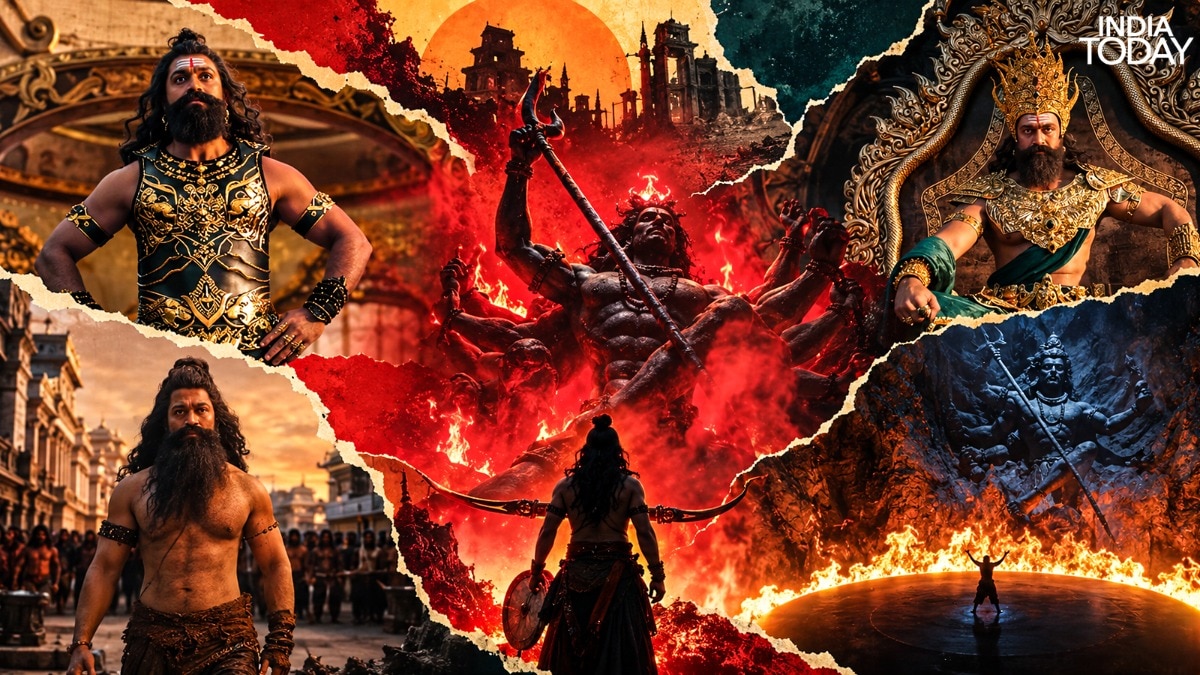
The Ravana Tandav music video from director Nitesh Tiwari's Ramayana: Rise of a Legend offers a rare glimpse into a character archetype that modern cinema rarely knows how to handle. In the visual sequence from the film, Yash’s Ravana stands inside a cavernous, fire-encircled sanctuary beneath a towering monolith of Mahadev, delivering a raw, rhythmic chant of complete devotion.On the surface, it appears to be a high-budget visual spectacle. But beneath the thunderous soundtrack and cinematic smoke lies something far more ambitious: an attempt to reclaim one of the most misunderstood conflicts in ancient literature — the legend of how the Shiva Tandava Stotram was born.To understand why this sequence matters, one has to peel back centuries of pop-culture simplification. Popular folklore often reduces the King of Lanka’s trek to Mount Kailash to a single, crude act of hubris — a monstrous conqueror attempting to physically tear the sacred mountain from the earth to prove his cosmic dominance.It is a clean, easy story for a standard blockbuster villain. But it completely ignores the character who actually made the journey.Long before he was branded the ultimate antagonist, Ravana was an intellectual titan. Born to the revered sage Rishi Vishrava and descended from Maharishi Pulastya, one of the mind-born sons of Brahma, he was a scholar who had mastered the four Vedas and the six Shastras. He was an expert on statecraft, an accomplished musician, and a ruler who understood the mechanics of the universe better than almost anyone of his era.Ravana did not march to Kailash out of mindless rage. He marched because he had exhausted every conventional ritual, every formal sacrifice, and every Vedic mantra known to mortal men in his desperate bid to behold Lord Shiva. For a scholar who had never encountered a boundary he could not cross through sheer intellect, encountering Mahadev’s absolute, unyielding silence was an unprecedented crisis.This is where the narrative shatters the standard templates of modern fantasy storytelling.In contemporary Western pop culture, the definition of a "villain" or a cosmic antagonist is almost always linked to an insatiable hunger for physical hardware. Thanos spends movies hunting the Infinity Stones; Darkseid wages war across galaxies for the Anti-Life Equation; Steppenwolf bleeds for the Mother Boxes. Supreme power in modern fiction is almost always represented by a tangible object, a sci-fi artifact, or a sudden power upgrade.Ancient Indian epics, however, operated on a completely different philosophical plane. The scholar-king of Lanka did not trek into the icy, unforgiving terrain of Kailash to hunt for a weapon. He already possessed supernatural armaments and military might that made kingdoms tremble.What drove his journey was a restless, spiritual ambition — a desire to confront and experience the supreme, unmanifested energy of the cosmos itself.When classical traditions describe his arrival at Kailash, the tension is not physical; it is psychological. Faced with the quiet, indifferent majesty of the mountain, the great scholar realised that all his Vedic degrees, his royal lineage, his political genius, and his military dominance meant absolutely nothing.Every strategic calculation failed. Every formal prayer fell silent.Driven to the absolute brink of frustration, Ravana reached the single most terrifying moment for an intellectual powerhouse: the total realisation of his own powerlessness. He dropped his weapons, abandoned his royal composure, and stripped away every layer of his pride.Standing in the frozen wilderness, he began to sing. Not in formal, rehearsed liturgical prose, but in a raw, explosive, highly rhythmic impulse of poetic surrender — the Shiva Tandava Stotram.Voicing his deep spiritual longing, he says, "Kada nilimpanirjhari nikunjakotare vasan, vimuktadurmatih sada shirahsthamanjalim vahan | Vilolalolalochano lalamabhalalagnakah, Shiveti mantramuchcharan kada sukhi bhavamyaham || (When will I be happy, living in a cave near the celestial river Ganga, keeping my hands folded above my head, with all evil thoughts washed away, continuously uttering the mantra of Shiva?)"Notice what happens in that verse. The king who ruled golden palaces asks for a cave. The ruler who commanded armies asks only for folded hands and a cleansed mind.When Lord Shiva finally acknowledged his devotion, the boon granted was not a flashy sword or a cosmic superweapon. According to Puranic accounts, what cemented his invincibility was the unshakeable inner aura born from total surrender to the divine.That is the paradox at the heart of his character. He was a seeker whose supreme intellect eventually led him to understand that true power cannot be stolen, demanded, or conquered — it can only be realised when the ego is burnt to ashes. By grounding its newest visual asset in this deep, introspective lore, the film signals that it isn't just delivering another CGI spectacle, but treating one of epic literature's most complex figures with the narrative gravity he deserves.Ramayana: Rise of a Legend was theatrically released on November 5, 2026.- Ends
The legend of Ravana and the creation of Shiv Tandav Stotram
Full Article
Original Source
Read the full article at Indiatoday →KhanList aggregates and links to publicly available news content. We do not host full articles from third-party sources. Always verify important information with original sources.