
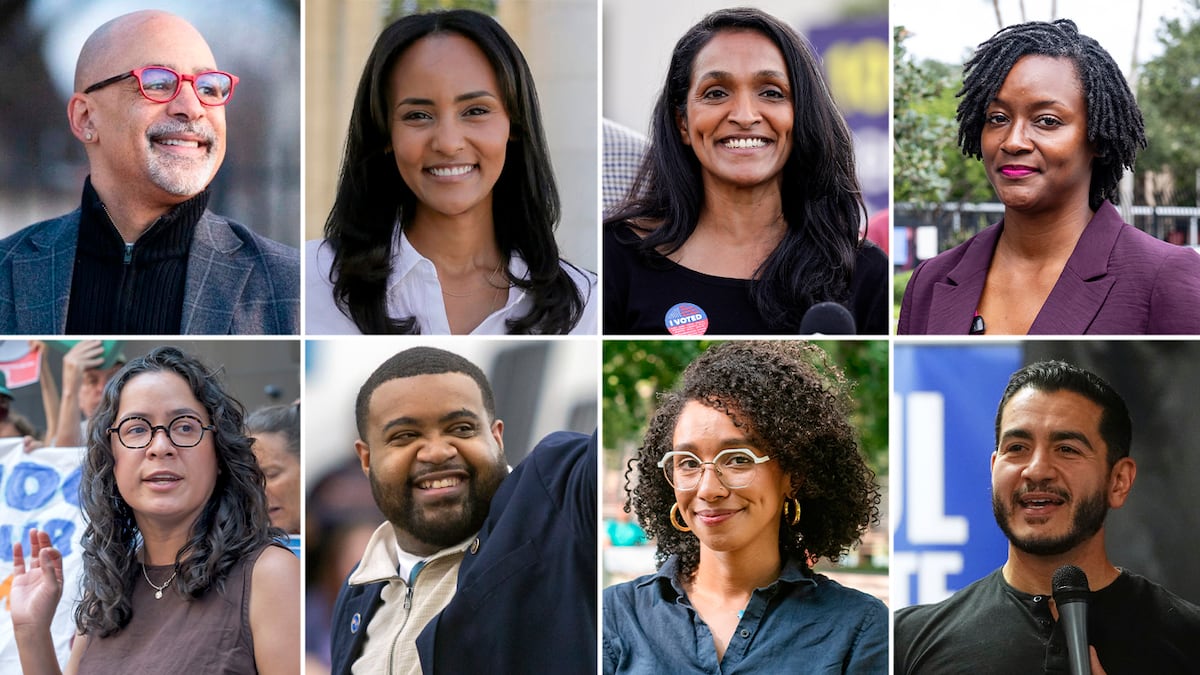
“We won! Thank you, Uptown and the Bronx. I can’t wait to bring you to the halls of power with me!” said Darializa Ávila Chevalier from New York on Tuesday night, becoming the first Dominican and the first socialist to win a seat in Congress. At around the same time in Detroit, supporters were already congratulating the African American candidate Donavan McKinney. And in Michigan, even before she spoke, voters were celebrating Rashida Tlaib’s victory, excited for her to confront the billionaire oligarchs who now surround the White House.These are some of the socialists who scored major victories in Tuesday’s midterm elections, a historic night in which at least five candidates backed by the Democratic Socialists of America (DSA) won congressional races and local executive offices. Until now, the movement’s presence in the House of Representatives had been limited to Rashida Tlaib of Michigan and Alexandria Ocasio-Cortez of New York. Although the DSA is not a registered political party, it backed around 200 candidates, and its influence in Washington is expected to grow beginning next year.“What happened last night raises a question for Democrats about the place of democratic socialism and the left within the party, though it does not provide a definitive answer,” Grant Davis Reeher, a political science professor at Syracuse University, told EL PAÍS. According to Reeher, the widespread rejection of the Trump administration can also be measured by the way Democrats on the party’s left flank “were able to ride that same wave, without being hurt by a smaller base of support or suffering defeats because of their progressive positions.”A Dominican graduate student; an artist and workers’ rights activist; an Ethiopian American lawyer; an advocate for healthcare workers; the daughter of a deportee calling for the abolition of ICE; a writer and educator who is openly pro-Palestinian; a woman who wants to clear Los Angeles’s streets of homeless encampments; and the daughter of Palestinian immigrants fighting against oligarchies. These are the socialists who will arrive in Washington in January, most of them young figures with backgrounds in activism or community organizing, united by several common causes: opposition to the American Israel Public Affairs Committee (AIPAC), condemnation of the genocide in Gaza, support for more affordable cities and universal healthcare, calls to abolish Immigration and Customs Enforcement (ICE), and dissatisfaction with today’s Democratic Party.Beyond a repudiation of Donald Trump’s presidency, the results of the midterm election were also a consequence of the socialist summer sparked by Zohran Mamdani’s campaign in New York, a momentum that carried over into the Democratic primaries. The other major question hanging over these elections was whether the United States was ready to embrace a surge from the more progressive wing of the left, and whether DSA-backed candidates could provide the boost that many believe the Democratic Party has long been lacking.“This puts the debate over the role of the left within the Democratic Party front and center as the presidential election cycle approaches,” Professor Reeher argues. In his view, Democrats already have the board set for 2028, but they have yet to decide on their opening move or their broader strategy. The scenario also poses a challenge for the left: “Will they actually be able to influence policy proposals and, ultimately, policy outcomes?” Reeher asks. “We’ve seen some examples of that in New York City, but can it be replicated across the country?”The biggest surprise of election night, and perhaps its boldest gamble, came in the form of Abdul El-Sayed, who is set to become the first Muslim senator in U.S. history. El-Sayed has described himself as a “capitalist,” not a socialist, yet his political rise was fueled by the same progressive energy that helped younger left-leaning candidates gain ground across the country as the left’s message took hold. “If Abdul can win in Michigan, anybody can win anywhere,” Alexandria Ocasio-Cortez said at a New York fundraiser for his campaign.Not all progressive candidates in the mold of Abdul El-Sayed are socialists, and not everyone backed by the DSA is a member of the organization. EL PAÍS selected some of the figures who drew the most attention ahead of the midterm elections.Claire ValdezValdez is perhaps the socialist who has most consistently championed workers’ rights. Born in Texas, she worked at Taco Bell and Pizza Hut before becoming an artist and moving to New York. Her life took a different turn when she joined the UAW Local 2110 union at Columbia University. Valdez, 37, built her career around advocating for better working conditions and living wages. In an interview with EL PAÍS after winning the primary, she said: “What’s so important to me about being in Congress, and earlier in the State Assembly, is getting as many people as possible to be able to organize, change their lives and recognize their power.”In this election, she won decisively with 83.08% of the vote. When she arrives in Washington as the representative for New York’s 7th Congressional District, she plans to push for passage of the PRO Act, which would make it easier for workers to form unions, hold employers accountable, and strengthen protections and dignity in the workplace.Abdul El-Sayed The first Muslim senator in U.S. history was elected to the upper chamber after a closely fought race in which he ultimately secured 52% of the vote. Abdul El-Sayed, 42, is a physician from Michigan who made universal healthcare a central pillar of his campaign. Over the final days of the race, appearances on CNN with Anderson Cooper and on CBS’s 60 Minutes showed a candidate who looked weary and visibly worn down by the demands of the campaign trail.The long contest left clear marks on someone who had to withstand Islamophobic attacks, firmly defend his stance against Israel, and, in the final stretch, absorb a last-minute blow from Haley Stevens, his former rival in the Democratic primary, who announced her endorsement of Republican candidate Mike Rogers. Although he is not a member of the DSA and has described himself as a “capitalist,” El-Sayed is closely aligned with the movement and political energy reignited by Zohran Mamdani. He has described himself as “a lifelong friend” of the Detroit DSA.Angie NixonAfter a tightly fought race in Florida that remained neck and neck until the end, Angie Nixon fell short in her bid for a U.S. Senate seat, unable to defeat Ashley Moody. But she came far closer than expected, finishing with 47.9% of the vote to the Republican’s 50.87%, despite polls giving Moody a lead of as much as 10 percentage points.Nixon joined the DSA just weeks before the Democratic primary, and her victory in securing the party’s nomination in the heartland of anti-Castro politics came as a surprise. Since then, she has probably been the candidate most frequently forced to answer questions about her ties to the socialist movement. In Florida, a state known for its large Cuban American electorate, which she crisscrossed in a campaign van, Nixon, 42, repeatedly faced the same questions: “Are you a socialist? A communist? Do you support the embargo on Cuba or not?”Time and again, the Jacksonville community organizer and labor activist insisted that she was not, strictly speaking, a socialist. But that was not enough to silence the criticism.Melat KirosAt 29, the lawyer first stunned Colorado politics by defeating a 15-term incumbent in the Democratic primary. She then went on to face Republican Christy Peterson in the race for Colorado’s 1st Congressional District, which includes Denver.Among the pillars of the Ethiopian-born candidate’s campaign were universal healthcare, public housing, and universal childcare, priorities she shares with many DSA-backed candidates. In an interview with the local outlet Denverite, Kiros said she was not only a “proud Democrat” but also hoped to help expand the socialist movement in the United States. “My mission has always been to build out this movement in a way that could actually combat the money and our politics and the corruption in our government,” she said. The result was in line with what the polls had predicted: a commanding victory, with 78.35% of the vote.Darializa Ávila ChevalierThe defining upset of New York’s Democratic primaries came when Darializa Ávila Chevalier, 32, defeated establishment-backed veteran politician Adriano Espaillat despite repeated attacks on her Dominican identity and criticism of her support for Palestine. Riding the momentum generated by Zohran Mamdani’s breakthrough campaign and backed by the mayor, Darializa cleared a path to the House of Representatives as the representative-elect for New York’s 33rd Congressional District.In an interview with EL PAÍS, she said that once in office she would fight to abolish ICE, expand access to housing, and eradicate child poverty. “That should shame the entire country, and we know what the solutions are,” she said.Her election to Washington was widely expected by the time voters went to the polls, and the final results confirmed it: she won in a landslide with 88.27% of the vote, compared with 10.46% for her opponent, Jomo Williams.Donavan McKinneyThe African American democratic socialist from Detroit won 93.30% of the vote to represent Michigan’s 13th Congressional District in the House of Representatives. His background as a union organizer for healthcare workers led him to place Medicare for All and universal access to reproductive healthcare at the center of his campaign. He also championed policies such as federal rent controls and called attention to the need for affordable access to clean drinking water.Another defining feature of McKinney’s campaign was his emphasis on racial representation in Congress, particularly in a majority-Black city like Detroit. Throughout the race, he argued that communities like his deserved leaders who reflected their experiences and priorities.As a democratic socialist, McKinney has said he is committed to “continuing to push for bold, progressive policy” when he arrives in Washington.Alexandria Ocasio-CortezIt has been nearly a decade since Alexandria Ocasio-Cortez made history in 2018 as the youngest woman ever elected to Congress. Today, the central question is whether, once the excitement of the midterm elections subsides, the 37-year-old lawmaker will launch a bid for the Democratic presidential nomination in 2028.The prospect has fueled debate within the DSA itself. Some members continue to back her unequivocally, while others argue that she has drifted away from the organization’s platform and no longer adequately represents the socialist movement. Even so, Ocasio-Cortez has spent years bearing the political costs of being one of the most visible faces of the American left.On November 3, neither polling nor conventional wisdom suggested there was any real chance she could lose the seat she has held for nearly eight years in the House of Representatives, representing New York’s 14th Congressional District. As a result, Ocasio-Cortez broadened her focus beyond her own race and invested her political capital in boosting Democratic candidates across the country, campaigning in states including Michigan, Ohio, California, Nevada, and Florida.The results reflected her strong standing with voters: she won 78.54% of the vote, compared with 20.78% for her challenger, Diamant Hysenaj.Angela Gonzales-TorresShe was raised by her mother alone after her father was deported, giving her firsthand experience of the toll that living without legal immigration status can take on a family. Now, after campaigning for a seat in Congress representing California’s 34th Congressional District, which includes key parts of Los Angeles, the 31-year-old politician has vowed to fight for the abolition of ICE.“We need to hold accountable these ICE agents,” she said in an interview on The Signal podcast. Like many DSA-backed candidates, Gonzales-Torres has advocated for affordable housing, expanded healthcare access, education, and broader social justice initiatives.She has also openly embraced her socialist affiliation. The DSA, which endorsed her candidacy, has been described by Gonzales-Torres as “a political home” for people who do not feel represented by the Democratic Party as it currently stands.As of Wednesday morning, with 77% of ballots counted, she held a 58.6% share of the vote, but the race had not yet been officially called.Chris RabbThe 56-year-old educator, writer, and politician campaigned to represent Pennsylvania’s 3rd Congressional District in the House of Representatives, championing priorities such as universal healthcare. Although he has openly identified as a socialist at a time when the DSA has faced increasing scrutiny, he made clear in comments to CBS News that he was not running “for socialism” but “for the people.”He has also been an outspoken critic of the pro-Israel lobby and of AIPAC. “We have to acknowledge our complicity in an ongoing genocide in Gaza,” he said during a debate in April. “It is our taxpayer dollars that are sending bombs.”On election night, November 3, he secured a decisive victory with 93.22% of the vote, compared with 6.78% for his Republican opponent, Dennis Mahoney.Nithya RamanA democratic socialist fought all the way to the finish line in her bid to become mayor of Los Angeles. That was Nithya Raman, the 45-year-old U.S. politician of Indian descent, who remained locked in a closely contested race against Democrat Karen Bass, the city’s first female mayor, who was seeking reelection.Until recently, Raman was little known beyond local political circles. A member of the DSA, she campaigned on a promise to use tax revenue more effectively to improve everyday life in the city. Her message focused on practical, local concerns: cleaner streets, fewer potholes, fewer people living on sidewalks, and the revitalization of Hollywood Boulevard.Two years ago, however, she found herself at odds with some members of the DSA after accepting the endorsement of Democrats for Israel-Los Angeles (DFI-LA).As of Wednesday morning, the race had still not been called. Raman was leading with 51.1% of the vote, with 63% of ballots counted.Rashida TlaibThe daughter of Palestinian immigrants, Rashida Tlaib has emerged as one of the most outspoken critics of the billionaire oligarchs with whom Trump surrounded himself as he assembled his second administration. Her campaign focused on directing more resources toward workers and local communities rather than the country’s wealthiest elites.“The American people, no matter the political affiliation, no matter where they live in the country, overwhelmingly want to tax the rich,” she said in an interview with The Guardian. Her reelection as the representative for Michigan’s 12th Congressional District, a seat she has held since first winning office in 2018, was considered all but certain.Earlier this year, during a congressional session devoted to condemning socialism in the United States, Tlaib stood out with a forceful defense of her views: “Proudly, as a DSA member, I say: tax the rich.”On Tuesday, she secured a victory, winning 84.78% of the vote.Sign up for our weekly newsletter to get more English-language news coverage from EL PAÍS USA Edition
The left’s victories at the ballot box: Zohran Mamdani’s socialist summer reaches the midterms
Full Article
Original Source
Read the full article at English →KhanList aggregates and links to publicly available news content. We do not host full articles from third-party sources. Always verify important information with original sources.