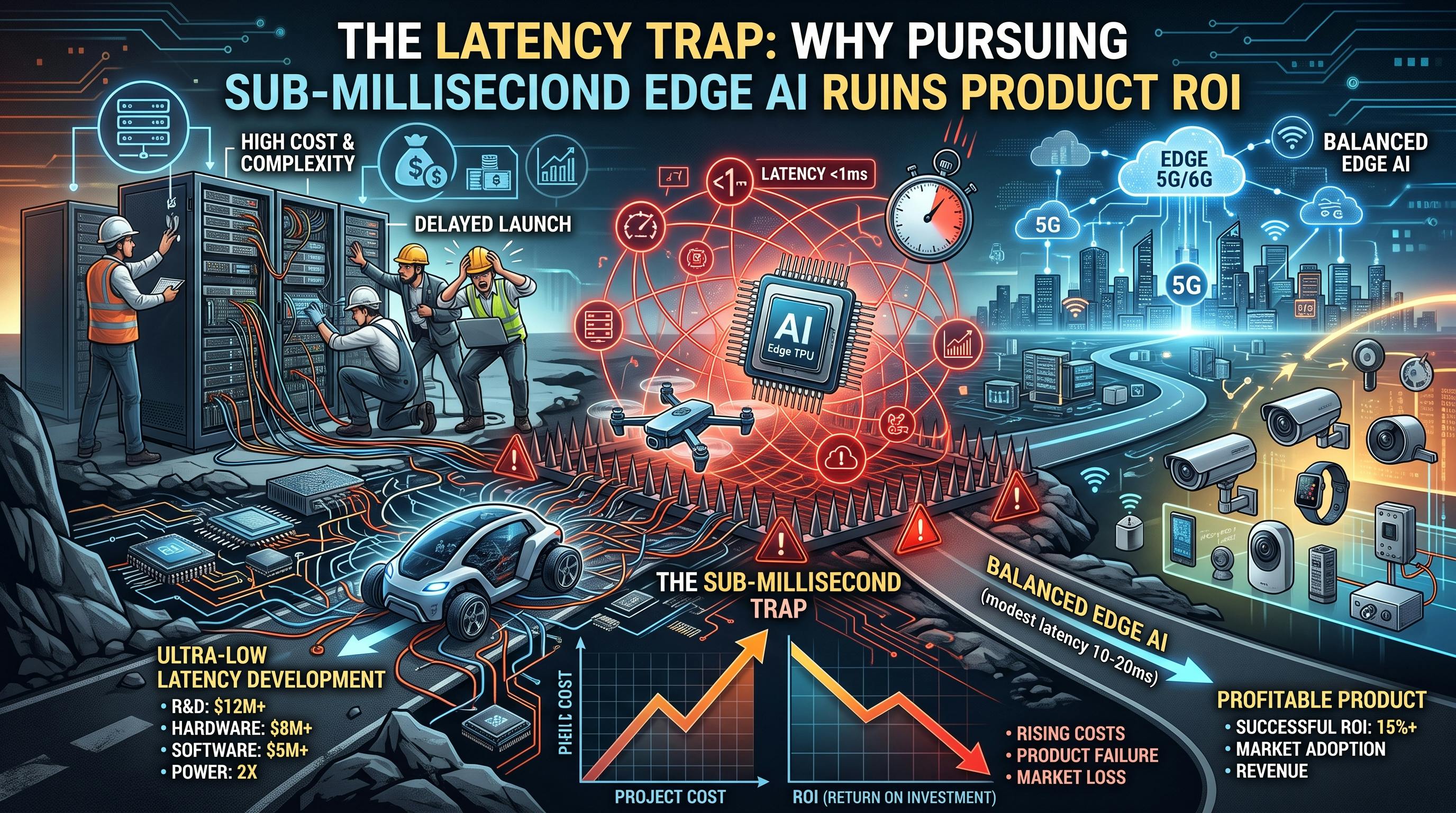
Every Product Manager knows the golden rule: Build for customer outcomes, not vanity metrics. Yet, in Edge AI product roadmaps, sub-millisecond latency has become the ultimate vanity metric. The Strategy Flaw: Solving a Metric, Not a User Need Engineering teams often push to minimize latency at all costs, assuming faster is always better. But tuning an edge deployment for sub-millisecond inference when the user only requires 100ms response time is like putting a rocket engine on a delivery van: it skyrockets operational costs without improving the core value proposition. The Product Reality Check Unless your product controls closed-loop robotics, autonomous collision avoidance, or high-frequency trading, an end-to-end response time between 20ms and 100ms meets the threshold of "perceived instantaneity" for human users and enterprise workflows. The Fundamental Strategic Trade-Off The Microsecond Speed Approach: Skyrocketing hardware BOM costs, fragile and jitter-prone architectures, and over-engineering for synthetic benchmarks rather than real-world conditions. The Deterministic Performance Approach: Predictable gross margins, scalable deployments, zero-trust sovereignty, full regulatory compliance, and direct alignment with customer value. The 3 Big Product Penalties of Over-Indexing on Speed Unviable Unit Economics: Requiring top-tier hardware at every edge node destroys product gross margins. Delayed Time-to-Market: Engineering cycles are wasted squeezing out marginal speed gains instead of shipping core features. Misaligned Value Proposition: Sacrificing model accuracy, uptime, and compliance just to save 10 milliseconds that the customer won't notice. Redefining Product Success: Determinism Over Speed Customer satisfaction at the edge is driven by predictability and reliability, not peak speed under benchmark conditions. Key Principle: A product that delivers a consistent 50ms response time 99.99% of the time creates a vastly superior user experience compared to a product that hits 5ms under ideal conditions but spikes to 500ms during load fluctuations. The PM’s Decision Framework for Edge Latency When drafting your Product Requirements Documents (PRDs), evaluate these three core criteria: Minimum Acceptable Latency (MAL): What is the actual threshold required for the user to take action? (e.g., Does a predictive maintenance alert on an oil rig need 1ms, or is 100ms sufficient?) ROI on Speed: How does lower latency directly impact Customer Lifetime Value (LTV) or willingness to pay? (If cutting latency in half doesn't increase retention or price tolerance, it’s bad ROI.) Infrastructure Tax: What trade-offs are being forced onto your infrastructure, hardware costs, and compliance models? Product Strategy Levers: Maximizing Value Without Inflating BOM To protect margins and ensure frictionless deployment, PMs must guide engineering toward pragmatic, high-ROI choices: Right-Sizing Models for Target Margins: Swap massive 70B+ parameter models for specialized, domain-tailored architectures. Leveraging techniques like quantization and knowledge distillation delivers 95% of the capability at a fraction of the hardware cost. Hardware Pragmatism & Agnosticism: Avoid locking your product into high-power, high-cost dedicated GPUs. Designing products that run efficiently on standard edge silicon or low-power NPUs lowers adoption friction, shrinks sales cycles, and expands your Total Addressable Market (TAM). Local Feature Caching: Leverage semantic caching and pre-computed embeddings. Storing frequent queries and context locally bypasses redundant model calls, dramatically boosting perceived responsiveness without hardware upgrades. The Real Enterprise Moat: Uncompromising Operational Sovereignty While competitors waste resources racing toward sub-millisecond benchmarks, smart product leaders focus on the real enterprise moat: Operational Sovereignty and Compliance. For regulated sectors - defense, healthcare, public sector, and critical infrastructure—the primary buying criterion isn't microsecond speed; it is absolute control over data, logic, and operational continuity. The 3 Pillars of Sovereign Edge Architecture 100% Data Residency: Sensitive data never leaves the local physical perimeter. Zero External Dependencies: Core workflows run continuously even if external network links drop entirely. Predictable Fixed TCO: Completely eliminates variable cloud API costs, bandwidth charges, and egress billing. The Competitive Advantage of True Air-Gapping Enterprise buyers are actively rejecting "cloud-washed" edge solutions that maintain hidden, persistent umbilical cords to remote public clouds. Strategic Advantage Business Outcome Zero External Telemetry Complies with strict data privacy and residency mandates out of the box. Network-Independent Uptime Guarantees continuous business value even during total network blackouts. Deterministic Cost Structure Protects margins from unpredictable ingress/egress fees and cloud management billing. Strategic Positioning: Value-Centric Messaging When taking an Edge AI product to market, rewrite your positioning playbook to focus on business impact rather than technical specs: Weak Positioning (Tech-Centric) Strong Positioning (Value-Centric) "Achieves 0.8ms inference latency at the edge." "Delivers deterministic, real-time insights with zero operational downtime." "Runs 70B parameter LLMs locally." "Optimized model footprint that reduces hardware deployment costs by 60%." "Connected hybrid cloud edge deployment." "Fully sovereign, air-gapped architecture that guarantees 100% data residency." Conclusion: Build Products That Scale, Not Just Models That Flash Great product management isn't about pushing hardware to its theoretical limits - it's about balancing user experience, unit economics, and market demand. The winning Edge AI products of the next decade won't be the ones that claim synthetic latency records. They will be the products that offer sufficient speed, predictable performance, sustainable margins, and unbreachable sovereignty. The Takeaway: Stop chasing latency ghosts in your product roadmaps. Start building resilient, high-margin Edge AI solutions that solve real business problems.
The Latency Trap: Why Pursuing Sub-Millisecond Edge AI Ruins Product ROI
Full Article
Original Source
Read the full article at Hackernoon →KhanList aggregates and links to publicly available news content. We do not host full articles from third-party sources. Always verify important information with original sources.