
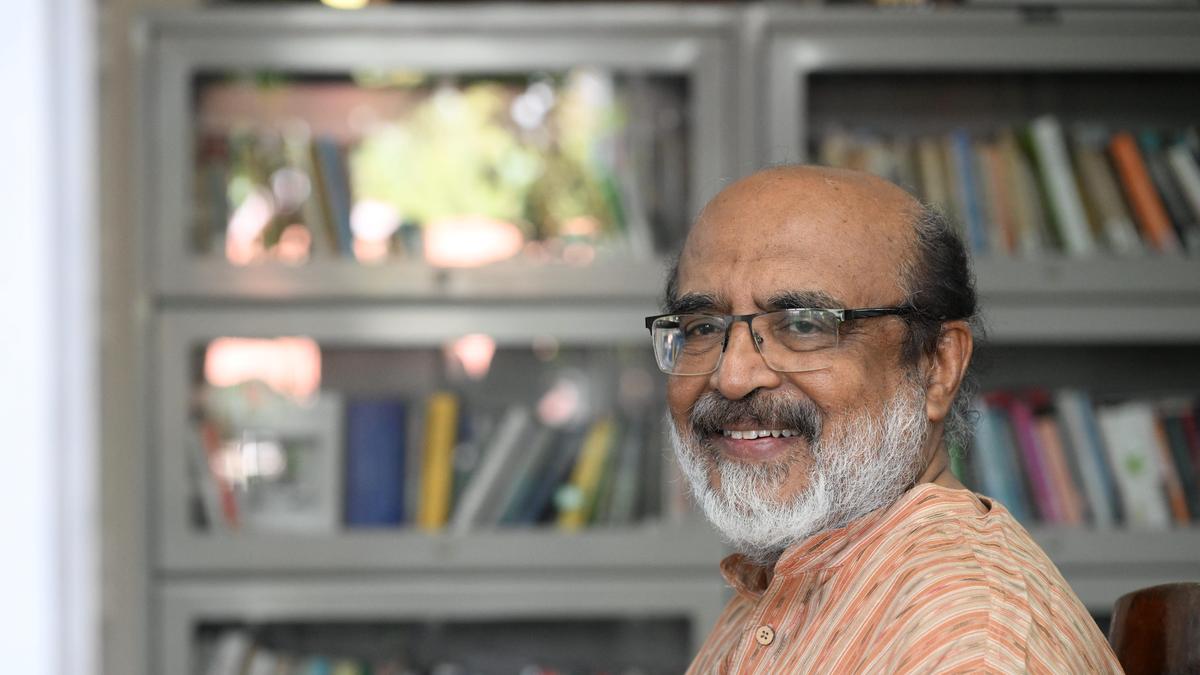
Dr. Thomas Isaac, editor of Chintha, has dismissed the allegations put forward by T.J. Angelos regarding the portrayal of T.V. Thomas as a ‘guest artist’ in the uprising. File photo | Photo Credit: Nirmal Harindran The placement of two photographs in a commemorative publication has triggered an unusual war of words between Kerala’s two Left allies, reopening a debate over how the Punnapra-Vayalar uprising, a defining episode in the state’s communist history, should be remembered and whose contributions deserve prominence.The controversy, which has played out largely on social media, centres on a special edition of Chintha, the CPI(M)’s ideological publication, brought out to mark the uprising’s 80th anniversary. CPI leaders took strong exception to the way it documented the struggle and its leaders, particularly the placement of photographs of C.K. Kumarappanicker and CPI leader T.V. Thomas at eighth and ninth positions respectively among around 60 leaders featured.Speaking at the AITUC Foundation Day celebrations organised by the All India Jute and Coir Workers’ Federation in Alappuzha recently, CPI district secretary T.J. Angelos criticised Dr T.M. Thomas Isaac, editor of Chintha, for allegedly portraying T.V. Thomas as a ‘guest artist’ in the uprising. He stressed that Thomas was president of the All Travancore Trade Union Council (ATTUC), which had decided to launch the workers’ strike on October 22, 1946, that preceded the revolt.Thomas was at the forefront of public campaigning during the uprising and the subsequent police firing, Mr. Angelos said. Mr. Angelos also cited Thomas’s confrontation with Diwan Sir C.P. Ramaswami Iyer at a tripartite meeting at Bhakti Vilasam as evidence of his central role in the struggle. For the CPI leader, the issue was not merely the order in which photographs appeared, but what he saw as an attempt to understate Thomas’s contribution to a defining moment in the communist movement.The remarks triggered a heated debate on social media, with people weighing in both in defence of and against Chintha’s portrayal of the uprising.Dr. Isaac, however, has dismissed the allegation as baseless, maintaining that the publication had adequately acknowledged Thomas’s role. In a social media post, he said the article clearly stated that the strike was called by the ATTUC, of which Thomas was president. It also carried a photograph of the tripartite meeting at Bhakti Vilasam, with the caption specifically highlighting Thomas’s presence.On the contentious photograph sequence, Dr. Isaac said it was not intended to rank leaders according to their contribution to the uprising. Except for P. Krishna Pillai, the photographs had been arranged alphabetically, with the first 19 featuring prominent leaders and the rest showing other important figures. Thomas appearing after Kumarappanicker, therefore, had nothing to do with the relative importance of their roles, he said.“The CPI(M) and CPI were not two separate parties at the time of the uprising. The distinguishing feature of the account in Chintha is that it presented history without such considerations. Anyone can compare the Chintha edition with other publications and verify this,” Mr. Isaac said.He also argued that a 3,000-word article could not cover every aspect of a complex historical event and that omissions should not be construed as deliberate attempts to distort history. Published - November 03, 2026 03:42 pm IST
The late Communist leader T.V. Thomas’s role in Punnapra-Vayalar uprising sparks CPI-CPI(M) row
Full Article
Original Source
Read the full article at Thehindu →KhanList aggregates and links to publicly available news content. We do not host full articles from third-party sources. Always verify important information with original sources.