
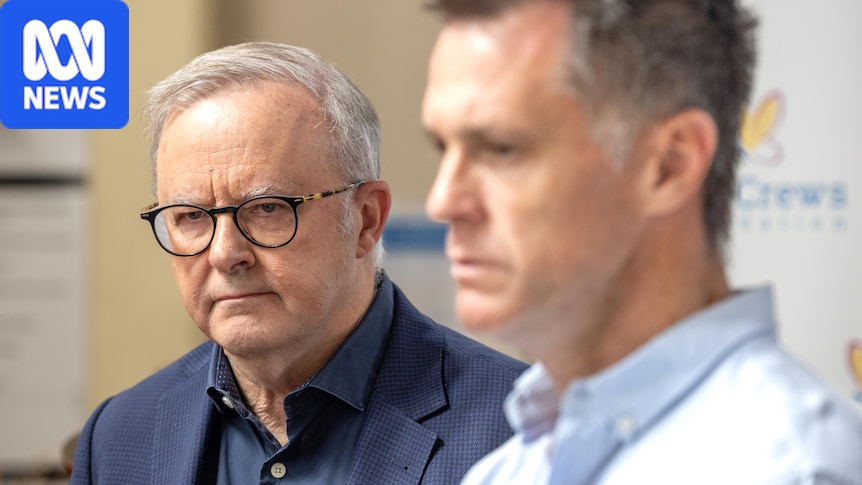
Welcome back to your weekly federal politics update, where Courtney Gould gets you up to speed on the happenings from Parliament House.Under pressure from opponents after another interest rate hike and more bad inflation news, the last thing Anthony Albanese needed was free advice from his own side.But that's what the prime minister got this week when fellow a Labor leader, NSW Premier Chris Minns, weighed in on the impact of government spending on Australia's economic woes.Albanese and Minns have been downplaying reports they've had something of a falling out recently. First, there were reports that the relationship between the prime minister and the NSW premier had deteriorated after the Bondi terror attack in December last year. Then came Minns's frustration over the tobacco tax excise, GST carve-up and hospital bed funding — to name a few issues said to have caused tension.But off the back of headline inflation jumping to 4 per cent and an interest rate hike this week, Minns seemed to add another gripe to his list: government spending."I'm not going to make a long commentary about other governments. It's up to them and their decisions, obviously," Minns said. "But we want to make it clear that we've been careful with public money, particularly the growth in public money, and that will continue if we're re-elected next March."With an election of his own around the corner, Minns did not come to Treasurer Jim Chalmers's defence and again distanced himself from his federal Labor counterparts. He wants voters to blame them, not him, when they head to the polls next March.It's the kind of jab more likely to come from the Coalition than a politically aligned leader; case in point was a speech from Queensland Treasurer David Janetzki. He used his address to the National Press Club on Wednesday to take a swing over the GST and cost-shifting.Former RBA governor Philip Lowe also popped up. He reckons the government should be running surpluses off the back of a near record-high tax take. It's not — and the intergenerational report handed down last week predicted there are 40 years of deficits to come.Nothing to see here?Albanese and Chalmers had been on the defensive all week over the government's economic record, arguing the Middle East war, not government spending, is turbocharging inflation.RBA Governor Michele Bullock didn't want to engage in the "blame game" when asked after the bank's board hiked the cash rate to a 15-year high of 4.6 per cent.But she did say inflation had been too high before the war and "domestic capacity measures" only added to it. Sluggish productivity was "doing nothing" to help the matter.Both the prime minister and treasurer rebuffed Minns's swipe when asked. Just like with the question of if they're at odds with Bullock, there is nothing to see here, they claim.Chalmers spent the week arguing that the government has been responsible in its spending decisions. Asked if more drastic action was required, he accepted there was always more work to do.A tough love approach to tackling inflation typically means cutting spending. But that won't necessarily sit well with a cohort of cash-strapped voters already looking elsewhere, including to One Nation, for the answers.Perhaps that's why by Wednesday, Albanese was already flagging more cost-of-living relief in the mid-year budget update in December. What form it will take has yet to be revealed. Chalmers insists it won't be another cut to the fuel excise.Coalition's make-or-break moment The next three months could make or break Angus Taylor's leadership.Momentum over government spending could provide him with an opportunity. The Coalition, or more specifically Shadow Treasurer Tim Wilson, have long been trying to make "Jimflation" happen.Taylor wrote to the prime minister back in February calling for a taskforce on spending restraint. He seized on this week's gloomy economic picture to prosecute the argument that Chalmers had lost control of the economy.Complicating the Coalition's argument is that they have backed themselves into their own big spending corner. Their promise to combat bracket creep by indexing tax brackets to inflation would be enormously expensive.If the opposition doesn't gain ground soon then Angus Taylor's challengers will likely start jostling. (ABC News: Ian Cutmore)Paired with their plan to slash the tobacco excise and cut the fuel excise every time the two week average global oil price jumps over US$100 ($140) a barrel, that would inject a lot of extra cash into the economy when inflation is already running hot.The Coalition argues all that spending will be offset elsewhere: the fuel excise will be funded, for example, by people buying more legal cigarettes once the excise on tobacco drops. Further offsets will be revealed closer to the 2028 election.If the opposition doesn't gain ground soon then Taylor's challengers will likely start jostling. In the meantime, Angus Taylor may hope to be like the bogong moth — currently swarming across the country after years of decline.A new era for the GreensStanding under the tree of knowledge, a sprawling fig outside the NSW parliament, a new era of the Greens began.A three-cornered battle for the leadership took place. It's the first time the minor party's leadership has been contested.David Shoebridge emerged as the leader with a pitch about the hip-pocket. He declared the Greens were coming to replace Labor. As he was talking, Mehreen Faruqi revealed her plan to freelance now she's not in the party's leadership.In the same statement, she attacked the manner in which Shoebridge was elected over her."Without a member vote, we cannot call ourselves a grassroots party," she said. "I call on the leadership team to set a timeline for one member, one vote."A timeline for the post-2028 election has been set for that grassroots vote. But circumstances overtook that timeline. While Larissa Waters stepped aside for health reasons, her lack of cut through was of concern.Shoebridge is the third leader in 18 months (Adam Bandt was dumped by voters at the last election). Shoebridge has a tough task in front of him: to unite a divided party room (several of his colleagues were curiously silent about his appointment) and lift the primary vote from where it's currently stuck around 10 to 12 per cent.As Patricia Karvealas wrote this morning, the Greens are looking to replicate the success of New York Mayor Zohran Mamdani's progressive campaign.Shoebridge wants a harder line on Labor than Waters took, and he's vowing to play hardball. That includes when it comes to legislation in the Senate, where Labor needs the minor party's vote.The approach sounds similar to the one Bandt and former MP Max Chandler-Mather (now head of the Green Institute) took last term — an argument the prime minister also made on Thursday.Both ended up losing their seats. But perhaps in the time of Pauline Hanson's rise, the Greens have learned the lesson that sometimes you just need to wait and try again when the times suit you.
The last thing Albanese needed was free advice from his own side
Full Article
Original Source
Read the full article at Abc →KhanList aggregates and links to publicly available news content. We do not host full articles from third-party sources. Always verify important information with original sources.