
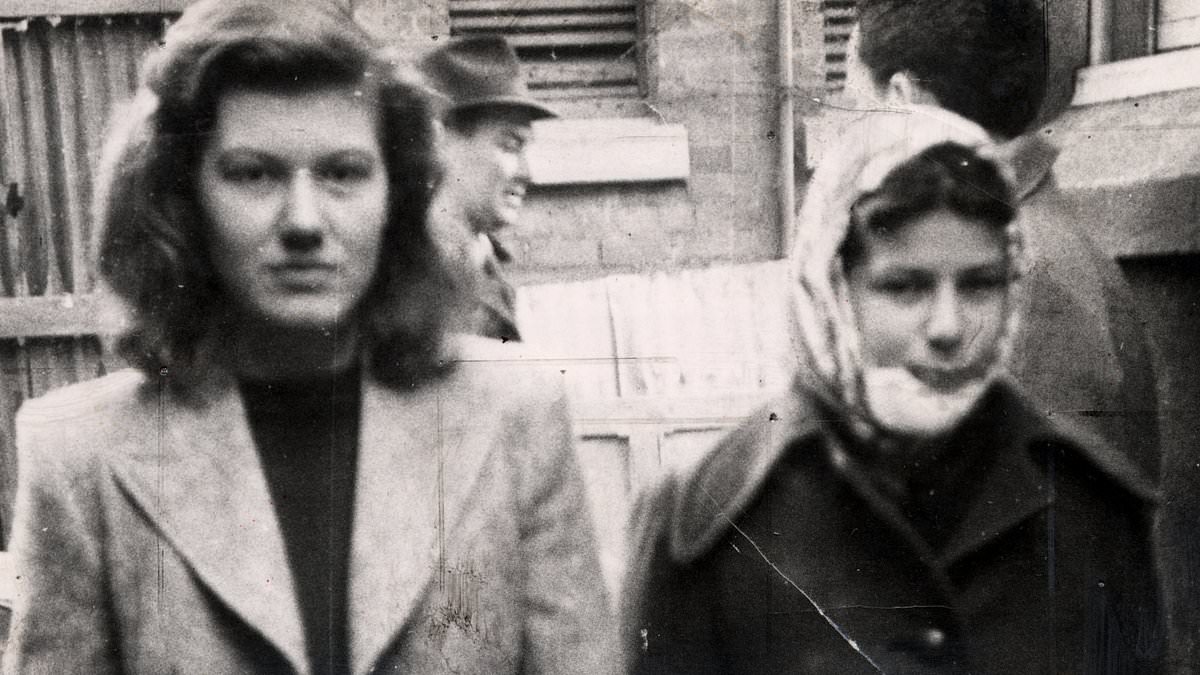
When Hilary Nathan passed away at the age of 88 on the Orkney island of South Ronaldsay earlier this month it was with the minimum of fuss.Her death was registered in the islands' capital of Kirkwall but no date was given and even the local sleuths on The Orcadian newspaper have no idea where her funeral was held or how many people attended it.And the nice lady who answered the phone at Braeburn Court, the assisted living centre in St Margaret's Hope (population 550) where Nathan lived up to her death, would only say: 'I'm not able to comment at all. Sorry.'It's all testament to one of the most successful disappearing acts in criminal history. For Hilary Nathan was better known as Pauline Parker, a notorious murderer.At the age of 16, she bludgeoned her mother to death with the help of her best friend Juliet Hulme, using half a brick wrapped in a stocking.In those days, she lived in Christchurch, a sleepy provincial city in New Zealand, known for its English manners and social respectability, where a scandal of this nature seemed almost unthinkable.Naturally, the Press had a field day. 'Dirty-minded girls plotted to kill mother' blared one headline. And the coverage persisted in the weeks that led up to the opening of the trial of the century in August 1954.So intense was the interest in the case that the girls were brought to court each day in a prison van that backed up to the doors of the court so they could enter unobserved. Juliet Hulme, left, and Pauline Parker in 1954. Aged 15 and 16, they bludgeoned Parker's mother Honorah to death in Christchurch, New ZealandBoth were convicted of murder after a six-day trial but, too young to be given the death penalty, the girls ended up serving just five-and-a-half years in different prisons before being given their freedom.Upon their release, both left New Zealand for the UK, where they changed their identities.Juliet became Anne Perry, a hugely successful crime novelist who, before her death in 2023, had written more than 100 books with sales in excess of 26million.Pauline, meanwhile, opted for total obscurity, changing her name to Hilary Nathan and becoming an apparently much-loved horse-riding instructor.Many will be familiar with the case because of Heavenly Creatures, New Zealand-born director Peter Jackson's Oscar-nominated 1994 film that dramatised the murder and the girls' obsessive friendship.The film, which starred Kate Winslet as Juliet in her first major screen role, prompted renewed interest in the real women behind the story and led journalists to uncover both of their new identities, igniting a media frenzy.Once exposed, their reactions could hardly have been more different. Perry acknowledged her past and went on to give numerous interviews about the case.But Nathan was appalled by the intrusion into her life in the shadows. When journalist Chris Cooke traced her to her home in Hoo, near Rochester in Kent, she insisted that he had 'got the wrong person'.After other reporters descended on the village, Nathan sold her house and retreated to what was clearly the most remote location she could think of: The Orkney islands, ten miles off the northernmost tip of mainland Scotland.The story's enduring grip on the public imagination is understandable. Matricide is among the rarest forms of homicide and, when committed by an adolescent daughter, it is rarer still.The fact that Pauline had outlined the girls' plans extensively in her diary, extracts from which are used as a narrative device in Heavenly Creatures, makes the case all the more sinister.Of their victim, we know remarkably little. Honorah Parker was born and raised in Moseley, Birmingham. When she was four, her father was admitted to an asylum and died there less than two months later. At 18, she emigrated to New Zealand, where she fell in love with Herbert Rieper, a married man who left his wife for her. They went on to spend more than 20 years together and have four children.The truth about their relationship came to light only after the murder, which is why Pauline – who had been brought up as a Rieper – was tried as 'Parker', a surname that she never knew she had.Pauline was a loner at school and the arrival of Juliet, a privileged English girl who had relocated to Christchurch after her father Henry Hulme was appointed Rector of Canterbury University College, transformed her world.Both had suffered from childhood illnesses. Pauline had chronic leg issues after an early bout of osteomyelitis, a painful inflammation of the bone, while Juliet had almost died of pneumonia and had spent long periods of her youth away from her parents in warmer climes. These two new friends were excused from school sports and spent their time bonding over their shared experiences of poor health, as well as their enthusiasm for books and art.Their mutual obsession soon intensified. It wasn't simply that Pauline and Juliet admired each other. They became convinced that they were rare geniuses who were universally misunderstood.They spent as much time as possible in each other's company, with Pauline often staying overnight in Juliet's bed at Ilam Homestead, the mansion provided for the Hulme family by the university.Unsurprisingly, the nature of the girls' relationship was hotly debated at their trial. Several doctors called as witnesses regarded it as homosexual, and the Press seized upon the idea of a lesbian infatuation, although Perry (Juliet) always denied that she and Pauline had been lovers.It was in the house and gardens at Ilam Homestead that the girls wrote stories and poems about what they called the 'Fourth World', a fantasy realm which they populated with lords and ladies of their own creation, along with idealised versions of their favourite film stars of that period whom they called the 'saints'.They even assigned each one a coded pronoun. Orson Welles was 'It'. James Mason was 'Him'. Mel Ferrer was 'This'.If this were not bizarre enough, Pauline claimed in her diary that they had gained access to this magical otherworld. The film (pictured), which starred Kate Winslet as Juliet in her first major screen role, prompted renewed interest in the real women behind the storyOn April 3, 1953, she wrote that they had 'found the key to the 4th World' and had seen a magical 'gateway through the clouds' that only they could enter thanks to 'an extra part' in their brains.It was at the high point of their obsession that the girls were threatened with separation.Juliet's mother Hilda had taken a lover called Bill Perry and even persuaded her husband to allow him to move in with them at Ilam.Perhaps inevitably, Henry eventually decided that it would be best if he left New Zealand with Juliet and her younger brother Jonathan.When Juliet demanded that Pauline be allowed to accompany them, both families refused to allow it.As the date of the girls' separation grew nearer, Pauline increasingly blamed her mother. She wrote in her diary: 'Anger against Mother boiled up inside me, as it is she who is one of the main obstacles in my path. Suddenly a means of ridding myself of this obstacle occurred to me. If she were to die...'By June 1954, both girls were discussing the 'moider' of Honorah, using the mock-gangster pronunciation of 'murder' they had picked up from the movies.'We have worked it out carefully and are both thrilled by the idea,' Pauline wrote. 'Naturally we feel a trifle nervous, but the pleasure of anticipation is great.'The plan was chillingly cold and deliberate. June 22, 1954 was, in Pauline's words, 'The Day of The Happy Event'. She wrote that the evening before she had felt 'very excited' and 'the night before Christmas-ish'. The girls had suggested to Honorah that she take them to Christchurch's Victoria Park for afternoon tea.Juliet had acquired a half-brick from the garage at Ilam that was later placed into an old stocking. This was to be the murder weapon.After tea and cakes, the three set off along one of the wooded tracks in the park where they would be alone. Juliet had brought along a pink stone and deliberately dropped it on the path.On their return journey, Pauline pointed out the stone and, while her mother bent down to examine it, she struck her on the head with the half-brick.The girls took turns to hold her down while the other delivered blow after blow.The sheer brutality of Honorah Parker's death perhaps explains the enduring sense of horror this case continues to inspire.This was not a single fatal strike delivered in a panic, but a prolonged and ferociously intimate attack, leaving the victim with dozens of injuries to her face and hands.The condition of the body meant that no one believed the girls' claim that Honorah had simply 'slipped on a plank and hit her head on a brick'.Why did they do it? Even after reading the endless articles and books and watching the films devoted to the subject, it is difficult to comprehend.At the trial, the defence argued that the girls had become so psychologically enmeshed that they were suffering from folie a deux, a shared delusional state. But its plea of insanity was rejected.After Perry (Juliet) died in 2023, Hilary Nathan (Pauline) became the last surviving person who might have offered some explanation for her actions. That possibility has now vanished. Juliet Hulme became crime novelist Anne Perry. Anne passed away in 2023 aged 84During her lifetime, Nathan refused to speak to the Press. The nearest she came to a public response was through her sister Wendy, who, after Pauline's new identity was revealed, told a journalist from the New Zealand Woman's Weekly that she had become a recluse, 'living in solitude' as 'a devout Roman Catholic' who 'spends much of her time in prayer'.Nathan's silence leaves unresolved the question of her sexuality.In a 1996 Guardian profile, writer Robert McCrum reported that, in 1960, while still on probation, she began a relationship with a female colleague.Earlier research by lesbian activists Julie Glamuzina and Alison Laurie also found that justice department officials had expressed concern about her 'lesbian associates'.After moving to England, she formed an exceptionally close friendship with another woman, Joan, who changed her surname to Nathan by deed poll so that the two could take out a joint mortgage and buy a house together. They remained close for some 30 years, although Joan always insisted that their relationship was platonic.We know little about Nathan's later life, and she clearly preferred it that way.After the Press exposed her in 1997, she settled at Klondyke, a farm on the island of Burray, where she kept horses and taught children to ride. In her final years, as we have seen, she moved into Braeburn Court.In So Brilliantly Clever, the definitive book on the case, Peter Graham recounts an interview with the American filmmaker Alexander Roman, who visited Nathan at her farm in Burray in 2010 in the hope of making a documentary.She angrily denied being Pauline Parker and pushed him back into his taxi. When he returned the following day to retrieve a bag he had accidentally left behind, Nathan told him she had burned it and accused him of harassment.Did the murderers ever meet again? Contrary to the common belief that they were not allowed to see each other after their release from prison, Peter Graham found that no such condition existed.That both women should eventually have settled within a few hours of each other in northern Scotland, half a world away from Christchurch, is at the very least a remarkable coincidence.After Hilary fled for Orkney, her house in Hoo was bought by a local man called Andrew Ayres. He discovered in an upstairs bedroom a painted mural which Ayres was sure was the handiwork of Nathan herself.It depicted two key figures in various scenes: One dark-haired girl and another blonde. In one vignette, the blonde girl can be seen flying away on a winged horse while the other girl tries to keep her on the ground. In another, the two girls are depicted as being forcibly separated by a giant axe.It is no great leap to suppose that these are artistic renderings of the young Pauline and Juliet. If so, they suggest that Hilary Nathan may have left Pauline Parker behind in name but not entirely in imagination.Now that Hilary Nathan and Anne Perry are both dead, all that remains is speculation. But what of the woman whose life they ended? While the public is understandably fascinated by the murder itself, the victim has been eclipsed.There is no memorial to Honorah Parker in Christchurch. There is no grave where flowers might be laid. We cannot even be certain what she looked like, since the authenticity of the few photographs said to be of her is disputed.She was cremated after a funeral service and the cemetery has no record of what became of her ashes. Whatever hardships Hilary Nathan and Anne Perry endured in the years that followed, they were at least granted something they denied Honorah Parker: The chance to grow old.
The last 'Heavenly Creature' takes her secrets to the grave: Woman who murdered her own mum in crime that inspired the film that launched Kate Winslet's career dies aged 88
Full Article
Original Source
Read the full article at Dailymail →KhanList aggregates and links to publicly available news content. We do not host full articles from third-party sources. Always verify important information with original sources.