
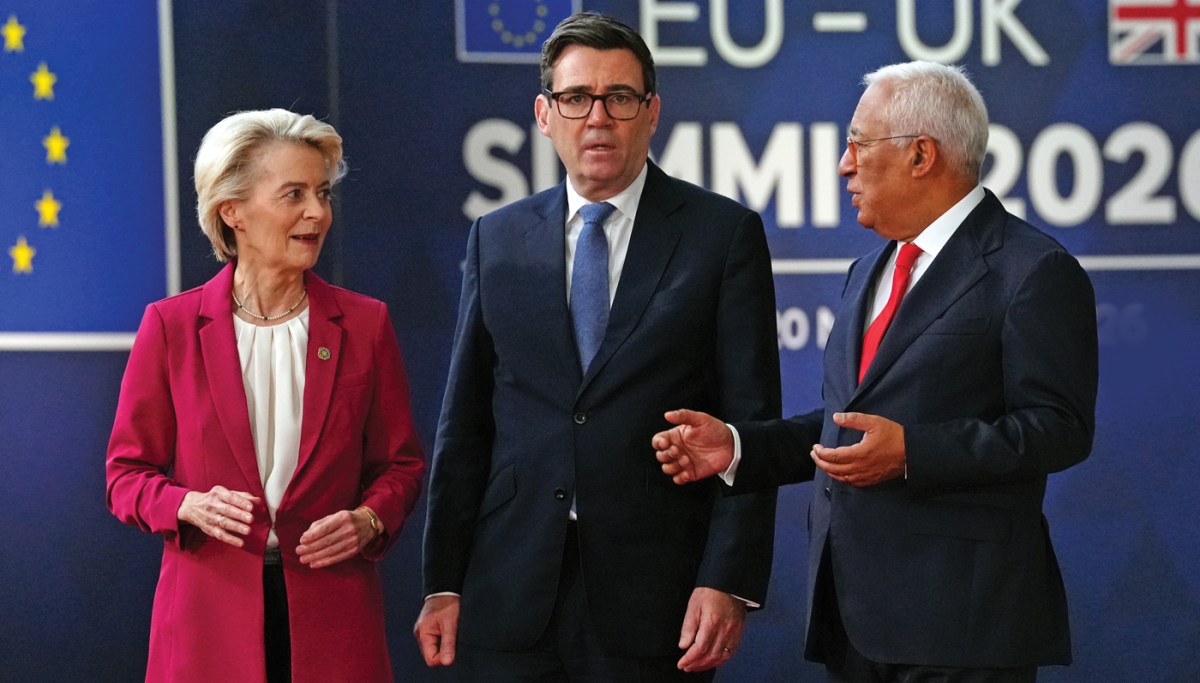
On Nov. 20, British Prime Minister Andy Burnham went to Brussels to announce his “reset” deal with the European Union. The deal, he said, was a “win-win” deal for both parties. Britain would rejoin the EU’s internal markets in electricity and carbon emissions trading, and its small businesses would benefit by Britain reentering EU regulations on cross-border trade in food and drink. Students from Britain and the EU would study in each other’s universities, as they had done before Brexit in 2020, and Britain and the EU would work together to stem the illegal traffic across the English Channel, which only goes in one direction. But the deal is not done.The EU added a further demand at the last minute. It insisted that its students should not pay international rates at British universities, as American students do. They should pay the British domestic rate of $12,800 a year. Negotiating this matter, according to the EU, will take at least six months. The other provisions in the deal that is not quite a deal will not come into effect until 2028. Given that Britain has had seven prime ministers in little more than a decade, Burnham is statistically unlikely to see the bright dawn of a new era in U.K.-EU relations from 10 Downing Street.Burnham’s Cabinet looked grim-faced as he claimed victory at a press conference. A bevy of former prime ministers, including the Labour Party’s Tony Blair and the Conservative Party’s David Cameron and Boris Johnson, warned that Burnham risked reigniting the cultural schism and political paralysis that followed the 2016 Brexit referendum. Several of Burnham’s senior ministers let it be known that they opposed rejoining the EU. The next morning, the London Times quoted an unnamed “senior ally” on Burnham’s thinking: “He wants to rejoin, that’s the truth of it. He feels it very deeply and thinks he is on the right side of public opinion.” Britain’s Prime Minister Andy Burnham and EU leaders Ursula von der Leyen and António Costa at the Brussels summit, Nov. 20, 2026. (Marius Burgelman/AP Photo) The Brexit referendum of June 2016 was the biggest democratic event in British history. The up-down vote on whether Britain should remain within the European Union or leave it produced a clear mandate for leaving. In January 2020, after Britain’s political and bureaucratic classes had done their best to undo the people’s vote, Britain and the EU signed a partial agreement that satisfied neither party. For decades, Britain had complied by subordinating its law to European law. The historic name for this kind of arrangement is “empire.” By securing divergence, Britain recovered its sovereignty and the sovereignty of its Parliament.To reverse this, either by stealth, by degrees, or by a studied and dishonest vagueness of intent would be the worst attack on democracy in our times. To reopen an honest and specific debate would derail British politics entirely. Yet Burnham, most of Britain’s political and media classes, and much of the liberal upper half of the middle classes, want to do it.Busted Britain When you reach the end of the road, you have to make a U-turn. Britain is hitting the wall. The balance sheet no longer balances. Taxes are at their highest level since 1948, when Britain was bankrupt and still had a wartime economy. Government spending in 2022-23 was equivalent to 45% of GDP, the highest level in over 40 years, well above the historic post-1945 average of 40%, and even further above the historic low of 34.6% in 1988-89. True, Britain’s economy is not doing as badly as Germany’s. But Germany is in an economic crisis.The British state spends 8.3% of its budget, or 3.6% of GDP, on servicing the interest on the national debt. This is much more than the debt-service load of the comparable economies of France, which spends 4% of its budget, or 2.3% of GDP, on debt service, and Germany, which spends 2.4% of its budget, or 1.2% of GDP. Britain will soon spend more on debt service than on education, which is 8.4% of the budget. In 2026, another 10.9% of Britain’s spending will go to welfare — the unemployment and sickness rolls have a case of “long COVID,” with able-bodied older workers opting out and younger workers failing to opt in. This consumes another 18%-20%. In 1956, the state spent 2.8% of the budget on the National Health Service and 7.6% on defense. In 2026, Britain will spend 2.6% on defense and somewhere between 18-20% on the NHS.Real wage growth has stagnated since 2008. The cost of the failed drive for net-zero energy means that industrial and domestic energy prices are higher than in Europe. Mass immigration has increased the population by 20%, from 58.1 million in 1997 to over 70 million in 2026. The cost of a home has risen ahead of incomes. Schools, hospitals and public transport are a crowded babel. The political system is corrupted by ethnic voting, notably in Labour strongholds. The justice system is discredited by ethnic crime, such as the mostly Pakistani and Bangladeshi “grooming gangs” that also prospered in Labour strongholds. Public spaces are protected with concrete barriers in case a Muslim goes postal. The diminishing number of English call them “diversity barriers” or “Allah ak-barriers.”The notion of “public opinion” assumes that there is such a thing as the public. As British society disintegrates into multicultural collectives, there are multiple publics, each with its boutique opinions. Burnham has chosen to split these publics along their existing battle lines: immigration and the economy. His moral bankruptcy does not just erode public trust and make Britain look unreliable, if not ridiculous. It accelerates the demise of the political system he wants to save by hastening two other kinds of bankruptcy. The post-1997 British economy, created by Blair’s Labour Party, was a high-immigration, high-welfare economy. Its fiscal basis collapsed in 2008. Beneath that are the moral foundations of the post-1945 welfare state, built by an earlier version of the party. Burnham wants to save social democracy by realigning Britain with the EU, but he will bury it.In the days when Europeans looked to the future in hope rather than trepidation or outright terror, the name of the future was “social democracy.” It had been Europe’s future for so long that it had long been part of Europe’s past. Germany’s Social Democratic Party, the first to claim it could steer the ship of state between the Scylla and Charybdis of capitalist exploitation and socialist revolution, was founded in 1875. Its conservative nemesis, the chancellor Otto von Bismarck, pursued a similar course, though he tacked to the right on the details: a market economy, state intervention in key industries, strong public services, and cradle-to-grave welfare.A similar agreement on the generalities ruled western Europe after 1945. The right-leaning parties that inclined toward traditional values and market economies called themselves Christian democrats. The left-leaning parties that trusted in progress and its invariable companion, progressive taxation, called themselves social democrats. The Germans, with typical literalism, called these parties the Christian Democrats and Social Democrats. The British called them the Conservatives and Labour. The Labour Party built Britain’s postwar state around high taxation and the NHS. The Conservatives, apart from their Thatcherite deviation, played along. Today, as the joke goes, Britain remains a hospital with a nuclear deterrent. But the numbers no longer add up. Someone has to pay.Other people’s money Chris Rokos has had enough. Rokos, a 56-year-old Briton, founded the hedge fund Rokos Capital Management in 2015. In the third quarter of 2026, the estimated worth of its portfolio was almost $27 billion. The Bloomberg Billionaires Index assesses Rokos’s personal worth at around $4 billion. In 2026, Rokos paid more than $4.3 million in taxes, making him Britain’s third-biggest taxpayer. In September, Rokos decided to move to Athens. If Rokos invests a minimum of $549,000 in Greek property, business, or shares in the next three years, he will pay a flat tax of $109,000 per year.Since 2024, an estimated 9,500 high-net-worth individuals have expatriated themselves and their taxes from Britain. The number of British-resident billionaires, the Sunday Times of London reported, declined from 177 to 157 in two years. Their preferred destinations are new-money Dubai, old-money Monaco and Switzerland, and the debt-stricken southern European nations of Greece and Italy, which offer preferential terms. The combined net worth of the tax fugitives was estimated at $160 billion.In 2025, Britain lost more millionaires than any other country. Their estimated combined wealth was $91.8 billion. The outflow of around 16,500 people was greater than the combined outflow from China (7,800), India (3,500), South Korea (2,400), Russia (1,500), and Brazil (1,200).Not all of the emigrants paid as much tax as Rokos. Many of them had lived in Britain as “non-doms,” nondomiciled foreign citizens who paid a flat fee of $39,343 and were taxed only on income brought into Britain. In 2022, it emerged that Akshata Murty, the Indian wife of the Conservative chancellor, Rishi Sunak, was avoiding an estimated $2.75 million a year in taxes by claiming non-dom status. Sunak had lately raised taxes to Britain’s highest level since 1948 to cover the tab for his COVID-19 subsidies. Murty volunteered to pay taxes on her global income. Sunak became prime minister later that year, and in March 2024, his government canceled non-dom status.Those who do pay taxes are the unacknowledged Atlases on whose impeccably tailored shoulders the British state rests. In 2023-24, according to the U.K. Treasury, the top 1% of earners generated 12.9% of the U.K.’s total income but paid 28.5% of the nation’s taxes. Those in the 90%-99% range earned 21.5% of the nation’s income and paid 31.8% of its taxes. This means that the top 10% of Britain’s earners pay 44.7% of its taxes. In 2023-24, according to the U.K. Treasury, a taxable income of $88,365 put an earner in the top 10. In the United States, the top 10% pay about 70% of federal tax income, and around 60% of all taxes, but the minimum top-10 income is estimated at $210,000.The rich really are different. We sympathize with the poor, but the rich are envied and resented. Regardless, a shortage of rich people becomes everyone’s problem in a welfare state whose services depend on a small number of taxpayers whose patriotism outweighs their financial sense. The London Times estimated that Rokos’s annual taxes matched the U.K. Treasury’s income from 38,000 workers. Robert Jenrick, Reform UK’s shadow chancellor, translated it to 52,000 workers earning $46,000, which is a little less than Britain’s average pre-tax income. The Telegraph reckoned it equated to the total tax burden of 21,000 families paying the average tax bill of $20,000.In July, Burnham said his government might have to “ask for a little more” tax. For the moment, he remains bound by his predecessor Keir Starmer’s 2024 manifesto promise not to raise income tax and licensed by Starmer’s alternative, raising taxes on everything else. Starmer was licensed by Sunak’s stealth taxation. Before the 2024 elections, Starmer mocked Sunak as “Mr. 25 Taxes” for his innovations in revenue extraction. Since then, Starmer and Burnham have added around 50 new taxes. Before the 2024 elections, Starmer and his shadow Cabinet criticized Sunak for freezing tax thresholds. After the elections, however, Starmer’s chancellor, Rachel Reeves, extended the freeze to 2031.Returning from his non-deal in Brussels, Burnham claimed that he had secured marginal economic gains for Britain. By the government’s calculations, these gains would not accrue until 2040. By pro-Brexit economists’ calculations, there were no gains in the deal, and possibly negative effects. By everyone’s calculations, the British economy has grown faster than the Eurozone since 2016. While Britain’s third-quarter growth in 2026, 0.7%, is anemic, it is positively vibrant compared with the Eurozone’s 0.4% and Germany’s 0.2%. It is easier to quantify the electoral implications for a government that lumbers British workers who privately educate their British-born children with a 20% sales tax on school bills, while using the same taxpayers’ money to subsidize the children of Europe’s elites while they study in British universities.Either Burnham is, as his deer-in-headlights approach to Britain’s polycrisis suggests, an economic illiterate and political amateur or his motives for realigning and even reuniting with the EU are ideological, and he has an intuitive feel for splitting the electorate.The last of Labour Burnham has not won a general election. By custom, he is bound by Starmer’s 2024 manifesto, especially because he did not run in 2024. Labour’s 2019 manifesto promise to hold a second referendum in the hope of reversing the first contributed to the landslide Conservative victory that allowed Boris Johnson to push a Brexit deal through Parliament in January 2020. Starmer’s 2024 manifesto diluted the 2019 position to a “reset” in the U.K.-EU relationship and reduced regulatory barriers. Two days before the July 2024 elections, Starmer, the Labour leader, was asked if he could see any circumstances under which Britain would rejoin the EU’s single market or customs union in his lifetime.“No, I don’t think that that is going to happen,” Starmer replied. “I’ve been really clear about not rejoining the EU, the single market, or the customs union, or a return to freedom of movement.” Instead, Starmer said, he wanted “a better deal than the botched deal we got under Boris Johnson on the trading front, in research and development and on security.”“I am not proposing that the U.K. considers rejoining the EU,” Burnham said when he ran as a member of Parliament prior to replacing Starmer in the summer. “I respect the decision that was made at the referendum. It would undermine everything I’ve said about strengthening democracy if we don’t respect that vote. The last thing we should do is rerun those arguments.”WE BLEW ITThree months later, Burnham reran those arguments in a speech to the Labour Party conference. Britain, he said, had been “on the wrong path for a long time,” since the 1980s: “Deindustrialization. Deregulation. Privatisation. Austerity. Brexit.” Britain would not have a “clear path” forward until it decided on a “long-term relationship with what is still our largest market.” Interviewed after his speech, Burnham said Britain could “go all the way” by rejoining the EU, or rejoin the customs union, or rejoin the single market, or “stay as we are.” By going to Brussels, he showed that he does not consider the last option to be an option.There may, as Adam Smith said, be a “great deal of ruin in a nation,” but there is only so much money. There is also a limit to legitimacy. The Marxist historian E.P. Thompson once described the social contract of Georgian England as a “moral economy.” When the rulers violated this unspoken understanding, the ruled rebelled, often violently. The democratic state reconfigured those assumptions into an explicit exchange. The state extracted taxes in return for political expression and legal and physical protection. As the British state runs out of money, it cannot sustain its end of the deal. Burnham has committed to sustain the unsustainable. As the state crumbles, the bedrock of the old moral economy will reappear. Labour and social democracy may disappear in the rubble.Dominic Green (@drdominicgreen) is a Washington Examiner columnist and a fellow of the Royal Historical Society.
The last days of Labour Britain
Full Article
Original Source
Read the full article at Washingtonexaminer →KhanList aggregates and links to publicly available news content. We do not host full articles from third-party sources. Always verify important information with original sources.