
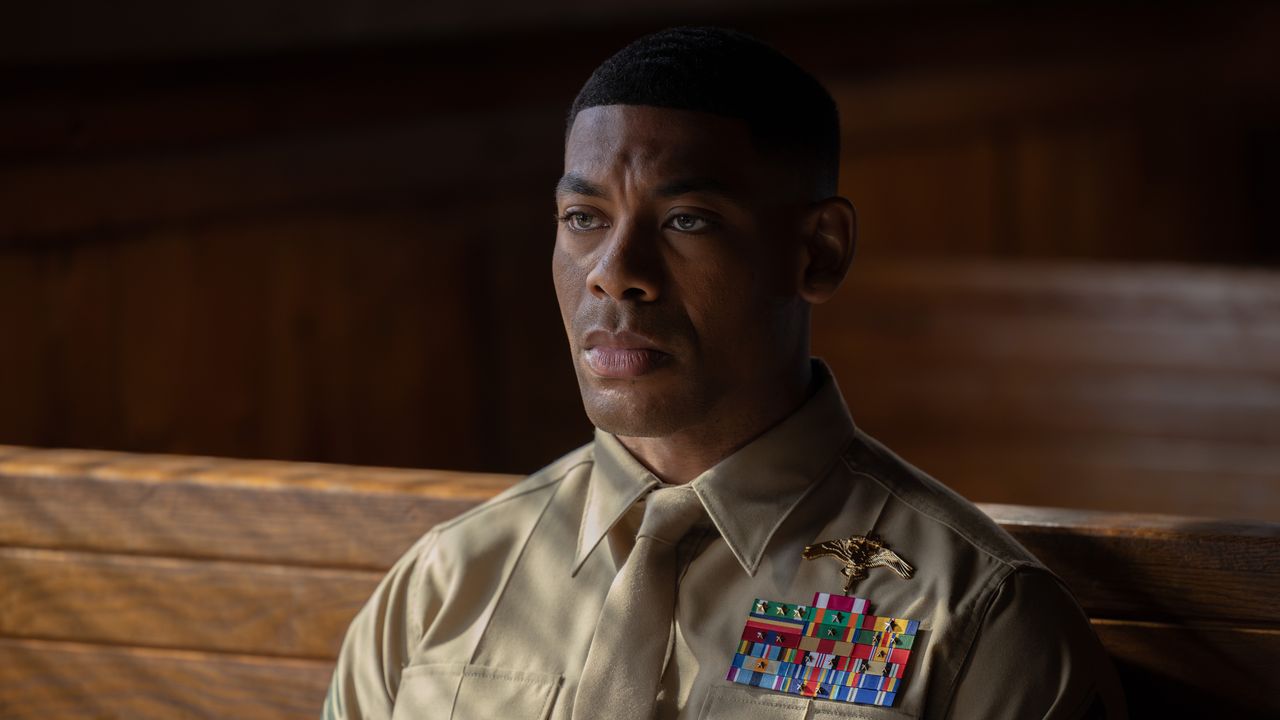
Screenwriter Vanessa Baden Kelly unpacks the themes (and the critiques) of the freshman superhero series’ standout episode “OutKast” and tees up what’s in store for the rest of the season.Courtesy of HBOThis story contains spoilers for Lanterns episode three, “OutKast.”In the tradition of the classic HBO Sunday-evening shows before it, Lanterns has officially arrested the timeline. The DCU series is the first major look Green Lantern has gotten as a superhero property since the much-maligned Ryan Reynolds movie back in 2011, and at the halfway point of this eight-episode season (from co-creators Tom King, Chris Mundy and Damon Lindelof, who ran a similar play a few years ago with Watchmen), fans who grew up reading about the adventures of Hal Jordan or John Stewart and Lantern agnostics alike—along with Kyle Chandler ball-knowers—are increasingly invested in the show and the world it’s building.The discourse hit a peak last week with episode three, a flashback episode devoted to John Stewart’s backstory that touched on elements of race, parenting, exceptionalism, and destiny and got all corners of the audience riled up. Some are calling it a breakout performance moment for Aaron Pierre as John, and already holding space at next year’s Emmys for Jasmine Cephas Jones and J. Alphonse Nicholson as John’s parents. Other, more noxious corners of the internet have slammed the episode—in which Bernadette Stewart at one point asks an alien if she understands what it means to be a Black man in America—as a product of the “woke” agenda, with particularly determined haters spamming review sites to make it the lowest-rated hour of the season so far. GQ hopped on with “Outkast” writer Vanessa Baden Kelly to sift through it all, and get an idea of what’s coming next after this past Sunday’s big twist.What's the reaction to episode three been like?In a lot of ways, it's been really amazing. A lot of people feel really seen. A lot of people feel like the episode spoke to either things that they themselves had gone through or that they had recognized from their own childhoods… obviously the use of the Outkast [songs], that just felt like it was “For the Culture” work there. And of course there are people that are really unhappy about it. I've tried to just let it simmer, let people continue to go on this journey with us because I feel, beginning [with episode 4] I started seeing people back off because they realized that's not the statement that they thought we were making… [Episode 3] is not quite the entire picture. But I also recognize it's a little bit different when you're not getting to binge the show and having to watch one episode a week.I personally love the anti-binge method, and for this show especially, it's been fun to watch people go along for the ride week to week.Yeah, same, I like it too! It feels like the TV I grew up watching, but also I think the fun of TV and why I prefer doing it personally over film is because you get this time to talk about it and have theories and wonder what's going to happen. Those watercooler moments I think are what make TV so much fun.When you and the writers’ room sat down to break the season, what was the intention behind doing a John-centric flashback episode?Well we just wanted to make sure that we gave John a fleshed-out backstory and that we made his character somebody who felt tangible and felt fully formed. But the thing that we kept discussing, especially considering that we were making this season of television very grounded: What would it be like for somebody like John to get the ring? We talked a lot about Black exceptionalism and extraordinary individuals, we talked about Tiger Woods and Venus and Serena, even the Jackson family. How do you create a person that is larger than life? We pulled a lot of that in as new lore for this volume of the character of John Stewart.But what that meant for us is creating a complex individual—who I felt very lucky to be able to create, because he's not this static character. Hal has a very complex backstory. Kyle Rayner has a very complex backstory. So we just wanted to be able to give John the same thing.I love that you basically just compared Bernadette to Joe Jackson.[laughs] But have you seen all the memes that do it? We certainly were not thinking about it at the time, but the fact that [Michael] had just come out, there was a [cultural] remembrance like, Oh yeah, that was a thing.You know a show is as close to monoculturally relevant as it gets today when the memes are everywhere. But it's interesting too, because when you make a comparison like that, it raises questions. There's a lot of loving moments between John and his parents, but also it's a little thorny as to whether what they're doing is right, and how they're going about it, and if it was worth it. Were those all elements that you wanted people asking?All of it. And there will be more of that, but if you would've asked me six months ago, I thought that that was going to be the biggest talking point of the episode. What's too much? Are we pushing too much? The parental discussion and debate around that. When I see people be like, "Bernadette was abusive," and the other side's like, "Yeah, but… was she?" I love those debates because that's what makes John's character so rich.Some of the reaction is coming from people taking it in an almost binary way. Some of the audience are watching it thinking the episode is saying she's right. Then a lot of people watching think the episode is saying she's wrong. I also like how the Stewarts’ marriage has that same complexity. It's almost like there's a little bit of projection from Bernadette on some part, and also like she agrees about her husband’s weakness, without saying it outright. How fun was it to just dig into all of that?The debates we would have in the room would be like, if a pipe breaks and the first thing we think to do is put duct tape around it…it ends up damaging the pipes more. But in that moment you panicked and you didn't know what to do and you were just trying to fix the pipes. You know what I mean? That's how I would keep framing Bernadette. Did she do everything right? No. But she was also equally traumatized and also desperate and she was just trying to fix the pipes. What does that look like on the other side of it?J. Alphonse Nicholson and Jasmine Cephas-Jones in 'Lanterns' episode 3.Courtesy of HBOAnd so that's what I'm hoping as people continue to watch the series and we get to the end of it—that people will see all our characters, Bernadette included, having these full-circle moments, because life is long. And the things that we thought and did when we were younger people—especially for those of us who were younger parents—sometimes we get older and we're just like, "Maybe we shouldn't have did that."Bernadette is a very complex character and really wonderfully drawn, but it's one of those roles where you really need the perfect person to come in and kill it, and Jasmine really knocks it out of the park.Jasmine exceeded all expectations and she just brought something so special to the character. All of it was scripted, I don't want to pretend like it wasn't, but she brought something under all the words that you couldn't have written if you wanted to, and you couldn't have been looking to cast if you wanted to. It's just something that her person brings to it. So I feel really lucky to have her embody Bernadette, but also J. Alphonse Nicholson as John Senior. There was a soldier's strength, vulnerability, steadfastness even through his worst moment. They were so fantastic. Lightning in a bottle. You couldn't have planned that.I want to talk about placement because that's something that comes up a lot in modern discussions of TV too. I saw commentary saying that this episode should have been the pilot, which to me feels like a fundamental misunderstanding of why it works, because I think there's so much tension and context and nuance in having it here. For example, the scene with Bernadette doing the apple test hits way harder because you haven’t seen her in the present yet and you’re wondering if this is why.Well, I will say this: originally, this episode was not three. This episode I think was five. But everything was different back then. Right now we're telling a more linear story, but there was a time when the show was conceived to be told out of chronological order and so different timelines were telling different things. When we finally made the decision to make it like this, this episode got moved up. It was written for a specific point in the season, but moving it to where it was, I actually think really helped. It puts a lot of John Stewart into context as we're moving forward and the reason I think that that's particularly important is because his person up until episode 4 is somebody who is purposely—and probably a little bit programmed-wise— quiet. There's a lot we learn about Hal because Hal never stops talking, but we sometimes are trying to infer with John who is very quiet and we understand now why he is purposely quiet.Having that backstory episode where it is informs [our understanding of] John to the point where now, some of the stuff that we would otherwise just be making inference on, we know what's underneath it. When he makes a decision to not take the ring when he could have, we understand how that's going against programming that you otherwise wouldn't understand had you not seen episode three. And it says a lot about how [his and Hal’s] relationship is growing.But I also think we had to fall in love with Hal first, so that we could get this moment of going Damn, I guess he's not perfect to everybody. We love him, but looking at it from a different perspective, we could see how someone doesn't. And then we immediately flip the script again in the next episode where it's like, Yeah, John ain't perfect either. These are two imperfect individuals who are learning to be friends.How much can you say about what went into the decision to make the story be more linear?Ultimately I think stories like this, especially when you're telling stories in different timelines, just have to play a little bit. It's a little bit of musical chairs sometimes. It's about what makes things feel the clearest. There were several configurations of these episodes, but I think ultimately what landed on screen is the correct one.So when Damon put this room together and you sat down to start making this story, what was the intention that he set forth, and what do you hope to leave people with, both as a self-contained thing and then obviously going into John being in the next Superman movie?What we wanted to do was twofold. One, we wanted to make something that we all felt really proud of and that we would defend because we knew we would have to. Something that felt real and correct to us while simultaneously, the other part was that we wanted to make sure that we made something that we felt like the folks who grew up reading Green Lantern felt like we did those characters and the lore justice.Sadly, we did not have an agenda [laughs]. It was nothing like that. It was just like, Do we feel proud of it? Do we feel like the folks who grew up and waited for the next edition to come out, would feel proud of it? And then on a larger scope, John Stewart is in the world now, and we want him to be the type of character that is 360, has a full backstory, is somebody that people can see as both heroic and flawed and real, and especially little kids can look at and be like, "I could be a Green Lantern." Hopefully their parents don't train them to be one from the beginning of their lives, but that they can look at and be like, oh yeah, I can be him. I don't have to be perfect. I just have to be brave.Your episode feels like it's in conversation with “This Extraordinary Being,” the Emmy-winning flashback episode Cord Jefferson and Damon Lindelof wrote for Watchmen. Can you talk about how significant it is to center a Black perspective in stories like these, which have these Black legacy characters but don't always unpack them to this degree?As much of a lightning rod as it's been, and I think I was actually shocked at how much of a lightning rod that it's been, it still feels like that's the work and that's what we're supposed to be doing. And I don't just mean that as Black creators, but just creators in general. In Peacemaker, for instance, when there's an alternative Nazi universe, in that character's world it felt like somebody having to come to terms with who he was. It was an important storyline to tell, especially in the world that we're living in right now. That's the work. You have to say, if this is what portions of our country are going through, we have to be able to have those difficult conversations and what better way to do it than to do it on television. It's been hard to read [some of the backlash] and be like, that's what y'all took from that?I think whether it's comfortable or not is neither here nor there, but having the discourse that's come from it, especially on Threads or on Twitter or whatever— these are conversations that we have to be having and that we've shied away from for a little while, but it isn't helping anything to shy away from those conversations. We just have to be brave enough to do it. Damon and I were talking last week—he was calling to check in on me and see how I was feeling. And he was like, "When you make a decision to center somebody in a story, you are ultimately, whether you realize it or not, also making a decision to not center somebody else, and people are going to feel a way about that, but no matter how you slice it, that's intentional because you intended to center someone."The more that we keep making television and the more that shows are brave enough to do what we've done, what Peacemaker has done, what Watchmen did, everybody will feel like they see a little bit of themselves and these conversations will die down a little bit.Damon’s been a part of so many shows that encouraged a lot of really passionate reactions. Did he give you guys in the room any kind of prep or pointers about what it was going to be like once the show goes out to the world?I don't know if he's done it for everybody, but he and I spoke the day that my episode was coming out, and he 100% did that for me. He sent me a guy on TikTok that gives breathing exercises [laughs]. But I can't speak enough for how he's walked me personally through this entire process, and especially the last week. We were actually talking this morning because it's my birthday. I turned 41 today.Oh, happy birthday!Thank you. He texted me this morning to say happy birthday and also just to re-encourage me.It's interesting because you have something like Spider-Man, which everybody knows to some degree. Then you have a property like this, where there are hardcore fans who know Kyle and John and Hal, but you're also projecting to a lot of people who really don't know the ins and outs of the lore. Is it more difficult to be on that side, where you're almost introducing people to a thing?It is a hard needle to thread. I will say that, and I think it's going to continue to be difficult, but I hope that we are able to do it. And I hope that especially by the end, in retrospect, everyone looks back at this, both the people who knew all of the lore and the people who just got introduced to it four weeks ago, and they are like, "That was good." Iron Man came out in 2008. We were watching the world jump on to the MCU in a way that we had never seen before, because it was just a comic-book thing, and Iron Man was probably not the property that everybody knew.We're hoping to be able to do the same thing with it. There are a bunch of people who know it, and they're going to be a little bit upset by some of the stuff that's happening, but we're hoping that by the end they're like, "Oh, I see what they did there." But then you're hoping that you're giving it to folks who have not normally touched this property, many of whom have only ever known the MCU, we're giving them an opportunity to step into this in a way that makes sense for them. You slow-roll them into this, and then it’s like, Wait till y'all see Kilowog. The first Iron Man was hella grounded. So it's just bringing people into this world that we love and hopefully doing right by it.I'm glad you said the word ‘grounded’ because I think that's been a big point of debate. Some people really love that this show is like True Detective with Green Lanterns, and others feel like you guys are walking back a little bit from the spacier aspects. Even with something like this week’s darkness guns, I saw some comments like, "Where's the yellow light?"All I can say, and I will continue to say is, just keep watching. Keep watching. I think even the people who wanted them to literally be having pew-pews in space, they will get to the end of the season, and be like, "Yeah. Yeah." I think so. Even if they wish there was more, wish it was less, I think at the end of the season, everybody will be like, "I see what they did there."We're at the halfway point now, right? What can you tease in broad strokes about where the story's going?My favorite episodes of the season are yet to come. Four, five, and seven are my favorite episodes. A lot of the questions and the worry that people had from episode three, those problems begin to be approached in four. Many of them will be approached in [episode] five, almost all by [episode] seven. And that's the beauty of television. You just got to take the ride with the characters.Frazier Tharpe is an editor at GQ specializing in dictating entertainment coverage and contributing via his Tap In column, where he weighs in on the pop culture conversation of the moment with his unique perspective. Frazier has written GQ cover stories on Beyoncé, Michael B Jordan and SZA, as well ... Read More
The ‘Lanterns’ Writers’ Room Talked Tiger Woods, Venus and Serena and Even Michael Jackson While Breaking That John Stewart Flashback Episode
Full Article
Original Source
Read the full article at Gq →KhanList aggregates and links to publicly available news content. We do not host full articles from third-party sources. Always verify important information with original sources.