
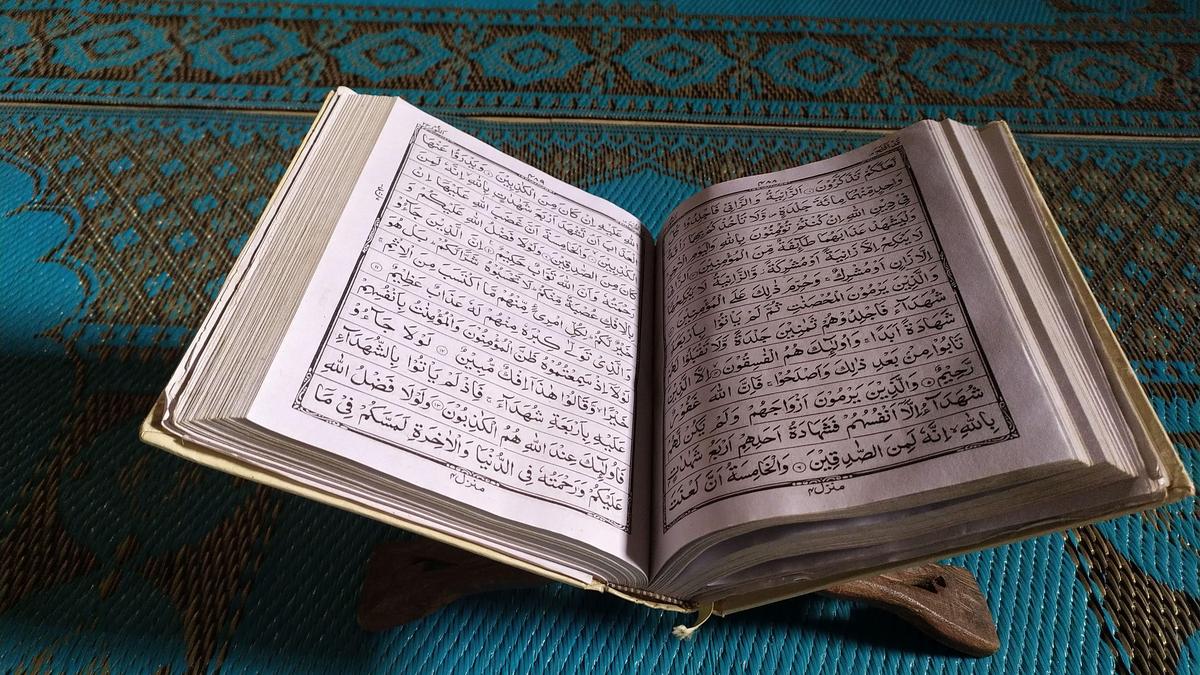
‘The Koran does not instruct women to remain confined to their homes. It is conservative clerics who have historically sought to impose such restrictions by taking out of context’ | Photo Credit: Getty Images/iStockphoto Recently, Kanthapuram A.P. Aboobacker Musliar of the Samastha Kerala Jamiyyathul Ulama issued a circular directing public halls and madrasas not to permit women to share public spaces with unrelated men during religious events.He subsequently sought to justify the restriction with the startling claim that bringing women onto public platforms would cause “great destruction.” He attributed this danger to the mixing of men and women and said that the Koran itself requires women to remain confined to their homes and prohibits them from appearing in public.But the Koran does not instruct women to remain confined to their homes. It is conservative clerics who have historically sought to impose such restrictions by taking out of context the instruction in verse 33:33 to “stay in your houses” (qarna fi buyootikunna) and “do not display yourselves as was the display of the former times of ignorance.”Yet the verse occurs within a passage beginning at verse 28 that is explicitly addressed to the Prophet’s wives wherein the Prophet is instructed to give them a choice: they may seek the comforts and adornments of worldly life, in which case they will be granted a gracious separation, or they may choose Allah, the Prophet and the hereafter, for which they will receive a great reward. Their position is then expressly distinguished from that of other women. “O wives of the Prophet, you are not like other women,” verse 32 says, before laying down a heightened standard of conduct for them: the punishment for serious wrongdoing would be doubled, while the reward for righteousness would also be doubled.The Prophet’s wives are then told to avoid overly soft speech with men, to remain in their houses, not to display themselves as women did in the pre-Islamic period, and to follow Allah and the Prophet. The passage culminates in a reference intended to keep the Prophet’s household spiritually pure.As is clear from the passage itself, the command to “remain in your houses” is addressed to women whom the Koran explicitly distinguishes from other women saying “you are not like other women.” To remove this instruction from its specific context and present it as a universal Koranic command requiring all Muslim women to remain at home is to extend the verse beyond the scope stated in the passage itself.Moreover, the historical record does not support the idea that Islam required women to be confined to their homes or excluded from public life. Hazrat Khadija, the Prophet’s first wife, was a successful merchant who conducted her own commercial affairs, and the Prophet himself worked for her as a trading agent before their marriage. Even after he became the Prophet, there is no indication that he asked Khadija to abandon her commercial or public life. This shows that the Prophet did not regard a woman’s participation in economic and social life as incompatible with Islam.The same is true of the Prophet’s wives who lived after the revelation of Koran 33:33. Hazrat Aisha travelled with the Prophet, including on military expeditions and for the Hajj, and later became one of the most important authorities on religion and law in the early Muslim community. Men and women consulted her, and she transmitted a large body of hadith. She also played a public role in the political conflict that culminated in the Battle of the Camel in 656 CE. Hazrat Umm Salama, another wife of the Prophet, was likewise consulted on matters of public and religious significance.These examples make it difficult to interpret “remain in your houses” in 33:33 as a command of absolute physical confinement. Whatever restrictions it imposed on the Prophet’s wives, the historical record provides little basis for turning it into a universal prohibition against women leaving their homes, participating in public life or sharing public spaces with men. Not surprisingly, in Al-Muhaddithat, the English introduction to his 43-volume Arabic compendium of Muslim women scholars, Mohammad Akram Nadwi rejects the view that Islam is “a human construct, done mainly by men and therefore done to secure advantages for them at the expense of women.”Nonetheless, the subjugation of women cannot be challenged through reformist rhetoric alone. It requires the Muslim laity to publicly question clerical authority itself, and political leaders to stop lending legitimacy to regressive clerical institutions through high-profile visits and public engagement. The recent meeting of Malaysian Prime Minister Anwar Ibrahim with Mr. Aboobacker in Keralam, illustrates the problem. Such public recognition can embolden male clerics to present patriarchal interpretations as divine commands and discourage Muslims from questioning them. The future of Islam cannot be left to those who claim a monopoly over its interpretation. If Muslims are to progress, the Koran must remain the primary point of reference, while the Prophet’s life must be taken seriously as evidence of how Koranic principles were actually lived.A. Faizur Rahman is Independent researcher and Secretary-General of the Islamic Forum for the Promotion of Moderate Thought. X: @FaizEngineer Published - September 22, 2026 02:06 am IST
The Koran and politics of purdah
Full Article
Original Source
Read the full article at Thehindu →KhanList aggregates and links to publicly available news content. We do not host full articles from third-party sources. Always verify important information with original sources.