
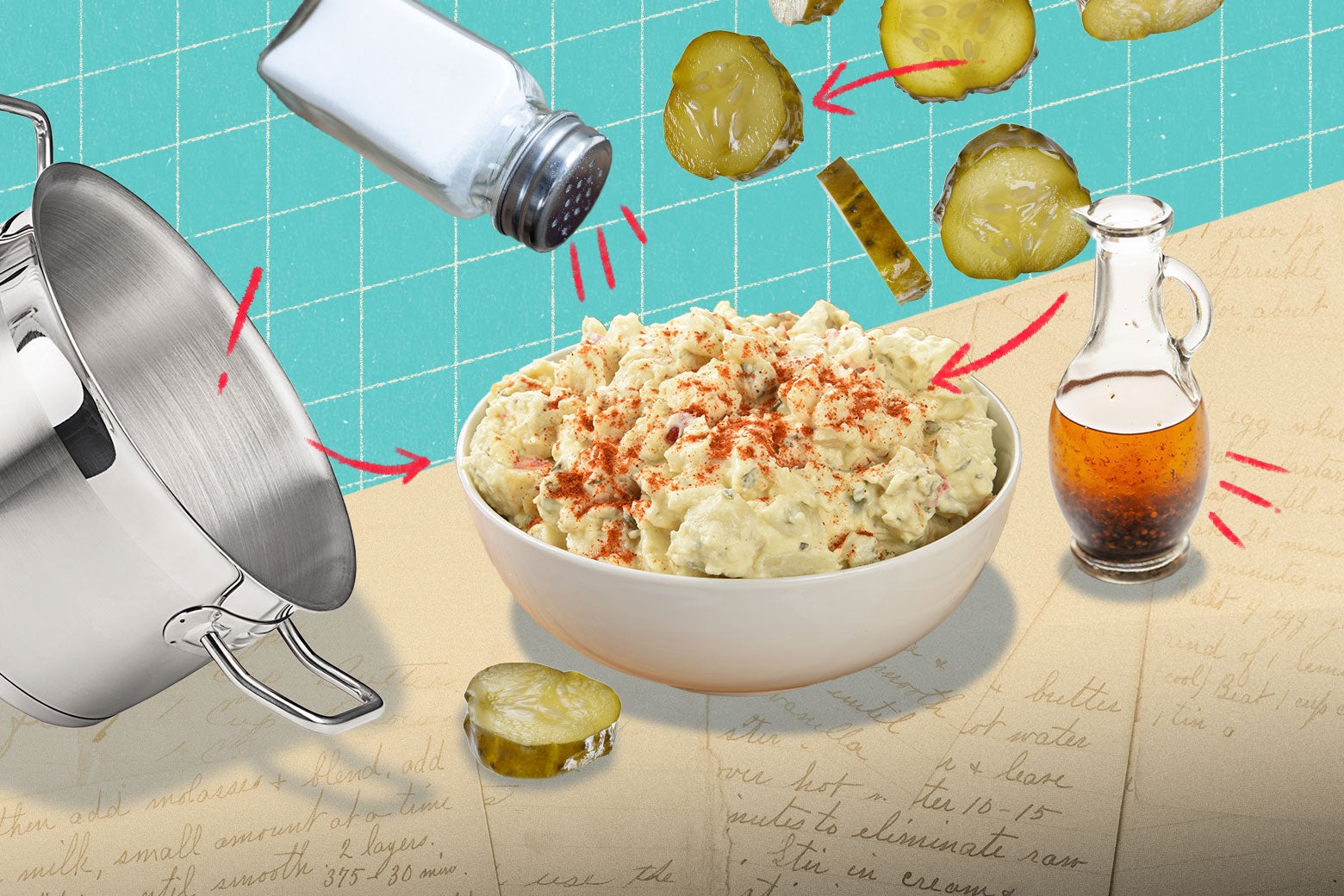
Food The Secret to Potato Salad With Real Flavor It’s not what you mix in that makes the difference. Photo illustraation by Slate. Photos by Sviatlana Zhornava/iStock/Getty Images Plus, MSPhotographic/Getty Images Plus, MurzikNata/iStock/Getty Images Plus, Hazal Ak/Getty Images Plus, and urfinguss/Getty Images Plus. Recipe for Disaster is Slate’s column about the things recipes get wrong—and how to fix them. If you’ve noticed a recipe annoyance, absurdity, or outright lie, file your complaint here and we will investigate! People love to argue this time of year about what should go into potato salad, but I’m here to tell you it’s a foolish debate. The issue isn’t mustard versus mayo. It’s not even Hellmann’s versus Duke’s. Celery, hard-boiled egg, pickles, onion, paprika, and my own personal flair, giardiniera, can all make potato salad more appetizing. But these are not the differentiators separating a good potato salad from a great one. Friends, it turns out it’s not what you mix into potato salad that makes it delicious—it’s how you cook the potatoes. I’ve researched nearly 50 potato salad recipes while writing this column, and I’m sorry to say that most of them will fail you in terms of flavor. Here’s the rub: Your bottom-tier recipe developer will instruct you to cook potatoes in unseasoned boiling water, cool them down, then apply mayonnaise, mustard, and chopped veggies. The next tier, a big step in the right direction, asks you to add salt to the boiling water. Finally, nearly the best you can hope for in a potato salad recipe are instructions that say to cook the potatoes in salted water, then spritz the tubers with vinegar right after they’re cooked, while they’re hot. This—generally known as the German method—applies sound logic: Vinegar added to hot potatoes actually has a chance of getting inside the potato. When acidic dressing is applied cold, it doesn’t actually pierce the outer layer. That’s right, I’m back on my horse about everybody’s favorite concept—flavor penetration. Flavor penetration is a term that’s really come to preoccupy us here at Recipe for Disaster, whether it’s the lackluster methods that fall short of achieving it (marinades) or how best to obtain it (brining and pounding chicken). One of the goals of home cooking, and by proxy, recipe writing, should be to penetrate any protein, vegetable, or starch with thorough flavor. Potato salad recipes almost always flop at this, which is why so many taste so completely unremarkable. The interior of your little potato chunks need a boost, and, despite what many recipes will promise you, no amount of Hellmann’s, Dijon, or apple cider vinegar will flavor the interior of a cold spud. It’s like adding salt to food after it’s been cooked. “But Danny, my cookout is tomorrow,” you say, “and I’m supposed to bring the potato salad—wtf am I gonna do?!” Don’t fret, because while I was slogging through all those bad recipes, I came upon one—just one!—that solves the problem: Kenji López-Alt’s take on Classic Potato Salad. Unassuming name, game-changing results. In it, López-Alt gets to the crux of the potatoey problem: “In a good potato salad, the pieces of potato should be seasoned all the way through to the core. Their hearty, earthy flavor does fine on its own or with a bit of salt when hot, but when cold, they come across as heavy and bland. Without plenty of acid to brighten it up, your potato salad is dead in the water.” Bingo. In López-Alt’s experiments, he found (using green-colored food dye) that cooked starch on the surface of a potato hardens and gelatinizes as it cools, which makes it harder for liquids and seasonings to break through. In addition, once the potato cools down, it contracts, tightening up. Vinegar won’t break through to a cold, stiff potato. It must be seasoned while hot, and, ideally, while it’s boiling in water, too. So what did López-Alt do? He created a two-pronged method: Cook the potatoes in a mixture of salt, sugar, and vinegar, and then again splash the potatoes with vinegar while they’re cooling down. The upshot? Thorough, brightly seasoned potatoes unlike any I’ve had before—in fact, these are potatoes that people will even enjoy eating plain (more on that later). “Well, that ends potato salad,” I said out loud to the sack of potatoes on my counter. After discovering this gem, which originally appeared in 2021, I scoured the internet and cookbooks to find a similar method, and wildly, no potato salad recipe I’ve found uses the López-Alt Dual-Seasoning Method. Everybody—the New York Times, America’s Test Kitchen, Bon Appétit, Matty Matheson, Alison Roman, the list goes on—ignores it. And in a world where the LADSM exists, that’s a categorical failure. I was stunned not only by the number of recipes that don’t make use of the twice-vinegared method, but also by the number of chefs who haven’t even heard of it. Cody Reiss, the brand-new cooking editor for the Los Angeles Times, told me he was unaware of the technique, but talking about it did recall some incredible potato salads of his past. “That reminds me of some incredible potatoes I had at Cervo’s,” he recalled. “I think they splashed with vin after boiling and somehow were just so damn good.” Reiss says his personal potato salad recipe is a “homemade mayonnaise vehicle.” Before you picture a big white goopy Prius, think of potato salad as a fresh canvas for condiments, herbs, and vegetables. And in order for those ingredients to do their magic, the potatoes themselves need to be seasoned properly. Otherwise, the mayo, the celery, the bacon fat, the pickles, they’re simply mismatched eyebrows and lips on Mr. Potato Head. It’s only after the potato’s center has enough vinegary tang that everything else can truly shine. If you need more convincing that the (very minor) extra work here is worth it, know that I applied the LADSM for Father’s Day, and everybody was snacking on the cooked potatoes plain. Naked. No dressing. My mom in particular was stunned at how tasty they were. This is the power of flavor penetration. When a food’s center, its very core, contains flavor, the difference is gobsmacking. Once the potatoes’ flavor was resolved, I then got busy creatively. I made potato salad much like pantry pasta—just kind of using what limited resources were available to me. I caramelized onions in butter, chopped up wispy dill with its crunchy, flavorful stalks, then diced up some giardiniera in lieu of fresh vegetables. I added plenty of black pepper, and employed a trifecta of Dijon, Duke’s mayonnaise, and apple cider vinegar (replacing López-Alt’s recommendation of rice wine vinegar). The potato salad was a damn hit, and even impressed my aunts (do you know how hard it is to impress my aunts?!). Everybody kept asking, “What’s in this?” But that wasn’t the right question. “What did you do to the potatoes?” is much more accurate. The more chefs I spoke to, the more I realized that this method needs a dedicated PR team. I reached out to Jesse Griffiths, chef/owner of Dai Due in Austin, Texas, who I usually contact with any new, exciting food technique. “Man, that guy is kinda unstoppable with the good ideas,” Jesse said about López-Alt in an email. “Closest I’ve come to this would be the German potato salad method of dressing the still hot potatoes with a lot of fairly acidic vinegar, mustard, onion and bacon dressing. I’ve got to try cooking them in vinegar, though.” Chef Griffiths goes on to sing the praises of potato salad in gumbo, a combination which he believes to be better than rice. This fact isn’t pertinent to our larger discussion here, but in the spirit of divulging valuable information, I wanted to pass it on to you, reader: Use this vinegary potato salad as the starchy base for your damn gumbo. Molly Mitchell, chef/owner of the idyllic Rose’s Fine Food in Detroit’s wonderful Eastside neighborhood, also hadn’t heard of the LADSM. “I usually cook mine in heavily salted water with a ton of bay leaves,” Molly says. She drains and cools the potatoes completely, then chops and seasons the potatoes. When cooking at home, she dresses the potatoes while hot, though she says they don’t hold their shape as nicely. “I’m going to try the method you mentioned,” she said. “It sounds like the best of both worlds!” Three chefs I adore, and all three hadn’t heard of López-Alt’s revelation. It’s one of the bigger recipe mysteries out there. The man solved potato salad, and recipe developers haven’t caught up. But now you, friends, have heard the gospel. There is no miracle ingredient for good potato salad. It’s not pickle juice, or olives, or even bacon fat. No, the secret ingredient has been hiding in plain sight all along. It’s the potato. Treat it thoughtfully, season it holistically, and you’ll never have bland potato salad again. Get the best of news and politics Sign up for Slate's evening newsletter. Cooking Food Recipes Recipe for Disaster
The King of Summer Side Dishes Never Lives Up to the Hype. Unless You Make It This Way.
Full Article
Original Source
Read the full article at Slate →KhanList aggregates and links to publicly available news content. We do not host full articles from third-party sources. Always verify important information with original sources.