
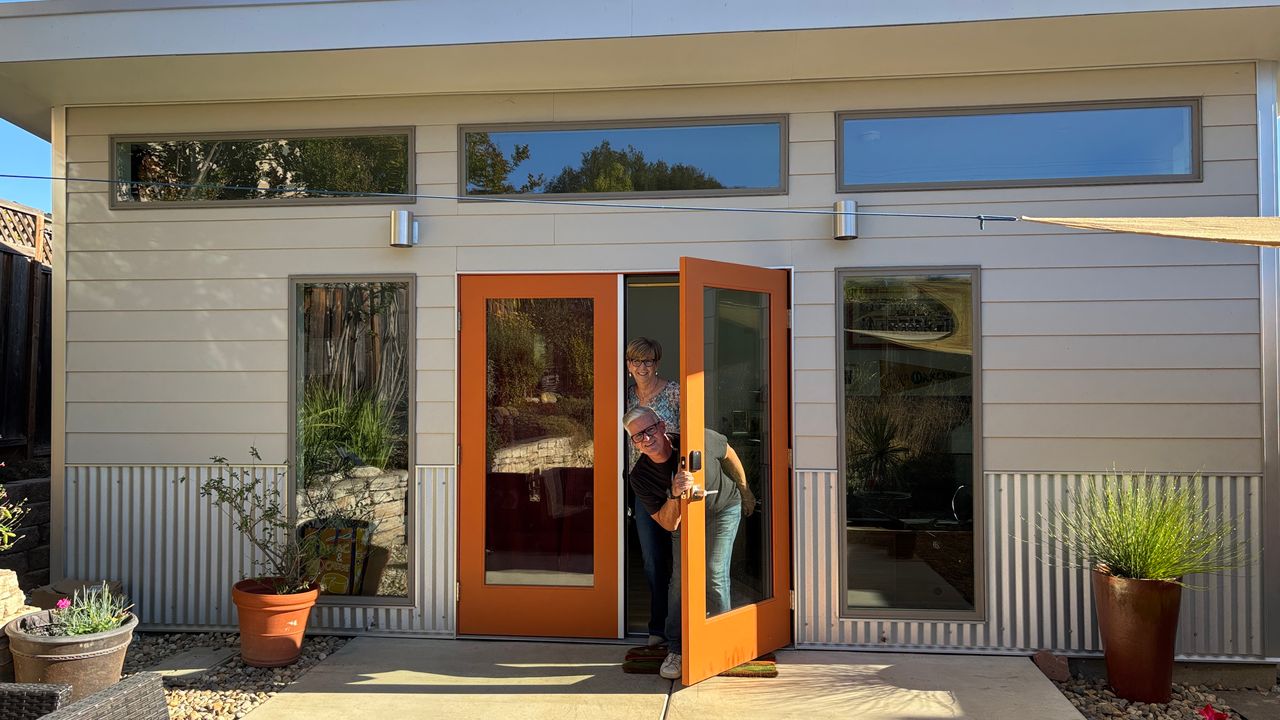
When Diane and Steve Weaver of Castro Valley, California, shipped their son Sam off to college in 2013, they hoped he’d someday find his dream job and a nice home. And while Sam is thriving professionally as a sales rep with his own place, they never expected that his house would be in their backyard. But the nightmarish Bay Area real estate market made a 400-square-foot ADU (accessory dwelling unit) on his parents’ property, complete with a separate entrance and direct street access, seem like the best option for the 32-year-old. “It was becoming difficult for him to afford rent while also saving toward eventually buying a place of his own,” Diane tells AD. “He’s close by, but it really feels like he has his own home.”While in-law suites and granny flats (a nickname for when ADUs house in-laws) have become popular among young, successful homeowners who want their elderly parents nearby, a growing number of Americans are now adding ADUs to their properties to house adult children threatening to move back in and reverse their status as empty nesters.Diane and Steve Weaver on their property’s ADU Photo: Courtesy of Diane and Steve WeaverPros share how they’ve devised functional, stylish ADUs that deliver ROI—and help keep the peaceBlame the return of the flock on the home affordability crisis. These days a homebuyer needs an annual income between $110,000 and $113,000—well above the national average income of $64,220 per year—to comfortably afford a median-priced home in the US, which is currently priced at $434,900. While this has led some grown kids to move back into their childhood bedrooms, in cases where acreage allows, families like the Weavers are opting to be neighbors instead of housemates by setting up self-contained living spaces on the same lot as their single-family homes. In California, they’re certainly no outlier. The state has passed legislation specifically encouraging the construction of ADUs to address the housing shortage—which resulted in quadruple the number of ADU permits issued in the Golden State from 2017 to 2022.More time at home this year translated to more home renovation projects—including, for many, the addition of accessory dwelling units. So, how do they function?Those in the ADU construction game say families like the Weavers make up an increasingly large slice of their business. Jeremy Nova, co-founder of the Colorado-based prefab ADU builder Studio Home, says ADUs for adult children are popular among his clients because the arrangement is mutually beneficial. The kids are afforded some independence and the ability to save money, “while for the parents, it can also be a long-term investment. The same space that houses an adult child today could eventually become a rental or a separate living space for a caregiver.” ADU builders on the opposite coast are seeing the same demand. Justin Olewack, president of Bolt Builders, says that ADUs for adult children are becoming a top request among his clientele in the DC, Virginia, and Maryland areas, where housing costs have risen 61 percent since 2016.If it cuts costs and results in a sellable amenity down the line, perhaps moving back home isn’t the failure-to-launch scenario it was once seen as.An ADU by Studio Home, built in the backyard of a Scottsdale, Arizona, family’s property. Photo: Courtesy of Studio HomeThe future of the adult children’s ADUOnce a family’s adult child moves out of the property’s ADU, especially if it has a kitchen and bathroom, the structure can serve as a rental, providing passive income for retired parents. Tracy Noh, who hired John Brennan of BZBuild Co to build her daughter Eliza Bowen an ADU in Burbank, was thinking long-term with her compound planning. “An in-home apartment would require sharing the space of our 1,000-square-foot main home. And, as someone who works from home, the ADU seemed a better solution,” she says.Noh and Eliza show off their Burbank ADU. Photo: Courtesy of Tracy NohThe living arrangement has also enabled Noh and her daughter to develop their own life paths. The structure gives her daughter a space in which she can become a young adult, and Noh the opportunity to step back from making the day-to-day household decisions. The former is learning how to manage her own household: planning meals, budgeting expenses, and making time for household chores.“That change in dynamic also allows us both to remain much calmer in our interactions with each other,” Noh says. It’s not just because there’s a separate place for each of them to retreat to; Noh says she has “gained an enormous amount of respect for Eliza and her ability to manage her own home. It’s a fabulous opportunity to begin to build that adult-to-adult relationship with your child.”The interior of Tracy Noh’s ADU by BZBuild Co Photo: Courtesy of BZBuild CoWhile modest ADUs serve single occupants just fine, more sizable ADUs allow a family’s adult children to bring their own kids in tow. Oren Amir, co-founder of SoCal builder GO Home Builders, points out that in his experience, the catalyst for aging parents to build an ADU for their adult children is almost never just the adult child themselves: It’s the grandchild they will be bringing with them. “The call comes a few months before or after a baby arrives,” he says. The grandparents don’t want to travel to visit their grandkids; they want them living nearby. Rent in Los Angeles is what stops people from saving, and early parenthood is when saving matters most, Amir says. An ADU in a grandparent’s backyard, therefore, lets the adult children stay in the neighborhood, raise the baby near help, and set some money aside for when the time comes to leave the nest for good. “Everyone gets what they need and nobody has to move in,” Amir says of the arrangement.While the Weaver family ADU is Sam’s for now, it could grow up to be a granny flat someday. “It’s possible that Sam might live in the main house and we could move into the ADU as we age,” says Diane. “It gives us a lot of options for how the space can be used as our family’s needs change.”
The Kids Are Outside: The Rise of the Adult Children’s ADU
Full Article
Original Source
Read the full article at Architecturaldigest →KhanList aggregates and links to publicly available news content. We do not host full articles from third-party sources. Always verify important information with original sources.