
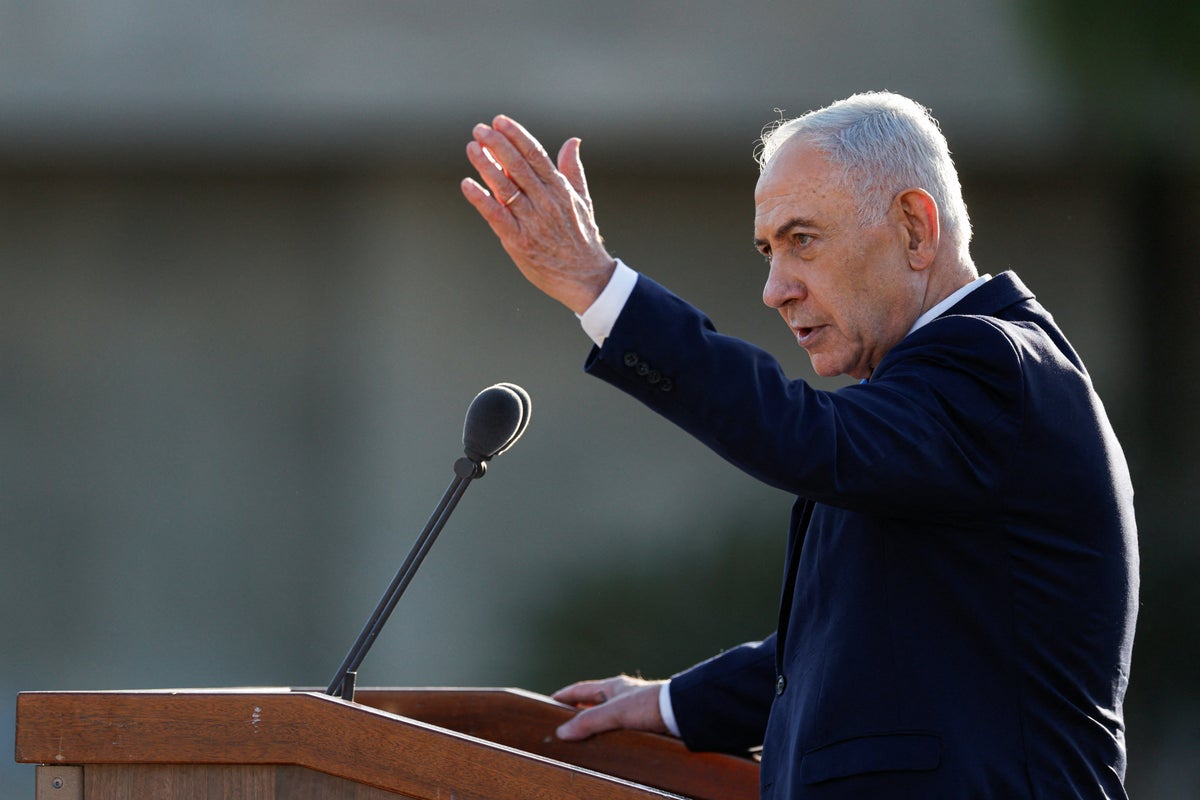
Israelis are set to vote on October 27 in the first national elections since the deadly October 7 attacks, and the devastating Gaza war that followed.With just days to go, polls suggest prime minister Benjamin Netanyahu’s current far right coalition will not survive. Netanyahu himself is still entangled in a long-running corruption trial and under renewed pressure from reports he was warned about the Hamas threat in 2023.But Israel’s longest-serving prime minister has entrenched himself as a political survivor, and is contending with a relative newcomer who formed his party only last year.A recent poll shows Netanyahu’s religious-nationalist bloc would take just 50 of the Knesset’s 120 seats if elections were held today, while the bloc around contender Gadi Eisenkot would win 52.No single party has ever won an outright majority, meaning the winner will likely rely on a broad coalition, which can quickly unravel in a fragmented political landscape. Below, The Independent looks at the key figures in Israel’s looming election.Benjamin NetanyahuBenjamin Netanyahu has been the dominant figure in Israeli politics for decades (Reuters)Netanyahu heads into this election with 19 accumulated years in office since he was first chosen as prime minister in 1996.The office has no term limits and a prime minister can serve an unlimited number of four-year terms so long as they maintain the confidence of a majority in the Knesset, or parliament.Since his last election in 2022, ‘Bibi’ has led Israel through its response to the October 7 Hamas attacks, the subsequent war in Gaza and hostage crisis, a ground invasion of Lebanon, strikes on Syria, attacks from and against Iran, and, most recently, into the ongoing conflict with Tehran alongside the United States.Domestically, he is still embroiled in a long-running corruption case, after being indicted in 2019 on charges of bribery, fraud and breach of trust in three cases, accused of receiving expensive gifts in exchange for political favours. The 77-year-old has called the case a witch hunt and proceedings stalled during the war in Gaza.Netanyahu with supporters during a Likud Party meet-and-greet (AFP/Getty)Netanyahu is also under an arrest warrant issued by the International Criminal Court (ICC) for suspected crimes against humanity and war crimes, and faces criticism from abroad for presiding over a rapid expansion of settlements in the West Bank.Many Israelis now say it is time for a change in the seat of government. A poll of 4,000 Israeli voters this month predicted that Netanyahu’s Likud party would secure only 19 seats, down from 32 currently, while the opposition, led by Yashar’s Gadi Eisenkot, could secure the most with 20.The Haredi bloc, which includes Likud and coalition partners Shas, could take 52-54 together, falling short of the 61 needed for a majority.Sigal Manzuri, a US-Israeli activist whose two daughters were killed at the Supernova music festival on October 7, told The Independent on the eve of the three year anniversary: “I know it’s not going to be smooth, but I feel that this is our chance.“We’re going to get a real opportunity to start to heal and to fix what really happened here for so many years, even before October 7. We need a new leadership really caring about their people and to try to start a healing process here.”Gadi EisenkotGadi Eisenkot, leader of the Yashar party, visits the Western Wall (Getty)Former military chief Eisenkot has presented himself as one of those possible outlets for change.Eisenkot, who lost a son in Gaza, has projected an image as a political outsider and security hawk whose humble background and family sacrifices stand in vivid contrast to Netanyahu's decades in high office and lingering corruption cases.Both Eisenkot and Netanyahu, along with the leaders of nearly all other Jewish-led parties, oppose the establishment of a future independent Palestinian state alongside Israel.They both say that Israel must retain ultimate security control over all territory between the Jordan River and Mediterranean Sea. And they agree that Israeli troops must not withdraw from Gaza until Hamas is disarmed.Eisenkot has framed the continued rule of Hamas in Gaza as a failure of state, vowing that within 18 months of taking office he would ensure the administration had been replaced, either through a US-brokered plan or through military force.But to unseat Netanyahu, he is likely to rely on the support of the Democrats, including the rump of the once dominant centre-left Labour Party that has has withered as the country has shifted to the right.The Democrats are now the only prominent Jewish-led party that supports a two-state solution, setting the stage for immediate conflict within a future coalition.Naftali Bennett and Yair LapidFormer prime ministers Naftali Bennett (left) and Yair Lapid attend an event for their B'Yachad party (Reuters)Former prime ministers Naftali Bennett and Yair Lapid also offer a challenge with Together, their political alliance founded only in April to oust Netanyahu from government.The party espouses a strong, right-wing stance on security issues, but offers more liberal positions on religion, the cost of living and education.On the campaign trail, Bennett vowed to maintain the Yellow Line - the IDF withdrawal line in Gaza - and declare Qatar an enemy state if elected.“The current government’s approach, essentially Bibi’s approach, is to get us used to living alongside Hamas. There is no real attempt to eliminate it,” he said.He also argued that resources should be diverted to Gaza border communities and away from the ultra-Orthodox community. He was confident a coalition of Zionist parties could manage a majority of 61 seats.Bennett served as Netanyahu’s chief of staff from 2006 to 2008, education minister in 2015 and defence minister in 2019. Lapid set up a secular, centrist, liberal-Zionist party in 2012 following a career in media.They managed to defeat Netanyahu in a 2021 election and set up a patchwork government of liberal and conservative parties, but that lasted only 18 months.Itamar Ben-GvirNetanyahu and Itamar Ben-Gvir shake hands in the Knesset last year (Reuters)Netanyahu’s far-right national security minister Itamar Ben-Gvir had existed on the fringes of Israeli politics before the war in Gaza brought his fiery, unmoderated rhetoric to younger voters who may have once considered him beyond the pale.The firebrand police chief has pushed Israeli politics further to the far right with his inflammatory comments and policies, which include urging “all of Lebanon must burn” for the deaths of IDF soldiers across the border, mocking foreign activists captured at sea trying to bring aid to Gaza, and trying to move crocodiles to a prison holding Palestinian detainees.Ahead of the election, polls show a boost in support for his Jewish Power party, which has managed to reach beyond its traditional base of settlers in the occupied West Bank and find a new audience in the cities. As many as a third of his supporters will be voting for the first time this election, according to Agam Labs.“I used to think he was a bit crazy, but then I actually looked at what he was saying, and it all made sense,” said Gavriel Marmon, an 18-year-old student and first-time voter from Beit Shemesh near Jerusalem.Kedmi, whose sister survived the Hamas-led attack on the Nova music festival, told Reuters: “It's almost like President Trump's ‘peace through strength’. But peace through Jewish strength.”Jewish Power is now forecast to win eight or more seats standing on its own, putting it on par with the Democrats.
The key players in Israel’s first election since October 7 attacks as Netanyahu fights for his political life
Full Article
Original Source
Read the full article at Independent →KhanList aggregates and links to publicly available news content. We do not host full articles from third-party sources. Always verify important information with original sources.